

VA Burial Allowance 2026: A Strategic Guide for Veterans
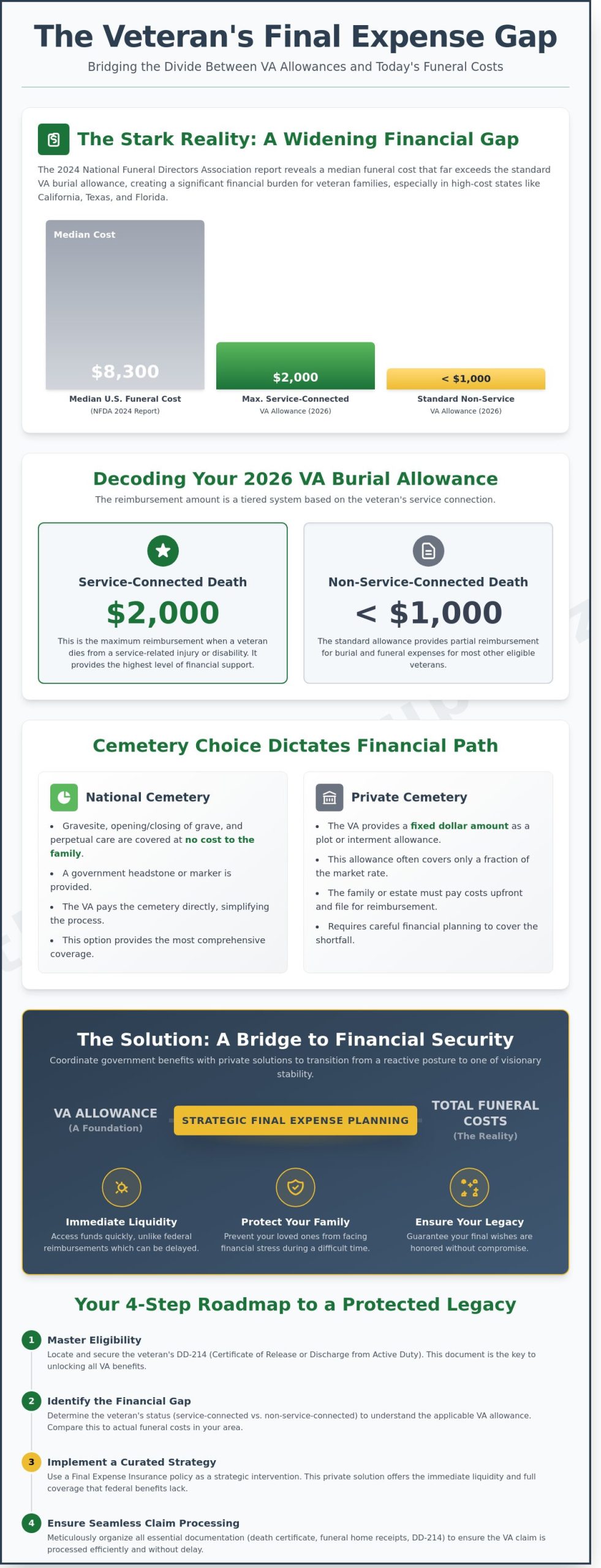
The 2024 National Funeral Directors Association report indicates that the median cost of a funeral has reached $8,300, yet the standard non-service-connected VA Burial Allowance often provides less than $1,000. This creates a stark financial gap for veterans in California, Texas, and Florida. You’ve likely felt the weight of this reality. You believe that a lifetime of service deserves a dignified conclusion that doesn’t compromise your family’s future stability.
The Paul Group provides a strategic methodology to bridge the distance between government allowances and actual market costs. We’ll detail the specific benefit tiers for 2026 and provide a roadmap for the application process. You’ll learn how to implement a curated strategy to manage the remaining balance; ensuring your legacy is defined by foresight rather than financial stress. We’ll move beyond the complexity of federal regulations to achieve a state of total structural clarity.
Key Takeaways
Master the nuances of eligibility tiers to ensure strategic alignment with the maximum reimbursement levels available for both service-connected and non-service-connected claims.
Identify the critical fiscal disparity between the standard VA Burial Allowance and the escalating costs of private funeral services in high-volume markets like California, Texas, and Florida.
Implement a disciplined, step-by-step methodology for filing claims to ensure that essential documentation is meticulously organized for seamless government processing.
Discover how a curated final expense insurance policy serves as a strategic intervention, offering the immediate liquidity that federal reimbursements often lack.
Learn to coordinate government benefits with private solutions to transition from a reactive posture to one of visionary, long-term financial stability for your family.
Table of Contents
Understanding the VA Burial Allowance: A Foundational Benefit for Veterans
Evaluating Eligibility and Benefit Tiers: Service-Connected vs. Non-Service-Connected
The Financial Reality: Bridging the Gap in Texas, California, and Florida
How to Apply for VA Burial Benefits: A Step-by-Step Methodology for Families
Strategic Final Expense Planning: Coordinating VA Benefits with Private Insurance
Understanding the VA Burial Allowance: A Foundational Benefit for Veterans
The VA Burial Allowance serves as a critical fiscal mechanism, designed to provide partial reimbursement for the costs associated with a veteran’s final arrangements. It isn’t a grant or an up-front payment. It’s a hard-earned entitlement, a structural acknowledgment of service that requires precise administrative execution to claim. For families in high-cost regions like California or the sprawling metropolitan areas of Texas and Florida, this benefit acts as a baseline for financial planning. The Department of Veterans Affairs administers these funds to offset expenses related to burial, funeral, and transportation; however, the benefit is divided into distinct categories that require separate consideration.
Strategic planners distinguish between the burial allowance and the plot/interment allowance. While the former addresses the service and preparation, the latter specifically targets the physical space of rest. This benefit isn’t intended to cover the entirety of a modern funeral, which often exceeds $10,000 in 2026. Instead, it offers a disciplined foundation. To ensure your family isn’t left with a financial gap, it’s wise to review the pros and cons of final expense insurance as a supplemental layer to these federal provisions.
The Scope of Burial Benefits in 2026
The VA typically covers the gravesite, the opening and closing of the grave, and a government-provided headstone. Under the 2026 guidelines, these benefits remain a baseline rather than a ceiling for total costs. The DD-214 serves as the primary methodology for proving eligibility; without this verified record of service, the claims process stalls. We view these benefits as a component of a holistic legacy plan, ensuring that the veteran’s service is honored without placing an undue burden on survivors. In 2026, the reimbursement rates reflect cumulative inflationary adjustments from the 2023 Veterans Benefits Improvement Act, providing a more robust, though still partial, safety net.
Interment in National vs. Private Cemeteries
Choosing between a National Cemetery and a private plot in states like Texas or California significantly impacts your total financial reimbursement. The National Cemetery Administration (NCA) manages over 155 national cemeteries where most costs are covered directly. If you choose a private cemetery, the VA Burial Allowance provides a fixed dollar amount that often covers only a fraction of the market rate in premium locations. This choice requires a trade-off between the prestige of a national site and the convenience of a local private plot. Your decision here dictates whether the VA pays the cemetery directly or if your estate must seek reimbursement after the fact.
Evaluating Eligibility and Benefit Tiers: Service-Connected vs. Non-Service-Connected
Strategic clarity begins with a precise classification of the veteran’s status at the time of passing. The VA Burial Allowance isn’t a monolithic benefit; it’s a tiered system designed to scale based on the nexus between service and the cause of death. For families in high-cost regions like California or Florida, these distinctions dictate the level of financial optimization available during a transition. The Paul Group views this process as a disciplined intervention, ensuring that every available resource is captured through meticulous documentation and strategic alignment with federal guidelines.
Service-Connected Death Benefits
A service-connected death occurs when a veteran dies from a disability that the VA has rated as service-related. In these instances, the financial support is at its most robust. For 2026, the maximum reimbursement for service-connected deaths is $2,000. This tier offers the highest level of stability, often covering a substantial portion of cemetery costs. Our methodology emphasizes that this classification requires rigorous documentation, ensuring the death certificate aligns with established VA disability records to prevent administrative delays. It’s a curated approach that honors the veteran’s sacrifice while protecting the family’s fiscal health.
Non-Service-Connected Allowances
The non-service-connected tier applies if the veteran was receiving a VA pension or compensation, or if they passed away while hospitalized in a VA facility. This benefit is bifurcated into two distinct components: a burial and funeral expense allowance and a plot or interment allowance. For deaths occurring in 2026, these VA burial allowances typically offer $948 for burial and funeral costs, plus an additional $948 for a plot if the death occurred in a VA facility. While these funds provide a necessary foundation, they often leave a significant financial gap for families in Texas or California where private funeral costs can exceed $12,000. This tier requires a visionary leadership approach to estate planning to ensure the remaining balance doesn’t disrupt the family’s long-term stability.
The Wise Advisor recognizes that eligibility is rarely a binary outcome. It’s a nuanced landscape where the surviving spouse acts as the primary claimant to secure these benefits. Success requires a disciplined approach to record-keeping. You must maintain archived copies of the DD-214 and current VA rating letters. This proactive alignment ensures that the structural integrity of the estate remains intact. If the projected VA support falls short of your family’s needs, examining the pros and cons of final expense insurance provides a logical path forward to bridge the fiscal divide.
Primary Claimant: The surviving spouse typically holds the legal priority for filing claims.
Documentation: Death certificates must explicitly state the cause of death to trigger service-connected rates.
Regional Impact: In Florida, where interment costs are rising, these allowances should be viewed as a partial subsidy rather than a total solution.
How to Apply for VA Burial Benefits: A Step-by-Step Methodology for Families
Securing a VA Burial Allowance requires a disciplined approach to administrative excellence. This process isn’t merely a bureaucratic hurdle; it’s a vital component of a veteran’s legacy and a family’s financial transition strategy. Families must navigate the filing of VA Form 21P-530EZ with precision to ensure that benefits are distributed without delay. A partnership with a seasoned advisor can transform this complex task into a manageable, logical progression. Clarity replaces confusion when you follow a curated methodology.
Gathering the Intellectual Order: Required Documents
Success starts with the DD-214. This document serves as the cornerstone of eligibility, proving the veteran’s honorable service record. Without it, the claim lacks its primary evidentiary foundation. If the claim involves a service-connected death, you’ll need to integrate medical records from the Department of Veterans Affairs or private providers to establish a clear causal link. Itemized receipts are non-negotiable. These documents provide the structural integrity needed for maximum reimbursement, detailing every expense from transportation to the final interment. Standard death certificates must also be included to confirm the date and cause of death, ensuring the VA has a complete profile for review.
Filing the Claim: Online vs. Mail
Efficiency favors the digital path. Submitting claims via VA.gov often results in faster processing times compared to traditional mail, as digital entries bypass many manual sorting phases. For those who prefer a localized touch, regional offices in cities like Phoenix, Arizona, or Albuquerque, New Mexico, provide physical points of contact for document submission. The Wise Advisor tip: keep a curated digital archive of every submission. This ensures that your claim remains intact even if administrative errors occur during the review cycle. Maintaining copies of all correspondence provides a layer of protection against systemic delays.
Time is a critical variable in this equation. Claims for non-service-connected deaths must be filed within two years of the veteran’s permanent burial or cremation. While service-connected claims don’t have a strict filing deadline, delaying the process can complicate the retrieval of older medical records. Acting with urgency ensures that the VA Burial Allowance is processed while documentation is fresh and accessible. This proactive stance reflects a commitment to excellence and honors the veteran’s service through meticulous planning.
Strategic alignment between funeral arrangements and VA benefits often requires looking at the broader financial picture. You can explore how these benefits integrate with other protection strategies by reviewing the best final expense insurance for seniors pros and cons 2026 to ensure a holistic approach to estate management.
Strategic Final Expense Planning: Coordinating VA Benefits with Private Insurance
The VA Burial Allowance serves as a foundational element of a veteran’s legacy, yet it functions as a retrospective reimbursement rather than an immediate liquidity tool. Relying solely on government disbursements often leaves families in California, Texas, and Florida facing significant out-of-pocket expenses during the initial 48 to 72 hours following a loss. The Paul Group views final expense planning as a curated intervention. We align government entitlements with private liquidity to ensure a seamless transition of responsibilities. This strategic coordination prevents the erosion of family savings while waiting for federal processing cycles to conclude.
Why VA Benefits Alone Are Not a Strategy
Survivors often encounter immediate financial strain due to the inherent lag in federal reimbursement cycles. While the VA provides essential support, it’s reactive by design. A proactive strategy utilizes burial insurance to provide the immediate coverage required for funeral home down payments and administrative fees. The Wise Advisor approach identifies these structural gaps before they become crises. By securing a fixed-rate policy, you provide your beneficiaries with day-one liquidity, bypassing the bureaucratic delays that typically follow a claim for the VA Burial Allowance. This ensures that the dignity of the service isn’t overshadowed by the stress of immediate debt.
The limitations of a reactive approach include:
Liquidity Gaps: Funeral homes in major hubs like Houston or Los Angeles often require payment or proof of funding before services commence.
Inflationary Pressure: Fixed government caps may not keep pace with the rising costs of private services in 2026.
Administrative Burden: Families must manage complex paperwork during a period of grief to secure their reimbursement.
Strategic Frequently Asked Questions
Is the VA burial allowance paid directly to the funeral home?
The VA burial allowance functions as a reimbursement rather than a direct payment to service providers. You’ll typically pay the funeral home first and then submit VA Form 21P-530 to recover costs. This structure ensures that families maintain control over the service selection while the VA provides the necessary financial offset to preserve the estate’s liquidity.
What happens if a Veteran passes away in a VA-contracted nursing home?
A death occurring in a VA-contracted facility triggers a higher reimbursement tier. The VA classifies these instances similarly to deaths in a VA hospital, which often includes the full cost of transporting the Veteran’s remains. This protocol ensures that the transition from care to final rest is handled with the same level of institutional support provided during the Veteran’s life.
Can I receive VA burial benefits if I choose cremation instead of a traditional burial?
You can receive the full VA burial allowance regardless of whether you choose cremation or a traditional casket burial. The VA’s strategic framework focuses on the Veteran’s service record and eligibility status rather than the specific method of final disposition. This flexibility allows families to curate a memorial service that aligns with the Veteran’s personal legacy and cultural values.
Does the VA burial allowance cover the cost of transporting the body?
The VA provides transportation reimbursement specifically for Veterans who pass away while under VA care or those with service-connected disabilities. If the death occurs at a VA medical center or a state Veterans home, the government covers the expenses for moving the remains to the nearest national cemetery. This provision mitigates the logistical complexities often associated with interstate transport in high-growth states like California and Texas.
How long does it typically take to receive the VA burial reimbursement check?
Processing times for reimbursement checks generally span 120 to 180 days after the initial claim submission. While the VA’s modernization efforts continue to optimize these timelines, families should plan for a six-month window to ensure financial stability. This duration reflects the rigorous verification process required to maintain the integrity of the federal benefits system.
Can a Veteran’s spouse or child also receive burial benefits?
Spouses and dependent children don’t receive a cash allowance, but they’re eligible for burial in one of the 155 national cemeteries managed by the VA. This benefit includes the gravesite, opening and closing of the grave, and perpetual care at no cost to the family. It’s a holistic approach to legacy planning that ensures the family unit remains together within a protected, honored environment.
What if the Veteran had a dishonorable discharge?
A dishonorable discharge generally disqualifies a Veteran from receiving any VA death or burial benefits. The VA’s eligibility criteria are rooted in the character of service, requiring a discharge status other than dishonorable to access the VA burial allowance. For those with Other Than Honorable discharges, a Character of Discharge review may offer a path to benefit restoration through a formal administrative appeal.
Is there a deadline to apply for VA death benefits in 2026?
A strict two-year deadline applies to non-service-connected burial claims, calculated from the date of the Veteran’s permanent burial or cremation. Conversely, service-connected death claims have no expiration date, providing a permanent window for families to seek reimbursement. Adhering to these timelines is a critical component of a disciplined estate strategy to ensure no entitled resources are forfeited.










Comment (1)
Finding a reliable slot platform has always been a hassle, but this one finally gets it right with lightning fast loads and zero lag on my old phone. I settle in with my evening tea, tap a few times to claim my bonus, and watch the multipliers stack up without any silly tricks. A solid spot for anyone who values speed and honest gameplay. 678slotapk