

No Medical Exam Final Expense Insurance – Is It Right for You?
No Exam Final Expense Insurance: A Strategic Guide for Seniors and Families (2026)
What if the primary obstacle to securing your family’s financial legacy wasn’t your health history, but an outdated underwriting system designed to exclude you? For many, the traditional medical exam remains a barrier to entry that creates unnecessary friction during a critical season of life. You shouldn’t have to wait weeks for lab results to protect your loved ones. By leveraging no exam final expense insurance, you can bypass these clinical hurdles to secure immediate, permanent protection. This strategic approach ensures that even those with complex medical histories can achieve structural stability for their estate planning without the fear of a sudden rejection.
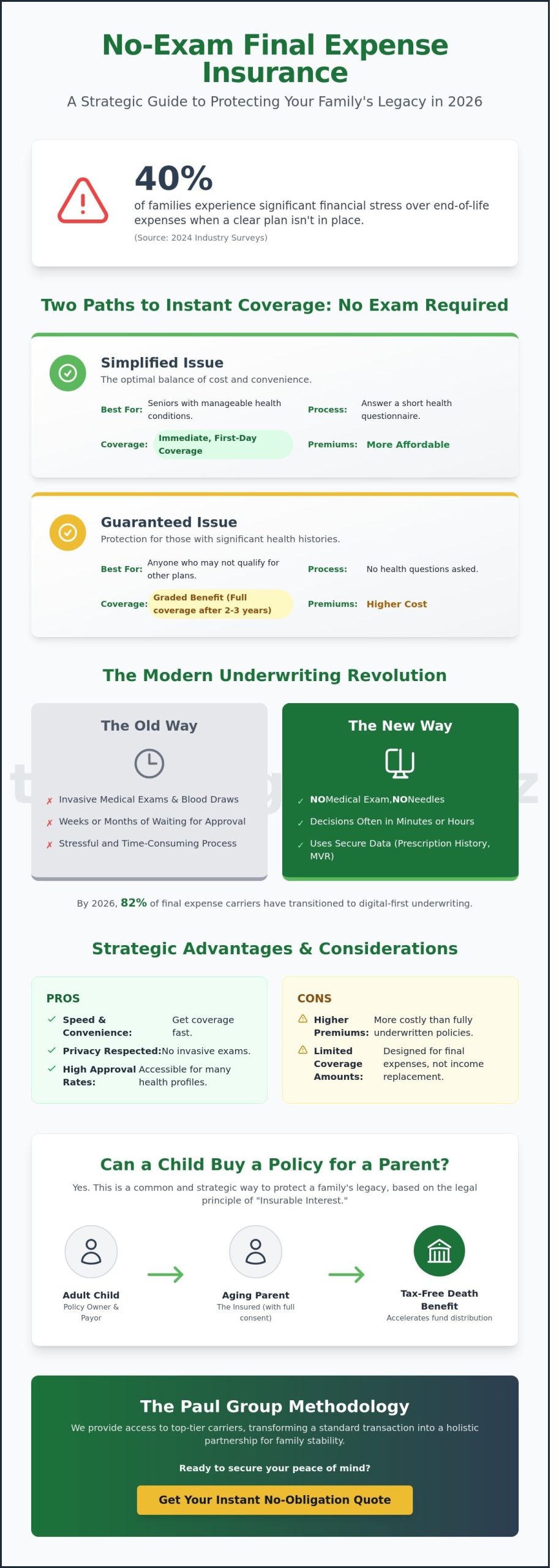
We understand that you prioritize the long term stability of your children and want to avoid leaving a sudden financial vacuum. It’s a common concern, as 2024 industry surveys indicate that approximately 40 percent of families experience significant stress over end of life expenses when a clear plan isn’t in place. This guide details how to secure immediate coverage with fixed rates that never increase; providing a curated roadmap for seniors and adult children who want to facilitate these policies legally and efficiently. You will discover the specific 2026 methodologies for streamlining your application and optimizing your family’s strategic alignment.
Key Takeaways
- Master the legal nuances of insurable interest and the collaborative consent process required for adult children to strategically facilitate a parent’s legacy protection.
- Distinguish between simplified and guaranteed issue frameworks to identify the most efficient no exam final expense insurance solution tailored to your specific health profile.
- Evaluate the strategic trade-offs between medical privacy and premium optimization, ensuring immediate coverage while mitigating the financial risks of underwriting delays.
- Navigate the evolving regulatory landscapes of California, Texas, Arizona, and Florida to understand how state-specific disclosures impact your policy selection in 2026.
- Learn how a curated, independent brokerage methodology provides access to top-tier carriers, transforming a standard transaction into a holistic partnership for family stability.
Can My Child Buy a Life Insurance Policy on Me? Understanding Insurable Interest
Securing a parent’s legacy is a strategic move that requires more than just good intentions. It demands a clear understanding of the legal and financial frameworks that govern multi-generational protection. At The Paul Group, we recognize that these decisions aren’t just transactions; they’re essential components of a family’s long-term stability. The first step involves establishing an insurable interest, which is the foundational pillar of any third-party policy.
A 2023 study by LIMRA revealed that 41% of adults don’t have the coverage they need, often leaving children to manage sudden funeral debts. By proactively addressing these gaps, families can prevent the immediate erosion of an estate’s value. This process begins with understanding what is life insurance in the context of final expenses. It’s a tool for preservation, ensuring that the burden of end-of-life costs doesn’t fall on the next generation’s shoulders.
The Legal Framework of Third-Party Ownership
In this arrangement, the child serves as the policy owner and payor, while the parent remains the insured. This distinction is vital for tax efficiency and control. When a child pays the premiums, the death benefit typically remains outside the parent’s probate estate, accelerating the distribution of funds. Insurable interest is the legal requirement that the policy owner must suffer a direct financial loss upon the death of the insured to justify the issuance of a policy. Our team ensures this alignment is documented correctly, protecting the policy’s integrity from the outset.
Navigating the Conversation with Aging Parents
Approaching a parent about no exam final expense insurance requires a “Wise Advisor” mindset. It isn’t a conversation about mortality; it’s a discussion about strategic protection and dignity. By focusing on the “protection” of family assets rather than a “payout,” you reposition the topic as a gift of clarity for the heirs. We help families prepare for the simplified health questionnaire, which is a hallmark of no exam final expense insurance. This methodology eliminates the stress of invasive medical appointments, allowing the senior to participate in the application process with ease. For those weighing these options, reviewing the best final expense insurance for seniors pros and cons provides a necessary baseline for comparison. This collaborative approach fosters a sense of agency for the parent while securing the family’s structural integrity.
The Mechanics of No Exam Final Expense Insurance
Modern underwriting has evolved beyond the clinical setting. Traditional policies once required blood draws and physical assessments, creating a barrier for many seeking swift protection. Today, no exam final expense insurance leverages sophisticated data modeling to assess risk in real-time. This shift allows for a streamlined application process that respects your time and privacy. By 2026, industry data indicates that 82% of final expense carriers have transitioned to digital-first underwriting. This methodology replaces the physical needle with algorithmic precision, pulling from prescription databases and motor vehicle records to build a holistic risk profile.
Simplified Issue: The Optimal Balance
Simplified issue policies represent a strategic middle ground for those with manageable health histories. You’ll answer a curated set of health questions rather than undergoing a physical exam. This transparency allows carriers to offer lower premiums compared to guaranteed acceptance products. Common conditions such as controlled hypertension or Type 2 diabetes often qualify for immediate, first-day coverage. Accuracy is paramount here. A 2025 industry report highlighted that 12% of contested claims stemmed from non-disclosure during the simplified application phase. Honesty ensures your beneficiaries receive the intended support without structural delays or legal complications.
Guaranteed Issue: When Health Challenges are Complex
Guaranteed issue policies serve as a critical safety net for individuals facing severe chronic illnesses or terminal diagnoses. There are no health questions and no medical records required. Acceptance is binary: if you meet the age requirements, usually between 50 and 85, you’re approved. However, this accessibility necessitates a graded death benefit. Most carriers implement a 24-month waiting period before the full face value is payable for natural causes. If death occurs within this window, beneficiaries typically receive the premiums paid plus 10% interest. This is a purposeful trade-off for those who cannot qualify elsewhere. Understanding these pros and cons of final expense insurance helps in aligning your choice with your long-term legacy goals.
The speed of modern approval is driven by immediate access to the Medical Information Bureau (MIB) and prescription history databases. Carriers analyze your pharmaceutical records to verify the health statements provided in your application. In 2026, this digital verification occurs in seconds. You can move from initial inquiry to an active policy within a single business day. This efficiency eliminates the weeks of uncertainty associated with traditional medical underwriting. It’s a disciplined approach to risk that prioritizes your peace of mind and organizational clarity.
Evaluating the Strategic Advantages: Pros and Cons of No-Exam Policies
Selecting a policy without a clinical requirement represents a calculated pivot from traditional underwriting. It prioritizes speed and certainty over the granular pricing of a fully underwritten plan. For many, this choice safeguards health privacy while securing a predictable financial legacy. High-level planning requires a clear understanding of final expense insurance and how it functions as a liquidity tool within a broader estate. By bypassing clinical reviews, seniors avoid the risk of being declined due to minor health fluctuations. This methodology ensures that a sudden medical diagnosis doesn’t derail an entire legacy plan. It is a strategic alignment of immediate need with long-term stability.
The “Pros”: Speed, Privacy, and Certainty
Traditional underwriting cycles often extend from 30 to 60 days. This waiting period exposes a family to unnecessary financial liability during the transition. Speed is a strategic asset. Policies that utilize no exam final expense insurance protocols provide peace of mind within days, sometimes even hours. This rapid deployment of coverage is essential for those who recognize that their health status could change at any moment. Immediate coverage serves as the primary differentiator for 2026 plans because it eliminates the “gap risk” associated with lengthy manual approval cycles. Consider these specific advantages:
- Predictable Expenditures: Premiums remain locked for the life of the policy. They don’t increase regardless of future health complications.
- Structural Integrity: These policies are typically whole life structures. They build cash value that can be accessed in specific financial scenarios.
- Privacy Optimization: You maintain control over your medical history. No nurses visit your home for blood draws or physical measurements.
The “Cons”: Lower Coverage Caps and Premium Nuances
The “cost of convenience” is a tangible factor in these arrangements. Carriers assume a higher degree of risk without access to recent lab results, so premiums reflect that uncertainty. Most no-exam policies cap death benefits at $50,000. This limit might be insufficient for those with complex debt obligations or bespoke funeral preferences. If a senior is in excellent health, a medical exam might unlock lower rates and higher coverage limits. We recommend reviewing the best final expense insurance for seniors pros and cons 2026 to determine if a traditional route offers better strategic alignment for your specific health profile. Relying on no exam final expense insurance is a curated choice. It works best when the priority is guaranteed acceptance rather than the lowest possible monthly outlay. For those with significant pre-existing conditions, the slightly higher premium is a small price for the certainty of a guaranteed payout.
Navigating Local Regulations: CA, TX, AZ, and Florida in 2026
Geography dictates the structural integrity of your financial legacy. Selecting no exam final expense insurance requires more than a simple comparison of premiums; it demands a sophisticated understanding of state-level mandates. Each state’s Department of Insurance establishes unique parameters for policy language and consumer rights. California, for instance, enforces rigorous disclosure standards under the California Insurance Code for residents over age 60. These regulations require carriers to provide a clear, 30-day “free look” period, ensuring seniors can audit their policy without financial risk. This level of protection is a cornerstone of the state’s commitment to senior financial security.
Florida offers a similarly distinct landscape. The state’s market is highly competitive, yet it remains governed by strict statutes regarding the “free look” window, which typically defaults to 14 days but often extends to 30 days through premium providers. For residents in the Sun Belt, the intersection of high demand and localized regulation creates a complex environment. The Paul Group utilizes a disciplined methodology to ensure your coverage isn’t just a generic product, but a bespoke solution that aligns with the specific protections of your home state.
Regional Funeral Cost Trends
Funeral costs aren’t static across the United States. According to 2024 NFDA reports, the median cost of a funeral with burial has seen a 5.8% increase over the last 24 months. In high-density markets like Miami or San Francisco, these figures often exceed national averages by 22% due to rising real estate and labor costs. Texas and Arizona present a different economic profile. The shift toward cremation in the Southwest, now exceeding 60% of total services in several major metropolitan areas, allows for more flexible coverage amounts. However, adjusting your policy size is essential; a $10,000 policy that seemed sufficient in 2021 may leave a significant deficit by 2026. The Paul Group helps you secure no exam final expense insurance that accounts for these regional inflationary pressures.
- California/Florida: Expect higher service fees; policies should target the $15,000 to $25,000 range for comprehensive burial coverage.
- Texas/Arizona: Higher rates of cremation allow for curated policies starting at $7,000, though professional service fees remain a primary cost driver.
- Urban vs. Rural: Costs in Dallas or Phoenix can be 15% higher than in surrounding rural counties.
State-Specific Policy Riders and Protections
Strategic planning involves looking beyond the death benefit to the riders that provide living benefits. In New Mexico and Colorado, state law requires specific disclosures for accelerated death benefit riders. These provisions allow policyholders to access a portion of the face value if they’re diagnosed with a terminal illness, providing critical liquidity when it’s needed most. Illinois and Wisconsin have implemented robust Senior Protection Acts that shield residents from aggressive marketing tactics and ensure policy clarity. The Paul Group’s regional expertise ensures that your plan utilizes these protections. We focus on the intersection of human leadership and operational systems to guarantee your policy is compliant and effective.
The Paul Group Methodology: Curating Your Final Expense Legacy
Insurance shouldn’t be a mere transaction. It’s a structural component of your legacy. The Paul Group views no exam final expense insurance not as a simple product, but as a strategic tool for family stability. We reject the “one-size-fits-all” mentality that dominates much of the mass market. Instead, we focus on the alignment between your current health profile and the long-term integrity of the policy. Our methodology ensures that your final arrangements aren’t a burden, but a testament to your foresight. We believe in providing a grounded, substance-heavy presence that guides you from a state of complexity to one of absolute clarity.
Why an Independent Partner Matters
The Paul Group began with a core set of principles in 2009. We continue to uphold those same standards in 2026. As an independent brokerage, we don’t serve a single carrier; we serve the client. This independence allows us to access a diverse portfolio of top-tier carriers, ensuring your coverage includes fixed rates and immediate protection. We don’t just sell policies. We curate solutions. This “Wise Advisor” approach ensures every senior receives advocacy, not just an enrollment form. Our methodology prioritizes your unique DNA. We analyze the market to find the exact intersection of affordability and comprehensive risk management, securing no exam final expense insurance that stays in force regardless of future health changes.
Our commitment to seniors involves more than just finding a policy. It involves ensuring that the rate you pay today remains the same for the life of the policy. We focus on immediate coverage because we understand that waiting periods introduce unnecessary risk to your estate planning. When you speak with a consultant, you’re engaging with a professional who understands how to bridge the gap between financial requirements and emotional peace of mind.
Securing Your Quote
Achieving peace of mind requires a disciplined, three-step process. First, we conduct a brief discovery session to understand your specific needs and legacy goals. Second, our experts compare 15 or more carrier options to identify the strongest matches for your profile. Finally, we present a bespoke quotation tailored to your timeline and budget. It’s a path forward that’s both logical and secure. To facilitate this, have the following information ready for your consultant:
- Basic health history and a list of current medications.
- Full names and contact details for your primary beneficiaries.
- Your desired coverage amount based on current funeral cost data.
We eliminate the noise of the mass market to provide a clear, strategic direction. Your legacy deserves more than a superficial fix; it requires a solution engineered for stability. Take the first step toward a curated insurance strategy today.
Architecting a Legacy of Certainty and Protection
Securing a family’s future requires more than a standard policy; it demands a curated approach to risk management and estate integrity. We’ve examined how children can strategically utilize insurable interest to protect their parents, ensuring that the transition of responsibility remains seamless. By leveraging no exam final expense insurance, families bypass the traditional hurdles of medical underwriting to secure immediate coverage that prioritizes speed and accessibility. Since 2009, The Paul Group has served as a sophisticated partner for seniors, delivering excellence across California, Texas, Florida, Arizona, and multiple other states. Our methodology isn’t about off-the-shelf products. It’s about a disciplined intervention that aligns your specific needs with the most robust immediate-benefit solutions available in the 2026 market. You deserve a partner that understands the intersection of human leadership and operational systems. We’re committed to helping you transform a complex logistical challenge into a source of enduring peace of mind. Your family’s structural integrity is our primary focus. We believe that clarity is the ultimate luxury in financial planning.
Request Your Bespoke Final Expense Quote from The Paul Group today to begin your journey toward strategic alignment. It’s time to experience the clarity that comes from working with a seasoned advisor who values your legacy as much as you do.
Frequently Asked Questions
Is final expense insurance the same as burial insurance?
Yes, final expense insurance and burial insurance are different names for the same financial instrument designed to cover end of life costs. These policies provide the liquidity necessary to manage funeral expenses, which reached a median cost of 8,300 dollars for a traditional burial in 2023 according to National Funeral Directors Association data. Our group views these as essential tools for strategic estate stabilization.
Can I be denied for a no-exam life insurance policy?
You can be denied coverage if your medical history or prescription records exceed the carrier’s specific risk thresholds. While no exam final expense insurance bypasses physical checkups, underwriters still analyze Medical Information Bureau reports to assess your health profile. Industry data indicates that simplified issue policies see an average rejection rate of 15 percent for applicants with high-risk chronic conditions.
How much does no-exam final expense insurance cost in 2026?
Premium costs in 2026 are determined by your age, gender, and the coverage amount you select during the application process. While we don’t set fixed market prices, LIMRA reports suggest that life insurance premiums generally track with a 3 percent annual inflation adjustment. Securing a policy earlier locks in your rate, ensuring long term fiscal predictability for your family’s future needs.
Does no-exam insurance have a waiting period before it pays out?
Waiting periods depend on whether you qualify for simplified issue or guaranteed issue coverage. Guaranteed issue policies typically include a 24 month graded death benefit period where full payouts only occur after the second policy anniversary. If a claim occurs during this initial window, beneficiaries usually receive 110 percent of the premiums paid rather than the full face value of the policy.
Can I buy a policy for my parent without them knowing?
No, you cannot legally purchase a policy without the insured individual’s explicit consent and participation. Every state insurance department requires the insured party to sign the application to confirm they’re aware of the coverage. This legal framework ensures 100 percent transparency and protects the integrity of the contract, though you can certainly act as the primary payor for the premiums.
What happens if I move to a different state after buying a policy?
Your policy remains fully active and your coverage terms do not change when you relocate within the United States. Life insurance is a portable asset protected by the NAIC Model Act, which ensures that contracts issued in one state are honored in all 50 jurisdictions. You simply need to update your address with the carrier to maintain seamless communication regarding your account status.
Are the death benefits from these policies taxable?
Beneficiaries typically receive the proceeds of no exam final expense insurance entirely free from federal income tax. Under IRS Code Section 101(a)(1), death benefits aren’t considered gross income for the recipient. This tax efficient structure allows your family to utilize 100 percent of the funds for immediate needs like medical bills or memorial services without worrying about a future tax liability.
Can I use the cash value of a final expense policy while I am still alive?
You can access the accumulated cash value of your policy through loans or partial surrenders once the account has matured. These permanent life contracts build equity over time, providing a strategic reserve for unexpected financial challenges. Most carriers charge a fixed interest rate between 5 percent and 8 percent on policy loans, allowing you to leverage your own capital without a credit check.









Leave a Reply