

Final Expense Life Insurance For Seniors
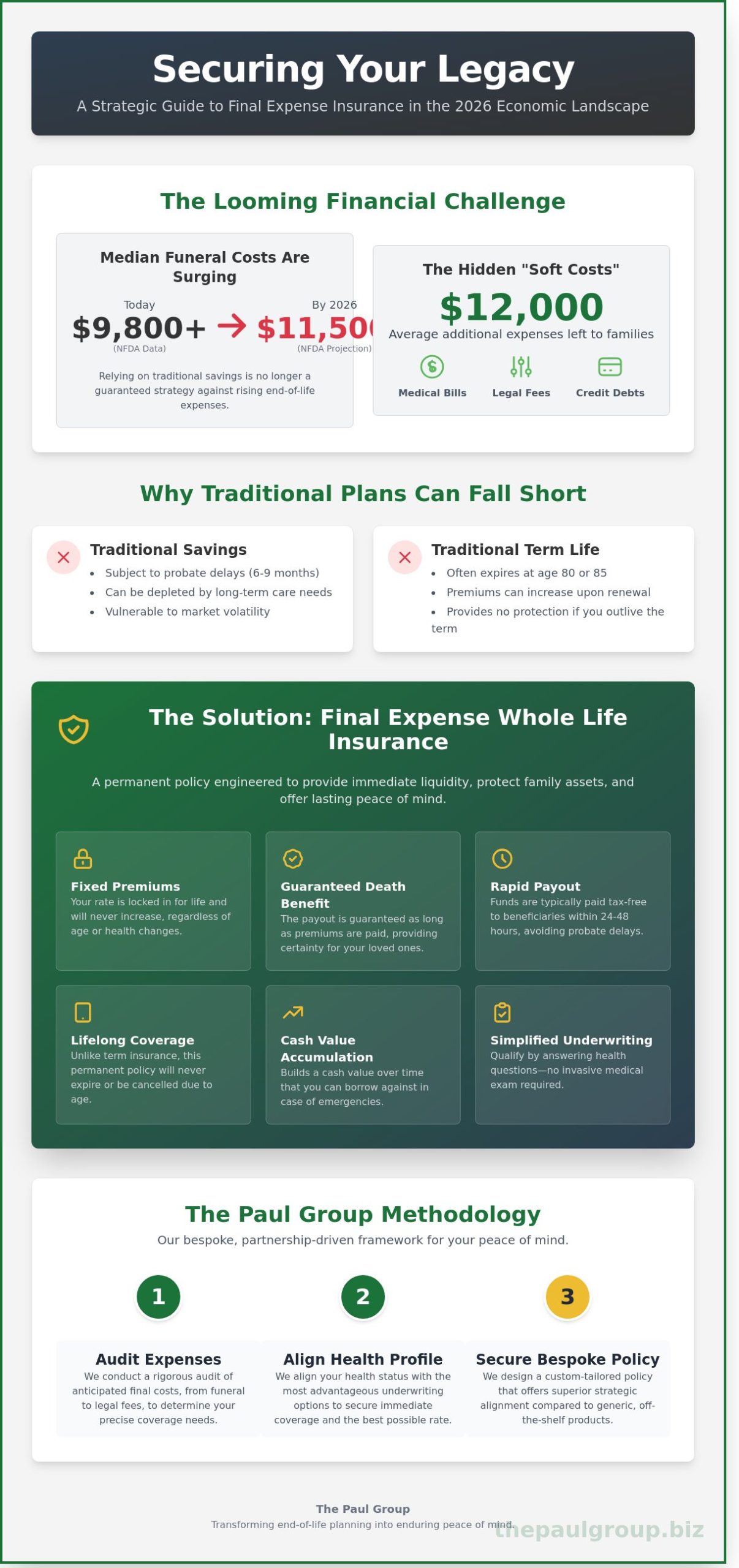
By 2026, the National Funeral Directors Association predicts the median cost of a funeral will surpass $11,500, marking a significant inflationary shift in end-of-life expenses. You’ve spent a lifetime building a legacy of stability; it’s only logical to feel concerned that rising costs or health-based rejections could jeopardize your family’s future financial security. At The Paul Group, we believe that securing final expense life insurance shouldn’t be a source of confusion or stress. It’s a strategic tool designed to provide immediate liquidity when your loved ones need it most.
We understand the frustration of deciphering the nuances between burial insurance and traditional life insurance. This guide offers a holistic methodology to shield your family from sudden financial burdens through a bespoke policy tailored to your unique health profile. You’ll discover how to secure a fixed premium that never increases and a policy that remains in force for life. We’ll outline the exact steps to transform your end-of-life planning into a source of enduring peace of mind, ensuring your strategic alignment with the future remains unshakeable.
Key Takeaways
Recognize how the 2026 economic landscape and rising funeral inflation necessitate a shift from traditional savings to more resilient financial structures.
Master the strategic mechanics of final expense life insurance to ensure fixed rates provide long-term stability and structural integrity for your estate.
Gain insight into the regional variance of end-of-life costs and how geographic location influences the scale of your required coverage.
Implement a rigorous two-step qualification framework to audit anticipated expenses and align your health status with the most advantageous underwriting options.
Discover how a bespoke, partnership-driven methodology offers superior strategic alignment compared to generic, off-the-shelf insurance products.
Table of Contents
The Financial Reality of Final Expenses in 2026
Managing end-of-life logistics requires more than emotional preparation; it demands rigorous financial foresight. Final expense life insurance serves as a permanent whole life policy specifically engineered to address the immediate fiscal obligations that arise upon a policyholder’s passing. In the economic climate of 2026, the National Funeral Directors Association reports that the median cost of a funeral has surpassed $9,800, a figure that continues to outpace standard inflationary markers. Relying on traditional savings accounts is no longer a guaranteed strategy, as these funds are often subject to market volatility or consumption by long-term care needs.
The Paul Group views this coverage not merely as a tool for "paying for a funeral," but as a mechanism for protecting family liquidity. When a death occurs, a family’s primary assets are often locked in probate or tied up in real estate. This creates a dangerous cash-flow gap. By integrating final expense insurance into a holistic financial plan, seniors ensure that their beneficiaries receive a tax-free death benefit, typically within 24 to 48 hours of a claim. This speed is essential for maintaining the structural integrity of the estate while avoiding high-interest debt during a period of transition.
The Hidden Costs Beyond the Casket
Final expenses are rarely limited to the mortuary. The Paul Group’s analysis of 2025 estate data shows that the average senior carries approximately $12,000 in "soft costs" at the time of passing. These include outstanding medical co-pays, legal fees for estate settlement, and recurring monthly obligations that don’t cease immediately. Probate delays can freeze access to liquid capital for six to nine months, leaving families to cover these costs out of pocket. Many seniors find that traditional term life policies fail them because they expire at age 80 or 85, exactly when the risk of mortality is highest. A permanent solution ensures the capital is there when it is actually needed, not just during a specific window of time.
Why Seniors Choose Simplified Issue Plans
The 2020s saw a decisive shift toward simplified issue plans. These policies eliminate the need for invasive medical exams, which is a significant advantage for those managing chronic conditions like hypertension or type 2 diabetes. The Paul Group prioritizes these plans because they offer immediate coverage options, providing instant peace of mind. To understand how these products compare to other market options, you should review the best final expense insurance for seniors pros and cons 2026. Unlike expiring term plans that carry the risk of leaving a family unprotected, permanent final expense life insurance offers:
Fixed premiums that never increase regardless of age or health changes.
Cash value accumulation that can be accessed in emergencies.
Guaranteed death benefits that cannot be cancelled as long as premiums are paid.
Strategic senior planning in 2026 is defined by the removal of uncertainty. By securing a policy that bypasses the complexities of traditional underwriting, families can focus on legacy rather than liabilities.
The Strategic Mechanics of Final Expense Life Insurance
Effective financial planning requires a deep understanding of the instruments at your disposal. Final expense life insurance isn’t a mere commodity; it’s a precision-engineered financial tool designed to provide structural integrity to a senior’s estate. The architecture of these policies rests on three pillars: level premiums, a guaranteed death benefit, and the steady accumulation of cash value. This trio creates a foundation of certainty in an otherwise unpredictable economic environment.
Our methodology emphasizes the necessity of fixed rates. For seniors operating on fixed incomes, such as Social Security or pension disbursements, predictability is the cornerstone of fiscal stability. Market volatility shouldn’t dictate your ability to maintain coverage. By locking in a rate at the time of application, you ensure that your strategic alignment remains intact regardless of future health changes or shifts in the insurance market. This disciplined approach prevents the "premium shock" often associated with term policies that expire or re-price as you age.
The underwriting process for final expense life insurance is built for efficiency. Unlike traditional life insurance that may require invasive physical exams or fluid samples, these plans utilize simplified underwriting. This involves a curated set of health questions and a review of prescription history. The National Association of Insurance Commissioners highlights how these streamlined processes allow for faster approvals, often within 24 to 48 hours. This speed ensures that protection is established quickly, bypassing the bureaucratic delays of standard medical exams.
Liquidity at the moment of need is the ultimate goal. The death benefit is delivered directly to your named beneficiaries, bypassing the time-consuming and often expensive probate process. This direct transfer allows families to address immediate obligations without waiting for legal hurdles to clear. It’s a clean, efficient mechanism for transferring wealth and settling final responsibilities.
Simplified Issue vs. Guaranteed Issue
Choosing the correct policy tier is an exercise in optimization. Simplified Issue policies are the preferred route for those who can affirm basic health benchmarks, offering the most competitive rates and immediate full coverage. If chronic conditions are a factor, Guaranteed Issue serves as a strategic fallback. While these plans typically feature a two-year graded period for non-accidental claims, they ensure that no individual is denied the opportunity for permanent protection. The Paul Group methodology focuses on identifying the most cost-effective tier that aligns with your current health profile, ensuring you don’t overpay for the security you require.
The Security of Permanent Protection
These policies are designed for institutional longevity. They don’t expire at a specific age; they remain in force as long as premiums are paid. Over time, the policy builds cash value, a modest but secure asset that can be accessed via policy loans if an emergency arises. To combat the erosion of purchasing power, we suggest selecting a benefit amount that accounts for the 3.1% average inflation rate observed in recent economic cycles. This forward-looking approach ensures your legacy remains robust. You can explore a holistic end-of-life strategy to see how these mechanics fit your specific goals.
Regional Cost Landscapes: From California to Florida
Geography acts as a primary driver of financial liability in end-of-life planning. A 2024 analysis reveals that the median cost of a funeral with viewing and burial has climbed steadily, yet these figures mask significant regional disparities. The Paul Group views these variances not as obstacles, but as data points that require strategic alignment. A policy that provides total peace of mind in a rural Midwest town might leave a family in a metropolitan hub with a five-figure deficit. We apply a holistic methodology to ensure your coverage matches the economic reality of your specific zip code.
Our multi-state expertise allows us to move beyond generic estimates. We understand that the cost of final arrangements is influenced by local real estate values, labor markets, and state-specific regulations. By analyzing these micro-trends, we help you secure final expense life insurance that functions as a precise financial tool rather than a speculative guess. This level of curated advice is essential for seniors who maintain residences in multiple states or plan to be interred away from their current home.
The High-Cost Markets: CA, AZ, and NV
Los Angeles remains one of the most expensive markets for final arrangements, where cemetery space commands a premium. California’s Department of Consumer Affairs enforces strict disclosure laws that protect seniors, but these protections don’t lower the baseline cost of service. In Phoenix, the arid climate and rapid population growth have shifted approximately 60% of residents toward cremation. This choice requires a different strategic approach to policy face values. This Forbes Advisor guide to burial insurance highlights how these regional choices impact the total capital required for a comprehensive plan. Our West Coast strategy focuses on high-liquidity options that account for these elevated service fees.
The Southern and Midwest Markets: TX, FL, and IL
Florida’s senior population exceeded 4.5 million residents in 2023, creating a unique market where final expense life insurance must often account for out-of-state transport. Texas regulations under the Finance Commission ensure high standards for funeral providers, yet they also create a complex intersection between insurance policies and pre-need contracts. In the Illinois and Wisconsin corridors, regional logistics often involve coordinating across state lines, which can add 15% to the total bill due to administrative and transport fees.
The Paul Group utilizes a disciplined intervention to simplify these complexities. We offer a curated look at the best final expense insurance for seniors pros and cons 2026 to help you navigate these regional nuances. Our goal is to transform a complicated geographic puzzle into a clear, logical path forward. We don’t just sell policies; we engineer sustainable solutions tailored to the unique DNA of your local market.
Designing Your Policy: A Strategic Qualification Framework
Securing final expense life insurance requires more than a signature; it demands a disciplined methodology to ensure the policy performs when your family needs it most. A haphazard approach often leads to coverage gaps or unsustainable premiums. We recommend a five-step framework to align your protection with your long-term financial architecture.
Conduct a holistic audit: Catalog every anticipated cost, including professional service fees, transportation, and immediate debt obligations. According to 2024 National Funeral Directors Association data, the median cost of a funeral with burial is approximately $8,300, but inflation-adjusted planning for 2026 should account for ancillary expenses.
Evaluate health status: Your medical history dictates your underwriting tier. Understanding where you sit in the risk pool allows for accurate premium forecasting.
Select a premium structure: Sustainability is paramount. Choose a level premium that remains fixed, ensuring the policy doesn’t lapse during your later years when income may be static.
Designate strategic beneficiaries: Choose individuals who possess the financial literacy to manage the payout according to your specific directives.
Finalize with a specialized advisor: Expert intervention ensures that your application is matched with the carrier most likely to offer immediate, first-day coverage.
Managing Health Inquiries with Confidence
Underwriters look for stability rather than perfection. Common conditions like well-managed diabetes or high blood pressure don’t automatically disqualify you, but they do influence your rating. A "Preferred" rating is typically reserved for those with no major health events in the last 24 months, while a "Standard" rating remains a highly accessible option for most seniors. Total transparency with your broker is the best way to prevent future claim denials. Carriers rely on the Medical Information Bureau (MIB) and prescription databases; discrepancies there can jeopardize your family’s security during the contestability period.
Customizing Your Benefit Amount
We define the "Legacy Gap" as the deficit between your current liquid assets and the total projected cost of your final arrangements. Most seniors find that a benefit range between $10,000 and $25,000 serves as the ideal "sweet spot." This amount covers professional services while leaving a modest cushion for unexpected legal or medical bills. To understand how these amounts weigh against different policy types, you should review our analysis on the best final expense insurance for seniors pros and cons 2026. Selecting an amount within this range optimizes the ratio between monthly cost and total utility. It prevents you from being "over-insured" while maintaining the dignity of your final transition.
Precision in planning is the hallmark of a secure retirement. If you’re ready to move from uncertainty to a structured plan, secure your family’s legacy through a tailored consultation with our strategic advisors today.
The Paul Group Methodology: Bespoke Protection for Seniors
The Paul Group has refined its partnership-driven approach since 2009. We don’t just sell policies; we engineer long-term stability for families. Our role as a Wise Advisor means we operate as an independent agency, which is a critical distinction in a crowded market. This status allows us to maintain superior strategic alignment with your interests rather than those of a single insurance company. We select from a curated list of carriers through a rigorous vetting process that prioritizes financial strength and claims-paying history. If a carrier doesn’t meet our standards for reliability, they don’t make it into our portfolio.
Our reach currently spans 16 states, from the rugged terrain of Alaska to the high deserts of New Mexico. This geographic breadth ensures we understand the specific regulatory nuances that affect your coverage options. We believe that final expense life insurance should be a precision instrument, not a generic product. Our methodology focuses on sustainable scaling of your protection, ensuring the plan you buy today remains robust decades from now. It’s about structural integrity in your financial planning.
A Collective of Experts Dedicated to Your Legacy
Our group identity is our greatest asset. It ensures you receive a synthesis of perspectives rather than a solitary, potentially biased viewpoint. We focus on the intersection of operational excellence and human empathy. Our curated plans are designed to offer more than a simple payout. They provide a clear path forward for your family, removing the structural and financial burdens that often follow a loss. We treat your legacy as a project requiring disciplined intervention and visionary leadership. Every plan we build is specifically engineered for the unique DNA of the individual client.
Securing Your Future Today
Securing a final expense life insurance plan shouldn’t be a complex organizational challenge. We’ve designed our application process for maximum clarity. There are no medical exams and no needles. We’ve optimized the system to focus on your health history through a simple, transparent consultation. This efficiency allows us to move from diagnosis to solution quickly without the typical friction of traditional underwriting.
You can learn more about the pros and cons of senior coverage to see how our methodology differentiates itself from mass-market options. To initiate your strategic consultation, reach out to one of our experts. We’ll help you build a stable, bespoke plan that honors your life’s work and protects those you leave behind. Clarity is only a conversation away.
Contact The Paul Group to secure your bespoke final expense plan today.
Architecting Your Sustainable Financial Legacy
Navigating the fiscal complexities of 2026 requires a shift from reactive planning to proactive optimization. You’ve seen how regional shifts in the cost landscape across 16+ states necessitate a final expense life insurance strategy that’s both flexible and robust. Relying on simplified issue plans ensures that medical barriers don’t obstruct your path to securing your family’s future stability.
The Paul Group has refined this methodology since 2009, serving as a dedicated senior advocate across primary markets like California, Texas, and Florida. Our focus remains on high-level strategic alignment, matching your unique health profile with bespoke protection that eliminates the need for invasive medical exams. We value the structural integrity of your long-term plan over quick fixes; it’s time to move from uncertainty to clarity through disciplined intervention and expert guidance.
Ready to align your intentions with a definitive action plan? Request Your Bespoke Final Expense Consultation today. You deserve the peace of mind that comes from a partnership built on excellence and intellectual rigor.
Frequently Asked Questions
Is final expense life insurance the same as burial insurance?
Final expense life insurance and burial insurance refer to the same type of whole life policy designed to cover end-of-life obligations. While the terminology varies depending on the marketing framework, the underlying mechanism remains a permanent death benefit with a cash value component. The Paul Group views this as a foundational tool for legacy preservation. It ensures that your family navigates the transition without the burden of immediate liquidity constraints.
Can I qualify for final expense insurance if I have a pre-existing health condition?
You can certainly qualify for coverage despite existing health challenges through our curated selection of guaranteed issue or simplified issue products. Approximately 95% of applicants find a viable path to coverage regardless of their medical history. We utilize a methodology that aligns your specific health profile with carriers that prioritize inclusive risk assessment. This strategic alignment ensures that even those with histories of chronic illness maintain access to essential financial protection.
How much does final expense life insurance typically cost for someone over 70?
Pricing is determined by your specific risk profile and the total benefit amount required to meet your legacy objectives. According to the National Funeral Directors Association 2023 report, the median cost of a funeral with a viewing and burial is approximately $8,300. We focus on the optimization of your premium to benefit ratio. This ensures your final expense life insurance provides maximum utility without overextending your current cash flow or compromising your broader financial stability.
What happens if the death benefit is more than the actual funeral costs?
The designated beneficiaries receive the full remaining balance after all immediate end-of-life expenses are settled. These funds act as a flexible liquid asset that your family can apply toward outstanding medical bills, legal fees, or direct inheritance. Our holistic approach treats the death benefit as a strategic reserve. It provides a layer of financial insulation that extends beyond the cemetery gates to support your family’s long-term transition.
Will my premiums increase as I get older or if my health declines?
Your premium structure remains fixed regardless of future health shifts or your advancing age. This stability is a core feature of the whole life methodology we employ to ensure your financial plan remains resilient against market volatility. Once the policy is active, the cost is immutable. This predictability allows for precise long-term budgeting and protects your estate from the inflationary pressures often seen in the broader insurance market.
How quickly does the beneficiary receive the payout after a claim is filed?
Payouts are typically processed with high efficiency, often reaching beneficiaries within 48 hours of the carrier receiving the necessary documentation. Speed is a critical component of our operational philosophy because immediate liquidity is essential during times of grief. By streamlining the administrative requirements, we ensure that the capital is available exactly when it’s needed most. This rapid response prevents the need for family members to utilize high-interest credit or personal savings.
Do I need a medical exam to get a final expense policy with The Paul Group?
You don’t need to undergo a physical examination or provide blood samples to secure coverage through our strategic partners. We prioritize simplified underwriting processes that rely on a refined series of health questions and pharmaceutical database checks. This methodology accelerates the approval timeline and reduces the friction often associated with traditional life insurance. It reflects our commitment to providing a sophisticated, accessible experience for every client we serve.









Leave a Reply