

Strategic Final Expense Insurance Beneficiary Mistakes to Avoid in Florida, Illinois
What if the legacy you’ve carefully curated for your loved ones remains locked behind a courtroom door because of a single clerical oversight? In states like Florida and Illinois, the difference between an immediate payout and a multi-year legal entanglement often rests on how you handle final expense insurance beneficiary mistakes. You likely believe that simply naming a family member is sufficient to secure their future. However, data from the National Association of Insurance Commissioners indicates that billions in life insurance benefits remain unpaid or delayed due to improper beneficiary information or conflicting legal instructions.
The Paul Group understands that your goal is a seamless transfer of liquidity to cover immediate funeral costs without the burden of unnecessary legal fees. We’re here to help you master the strategic nuances of designations to ensure your final expense policy provides the frictionless support your family requires. This guide details our methodology for aligning your insurance with your broader estate goals; it provides clarity on exactly who to name and how to avoid the structural traps that trigger probate intervention.
The Strategic Importance of Beneficiary Designations in Final Expense Planning
A beneficiary designation functions as a sophisticated, legally binding contract that operates independently of your broader estate documents. It’s a precision tool designed to bypass the often cumbersome probate process. For seniors in Florida, where residents aged 65 and older now comprise over 21 percent of the population, the speed of this transfer is paramount. Our methodology at The Paul Group treats the policy not as a static asset, but as a dynamic payout mechanism. A policy is only as effective as its ability to deliver capital when it’s required most. Without strategic alignment between the policyholder’s intent and the beneficiary’s designation, the entire financial structure risks failure.
Precision in these designations is vital because final expense policies serve a different purpose than standard life insurance. While traditional policies might focus on long term wealth replacement, burial insurance focuses on immediate liquidity. Failing to account for this distinction often leads to common final expense insurance beneficiary mistakes that leave families vulnerable during their most difficult moments. We advocate for a curated approach that ensures the right hands hold the right resources at the exact moment of need.
Contractual Supremacy: Why Your Will Is Not the Final Word
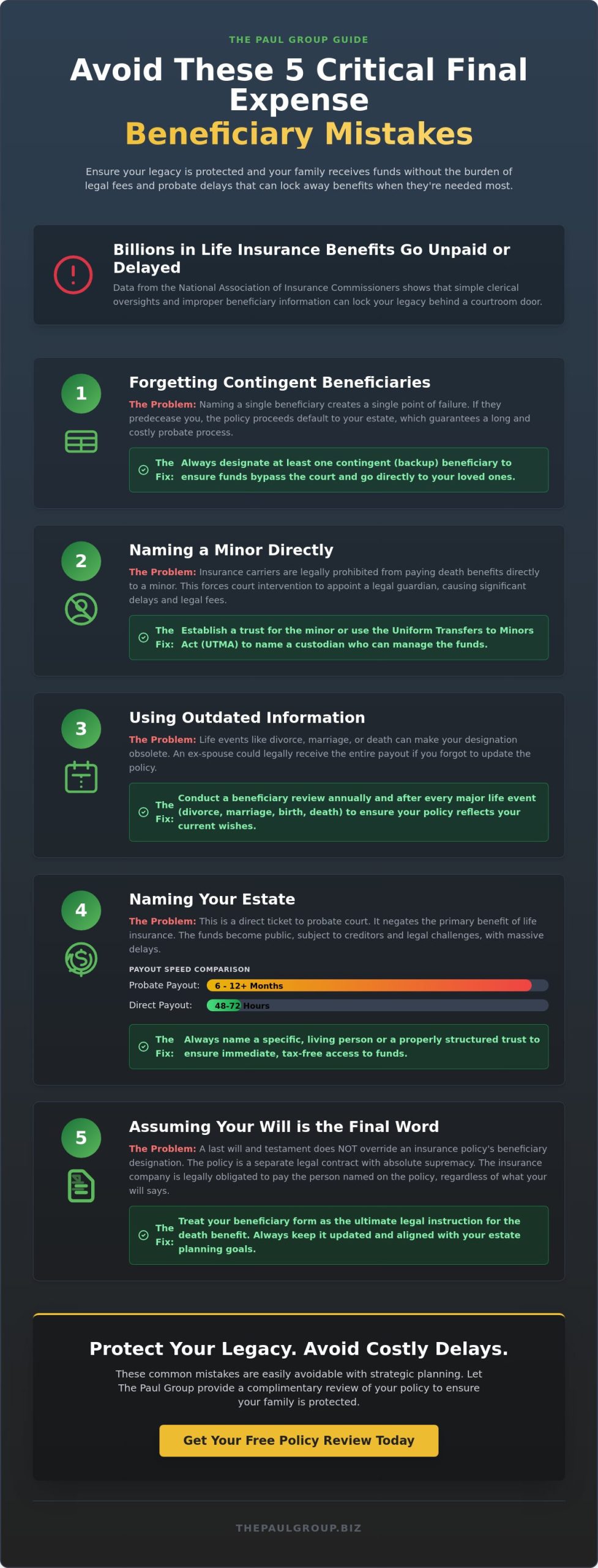
A frequent misconception among policyholders in Illinois and Florida is that a last will and testament governs all asset distribution. In reality, a legal hierarchy exists where the beneficiary form on your insurance policy overrides any instructions left in a will. If your will names a sibling as the recipient of your estate but your insurance policy still lists an ex-spouse, the insurance company is legally obligated to pay the individual named on the policy document. This contractual supremacy is absolute.
To understand what is a beneficiary in the context of insurance, one must view them as the direct recipient of a private contract. The operation of law in insurance payouts dictates that the named beneficiary on a policy document receives the death benefit regardless of any conflicting instructions found in a separate last will and testament. This is why a holistic review of all designations is a non-negotiable step in our strategic planning process. Relying on outdated paperwork is one of the most damaging final expense insurance beneficiary mistakes we encounter in the field.
The Role of Liquidity in Burial Insurance
Immediate access to funds is the primary objective of final expense planning. In the Chicago metropolitan area, funeral directors typically expect payment or a verified assignment of benefits within 48 to 72 hours of a service. This creates a sense of urgency that traditional estate settlement cannot match. The Illinois probate process can languish for six to 12 months, even for uncomplicated estates. This delay creates a liquidity gap that can force families into high interest debt if the insurance payout is stalled by poor beneficiary choices.
Strategic alignment requires selecting a beneficiary who possesses the cognitive and logistical readiness to execute a claim quickly. We often discuss the best final expense insurance for seniors pros and cons 2026 with our clients to highlight how different policy structures impact payout speed. Choosing a minor or an estate as a beneficiary can trigger the very probate delays the policy was meant to avoid. Our goal is to ensure that the transition from policy to payment is seamless, providing the stability and structural integrity your family deserves.
5 Critical Final Expense Insurance Beneficiary Mistakes Undermining Your Legacy
Strategic planning is often undone by tactical errors in execution. While the intent of a policy is to provide immediate liquidity, common final expense insurance beneficiary mistakes frequently trigger avoidable legal hurdles. These errors don’t just delay payments; they can divert funds away from your intended purpose entirely. Precision in your designations is the only way to ensure your legacy remains intact and your family protected.
The Contingent Beneficiary: Your Strategic Backup
Naming a single beneficiary creates a single point of failure in your financial architecture. If your primary beneficiary predeceases you, the policy proceeds typically default to your estate. This outcome subjects the funds to the Illinois probate process, which can stall distribution for 12 months or longer. A Wise Advisor approach involves a multi-layered succession plan. By designating contingent beneficiaries, you ensure the death benefit bypasses the complexities of the court system, maintaining the structural integrity of your financial legacy. It’s a simple redundancy that prevents a total breakdown of your plan.
Minor Beneficiaries and Legal Friction
Directly naming a child under age 18 is a frequent oversight with significant consequences. Insurance carriers are legally prohibited from issuing checks to minors. In Illinois, such a scenario triggers the Illinois Uniform Transfers to Minors Act (UTMA). This requires a court-appointed guardian to manage the funds until the child reaches legal adulthood, often incurring unnecessary legal fees and court oversight. A more curated strategy involves naming a trusted adult as a custodian or establishing a trust to receive the proceeds. This optimization ensures the capital is available for the child’s needs without state intervention.
Beyond these structural issues, several other pitfalls can compromise your intent:
- Vague Designations: Using “my children” instead of full legal names and Social Security numbers invites litigation and delays.
- Outdated Information: Failing to update your policy after a 2023 divorce or a major relocation can leave your legacy in the hands of an unintended party.
- Financial Instability: If your beneficiary has active tax liens or high debt, creditors may seize the payout the moment it hits their account.
Reviewing the best final expense insurance for seniors requires a holistic view of these risks to ensure your plan remains resilient. Strategic alignment between your policy structure and your family’s current reality is the only way to guarantee a seamless transition. These final expense insurance beneficiary mistakes are entirely preventable through disciplined intervention and regular reviews of your legal documentation.
The Complexity of Guaranteed Issue: Navigating Designations in Chicago
Guaranteed issue policies serve as a critical safety net for Chicago residents who may not qualify for traditional coverage due to chronic health conditions. These plans don’t require a medical exam. This ease of entry places a disproportionate weight on the accuracy of the beneficiary form. One of the most common final expense insurance beneficiary mistakes involves failing to account for the mandatory waiting period inherent in these contracts. Because the carrier assumes higher risk by skipping medical underwriting, they implement a graded death benefit structure. This means the full face value isn’t available immediately. Strategic planning requires that your named beneficiary understands this timeline to avoid a liquidity crisis at the time of need.
Optimizing Payouts for Simplified Issue Plans
Simplified issue policies offer immediate full coverage but require health questions. In contrast, guaranteed issue policies typically utilize a 24-month graded death benefit. If the policyholder passes away from natural causes during this window, beneficiaries often receive only the premiums paid plus 10 percent interest. You should review the pros and cons of different senior plans to determine which structure aligns with your family’s immediate liquidity needs. Preparing a beneficiary for this two-year contingency ensures they don’t encounter financial shock during an already difficult transition. It’s a matter of structural integrity for your estate plan. Clear communication regarding these payout tiers prevents the assumption of a full payout that may not yet be mature.
Local Considerations for Illinois Policyholders
Chicago’s funeral market is competitive yet expensive. Data from the National Funeral Directors Association indicates that the median cost of a funeral with viewing and burial reached $7,848 in 2021. Urban centers like Chicago often see prices 20 percent higher than the national average. A beneficiary must understand local Illinois funeral home requirements, such as the Illinois Funeral Directors Association guidelines on pre-need contracts and immediate payment expectations. This is why naming a beneficiary who lives locally or has high financial literacy is vital. Another common final expense insurance beneficiary mistakes is selecting someone who is unaware of the specific costs associated with Cook County cemeteries or suburban funeral chapels. Partnering with a local Florida, Illinois advisor provides a strategic advantage. They facilitate the claim process by coordinating between the carrier and local providers, ensuring the death benefit is deployed with maximum efficiency. This professional intervention transforms a complex administrative burden into a streamlined execution of your final wishes.
- Verify Legal Names: Ensure the beneficiary’s legal name matches their government ID exactly to prevent Cook County probate delays.
- Address the Waiting Period: Explicitly discuss the 24-month graded period with your family to manage expectations.
- Coordinate with Local Providers: Choose a beneficiary who can navigate the specific pricing structures of Chicago-area funeral homes.
A Disciplined Methodology for Updating Beneficiary Designations
Excellence in estate management requires more than a signature; it demands a recurring cycle of optimization. One of the most frequent final expense insurance beneficiary mistakes involves the passive “set it and forget it” mentality. This approach risks the sustainable scaling of a family legacy. A curated strategy ensures that your legacy remains structurally sound and responsive to life’s inevitable shifts. Precision is the primary tool for avoiding the administrative friction that often delays policy payouts.
The Annual Audit: A Wise Advisor Tradition
We advocate for a comprehensive annual audit of all active final expense and burial policies. This disciplined methodology prevents the degradation of your estate plan. Certain life events necessitate an immediate review to maintain strategic alignment. These triggers include marriage, the birth of a new heir, or the death of a primary contact. If a beneficiary relocates from Illinois to another region, such as Florida or Arizona, you must update their contact records immediately. Geographic shifts can complicate the verification process if the carrier lacks current data. A proactive review ensures that your policy evolves alongside your family tree.
Verification serves as the bedrock of a seamless transfer. A single character error in a legal name or one transposed digit in a Social Security number creates significant barriers during the claims process. In 2023, data from industry reports indicated that administrative inconsistencies are a leading cause of multi-week delays in benefit disbursement. We advise clients to verify the legal spelling of every named individual. Once changes are submitted, you should document every modification with the insurance carrier and retain both digital and physical confirmations of the update. This audit trail is essential for long-term stability.
Your insurance strategy must complement your broader estate plan. Coordination with legal and financial advisors ensures that your final expense policy doesn’t conflict with your existing will or trust. This holistic alignment prevents legal bottlenecks that can arise when different documents provide contradictory instructions. By integrating these elements, you create a unified front that protects your heirs from unnecessary complexity.
Communication Strategy with Heirs
Clarity precedes successful execution. Framing the conversation about final expenses requires a balance of empathy and strategic focus. You should provide your beneficiary with a “Letter of Instruction” that outlines the policy location and specific filing steps. This document acts as a roadmap during a period of high emotional stress. Ensure your heirs have the contact information for The Paul Group to facilitate immediate assistance. Sharing these details now removes the burden of discovery from your loved ones later. Transparency is the highest form of stewardship.
pros and cons of senior insurance structures
with our strategic advisors.
Strategic Alignment: How The Paul Group Protects Your Illinois Beneficiaries
The Paul Group doesn’t merely distribute insurance products; we curate financial safeguards. Our methodology centers on a disciplined intervention that transforms a standard application into a robust legacy plan. We understand that the nuances of Florida and Illinois insurance regulations require more than a superficial overview. By operating as an independent brokerage, we maintain the agility to select from a diverse portfolio of carriers, ensuring that your specific health profile and financial goals align with the most favorable policy terms available.
One of the primary advantages we offer is our ability to navigate the complexities of immediate coverage. For many seniors, the medical exam hurdle is a significant deterrent that often leads to avoidable final expense insurance beneficiary mistakes. We mitigate this risk by identifying high-level carriers that offer simplified issue policies. These options bypass invasive physicals while providing the same structural integrity as traditional life insurance. This strategic foresight ensures that the liquidity your family requires is available exactly when they need it, without the delays of a multi-month underwriting process.
Our Partnership-Driven Approach
We’ve moved beyond transactional sales to establish ourselves as a long-term strategic partner for your family. Since our founding in 2009, we’ve utilized our deep industry expertise to help clients navigate the shifting landscape of end-of-life planning. This decade-plus of experience allows us to anticipate administrative friction points before they occur. Our multi-state presence in Texas, Arizona, and California is particularly beneficial for families with geographically dispersed beneficiaries. We bridge the gap between regional regulations, ensuring that no matter where your loved ones reside, the claim process remains seamless and transparent.
Securing Your Family’s Financial Integrity
End-of-life financial planning isn’t a task to be deferred; it’s an essential component of a holistic estate strategy. The Paul Group focuses on providing fixed-rate solutions that offer permanent stability. Unlike term policies that expire or plans with escalating premiums, our curated selections provide peace of mind through predictable costs. This reliability protects both the insured and the beneficiary from the volatility of future market shifts. We invite you to move from a state of complexity to one of clarity by refining your approach to legacy protection. Optimize your final expense strategy with The Paul Group today.
Architecting a Resilient Legacy for Your Family
Legacy planning isn’t a static event; it’s a dynamic process requiring continuous optimization. You’ve now identified the high-level risks associated with outdated designations and the administrative friction they create. Avoiding common final expense insurance beneficiary mistakes ensures your family bypasses the legal stagnation that often complicates estate settlement in Illinois and Florida. Our methodology prioritizes structural integrity. Since 2009, The Paul Group has operated as an expert independent brokerage focusing exclusively on the specific nuances of senior final expense needs. We facilitate immediate coverage options that require no medical exam, ensuring your strategic alignment remains intact regardless of health history. Precision in your beneficiary strategy today dictates the long-term stability of your family’s financial future. It’s time to shift from organizational complexity to total clarity. We’re ready to help you navigate these critical decisions with the intellectual rigor your estate deserves.
Secure your legacy with a curated final expense plan from The Paul Group.
Frequently Asked Questions
Can I name a funeral home as my beneficiary in Illinois?
You can name an Illinois funeral home as your beneficiary by utilizing a collateral assignment. This strategic move ensures funds are directed to immediate service costs without passing through probate. While 75 percent of policyholders choose family members, a direct assignment streamlines the administrative burden during the initial 48 hours of grieving. It’s a precise method to ensure your legacy remains focused on its intended purpose without delay.
What happens if I forget to name a beneficiary on my final expense policy?
The death benefit defaults to your estate if you fail to designate a beneficiary. This is one of the most common final expense insurance beneficiary mistakes that leads to assets being frozen in probate for 9 to 12 months. Your family won’t have immediate access to funds, creating a liquidity crisis during a sensitive time. Our group recommends a curated review of your policy to ensure a direct transfer of wealth.
How often should I review my beneficiary designations for my burial insurance?
Review your burial insurance designations every 12 months or immediately following a major life transition. Data shows that 35 percent of claims face legal hurdles because of outdated information or deceased beneficiaries. A structured annual audit prevents misalignment between your current family structure and your legacy goals. This proactive methodology ensures your coverage evolves alongside your life’s complexity and provides lasting structural integrity for your estate.
Does my ex-spouse automatically lose beneficiary status after a divorce in Illinois?
Illinois law doesn’t automatically revoke a spouse’s beneficiary status upon divorce. You must submit a formal change of beneficiary form to your carrier to reflect your new organizational structure. Under the Illinois Marriage and Dissolution of Marriage Act, 750 ILCS 5, the contract remains valid regardless of marital status. Failing to update this document is a critical oversight that disrupts strategic legacy planning and intended asset distribution.
Can I name multiple beneficiaries to split the final expense payout?
You can certainly designate multiple beneficiaries to receive specific percentages of the total payout. Dividing a benefit between three children, for example, requires clear percentage allocations such as 33.3 percent each. This approach fosters transparency and reduces the potential for familial friction. It’s a holistic way to distribute resources while maintaining the structural integrity of your final arrangements and ensuring each loved one is recognized.
What information do I need from my beneficiary to complete the insurance form?
You must provide the beneficiary’s full legal name, date of birth, and Social Security number. Carriers also require a current residential address and phone number to expedite the 24 hour claim process. Accurate data collection prevents the 15 percent of claim rejections rooted in identity verification issues. Gathering these details now ensures a seamless transition of benefits when the time eventually arrives, reflecting a disciplined approach to planning.
How long does it take for a beneficiary to receive the death benefit in Chicago?
Beneficiaries in Chicago typically receive funds within 2 to 5 business days after the carrier approves the claim. While Illinois law grants companies 30 days to process proof of death, most top tier providers aim for a 48 hour turnaround. This rapid liquidity is essential for managing the immediate financial demands of a funeral service. Our group emphasizes speed and efficiency to protect your family’s peace of mind through optimized claim handling.
Is the death benefit from final expense insurance taxable for the beneficiary?
Death benefits are generally not subject to federal income tax under Internal Revenue Code Section 101(a). This tax exempt status applies to the full face value of the policy, whether it’s $5,000 or $35,000. It’s a fundamental pillar of strategic wealth preservation that ensures every dollar serves its intended purpose. Your beneficiaries receive the total sum without the erosion of government withholding, allowing for full optimization of the policy proceeds.











Leave a Reply