

Burial Insurance Policy For Seniors
By the start of 2026, industry projections from the National Funeral Directors Association suggest that the median cost of a funeral with burial will continue its upward climb, often exceeding $10,000 when accounting for inflation and service fees. Most families realize that standard savings accounts can’t always keep pace with these rising costs, yet the search for a reliable burial insurance policy often ends in frustration due to dense industry jargon. You likely feel the weight of ensuring your children aren’t left with an unexpected financial burden, but the lack of clarity in the market makes it difficult to take the first step.
The Paul Group believes that final expense protection should be a pillar of your long-term legacy, not a source of stress. We’ve developed this guide to help you strategically secure your family’s financial future by selecting the right burial insurance policy tailored to your state’s specific requirements. You’ll learn how to lock in fixed monthly rates that never increase and experience a simple application process designed for immediate peace of mind. This briefing provides a clear, logical path toward structural financial integrity, ensuring your final wishes are honored without compromise.
Key Takeaways
Analyze how macro-trends in funeral inflation necessitate a burial insurance policy as a cornerstone of strategic estate preservation.
Decipher the structural advantages of "no medical exam" policies to ensure your coverage aligns with your unique health and age profile.
Understand how regional cost variances across states like California and Texas dictate the required scale of your final expense protection.
Apply a rigorous evaluation framework to compare carrier financial ratings and secure a policy backed by institutional stability.
Learn how a curated, expert-led methodology provides the intellectual order needed to navigate the complexities of senior life insurance.
Table of Contents
The Strategic Necessity of a Burial Insurance Policy in 2026
Deciphering Policy Structures: Simplified Issue vs. Guaranteed Acceptance
Regional Cost Dynamics: Burial Expenses Across CA, TX, and Florida
Evaluating Your Coverage: A Framework for Strategic Legacy Protection
The Strategic Necessity of a Burial Insurance Policy in 2026
Securing a burial insurance policy represents more than a simple purchase; it’s a critical act of financial optimization for the modern estate. At its core, this coverage is a specialized variation of low face value whole life insurance policies designed specifically to address the immediate liquidity needs that arise at the end of life. While traditional term life insurance serves as a temporary safeguard for income replacement, it often expires before a senior truly needs it. The Paul Group views burial insurance as a permanent pillar of structural integrity. It ensures that capital is available precisely when it’s required, regardless of when that moment arrives.
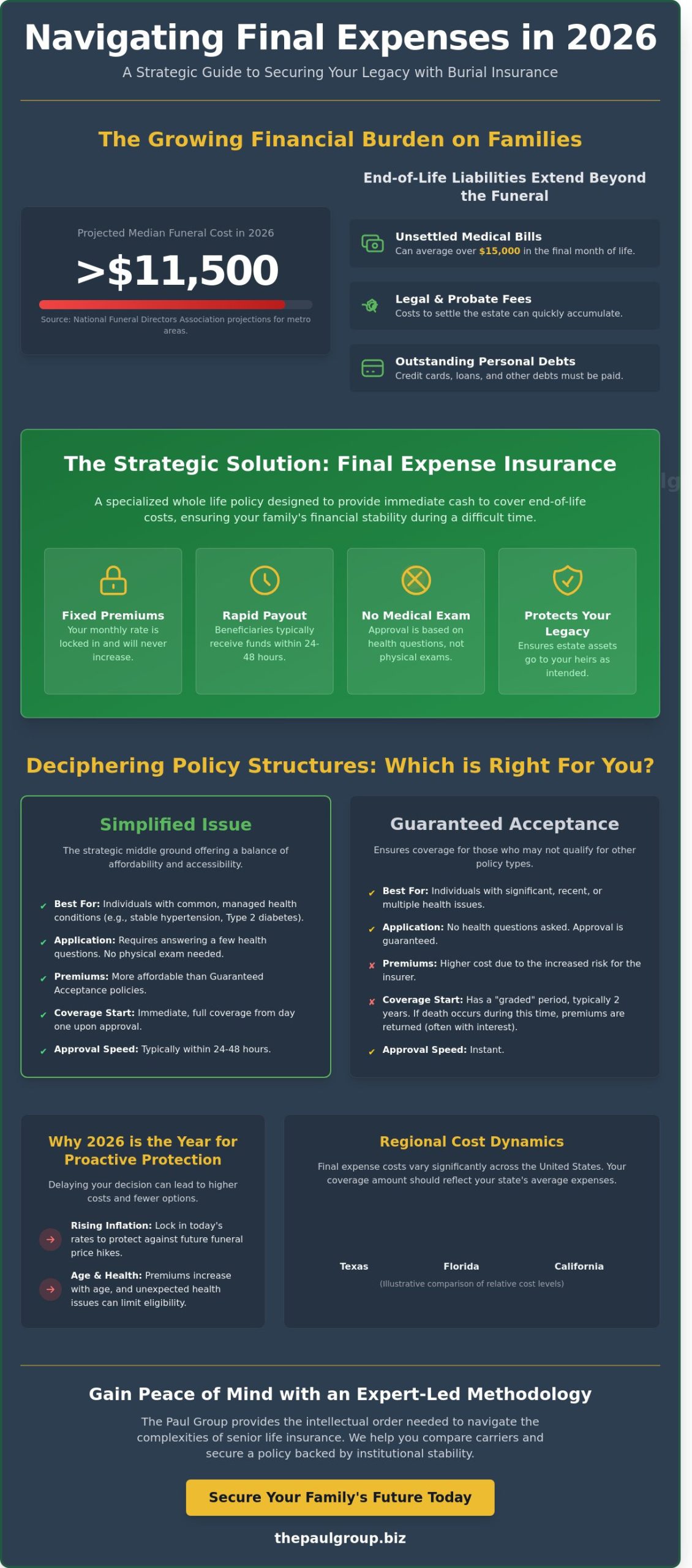
The macro-economic environment of 2026 has introduced new pressures on family legacies. Data from the National Funeral Directors Association (NFDA) indicates that the median cost of a funeral with viewing and burial has climbed steadily, with 2026 projections suggesting costs will exceed $11,500 in many metropolitan areas. For the unprepared, this creates a sudden, high-interest liability that can erode decades of careful savings. Reactive planning is a risk to legacy. Waiting for a crisis to manage these costs often forces families into high-stress decision-making, leading to sub-optimal financial choices and emotional strain. We believe in a partnership-driven approach that prioritizes foresight over reaction.
Neutralizing End-of-Life Liabilities
End-of-life expenses extend far beyond the mortuary. Hidden costs often include unsettled medical bills, which the Health Care Cost Institute recently noted can average over $15,000 in the final month of life, alongside legal fees for probate and outstanding personal debts. A burial insurance policy provides an immediate cash benefit, usually within 24 to 48 hours of a claim. This rapid deployment of capital provides profound emotional relief. It transforms a chaotic period of financial uncertainty into a structured, manageable transition. By neutralizing these liabilities, the Group helps clients maintain the intended distribution of their primary estate assets.
Why 2026 is the Year for Proactive Protection
The current economic climate makes 2026 a pivotal year for securing fixed-rate protection. As inflation impacts the service sector, funeral homes are adjusting their pricing models annually. By locking in a policy now, you insulate your family from future price hikes. Delaying an application often results in higher premiums due to age or the sudden onset of health conditions that could restrict your coverage options. Exploring the best final expense insurance for seniors allows you to evaluate the strategic advantages of different plans while your eligibility is at its peak. This disciplined intervention ensures that your financial plan remains resilient against the rising costs of the future.
Deciphering Policy Structures: Simplified Issue vs. Guaranteed Acceptance
Selecting a burial insurance policy requires a disciplined evaluation of health risk versus financial efficiency. The Paul Group recognizes that traditional underwriting often alienates seniors through invasive medical exams and lengthy waiting periods. Modern final expense structures solve this by removing the physical exam requirement entirely. This strategic shift allows for a more streamlined approval process, focusing on accessibility rather than exclusion. By utilizing a curated methodology, carriers can offer protection that aligns with specific health profiles without the friction of blood draws or physician statements. The result is a more agile approach to legacy protection that respects the applicant’s time and privacy.
Simplified Issue: The Strategic Middle Ground
Simplified issue coverage serves as a high-value option for those who can answer a few fundamental health questions. This structure avoids the complexity of full medical underwriting while offering lower premiums than guaranteed alternatives. Carriers typically look for stability in chronic conditions like managed hypertension or Type 2 diabetes. The approval speed is a primary advantage; most applicants receive a determination within 24 to 48 hours. For those who meet the criteria, immediate coverage is often available from day one. This comprehensive guide to burial insurance highlights how these policies balance affordability with rapid protection. It’s an optimization of the application process that favors proactive planning and rewards those in relatively stable health.
Guaranteed Issue: Protection for Every Health Profile
Guaranteed acceptance policies provide a critical safety net when serious health challenges exist. These plans utilize a no-questions-asked methodology, ensuring that no individual is denied coverage based on their medical history. This is often the most logical strategic choice for those with terminal diagnoses or significant cognitive impairments. Because the carrier assumes a higher level of risk, these policies include a graded benefit period. This usually involves a two-year waiting window. If the policyholder passes away during this timeframe from natural causes, beneficiaries typically receive all paid premiums plus an additional 10 percent interest. This structured approach ensures that even the most complex health profiles can secure a burial insurance policy to protect their legacy. Understanding the nuances of the best final expense insurance for seniors is vital for long-term stability and effective estate management.
Regional Cost Dynamics: Burial Expenses Across CA, TX, and Florida
Geographic location remains the most significant variable in determining the finality of a financial plan. Costs are not uniform. A burial insurance policy must reflect the economic realities of the specific market where services will eventually be rendered. Strategic planning requires an understanding of how regional regulations and land availability influence the bottom line. In states like California and Texas, the disparity between urban centers and rural municipalities creates a complex pricing landscape that demands a curated approach to coverage. It’s not just about the service; it’s about the local market’s demand for space and resources.
The High Cost of Finality in California and Florida
Land scarcity drives the premium pricing observed in coastal regions. In Los Angeles and Miami, the cost of a burial plot can rival the price of a mid-sized vehicle, often exceeding $5,500 for the land alone. Data from industry reports suggests that the median cost of a funeral with a vault and burial has climbed steadily, with 2026 projections placing major metropolitan averages well above $11,800. To address these elevated costs, many families utilize Simplified Issue Life Insurance to secure rapid liquidity without the delays of traditional medical underwriting. Our advisors at The Paul Group specialize in calculating a precise regional need figure. We ensure that inflation in high-demand markets doesn’t leave a legacy of debt for the survivors.
Texas and Arizona: Navigating the Southern Market
The Southern market presents a different set of logistical challenges. Texas exhibits a sharp divide. Urban hubs like Houston see costs comparable to the coasts, while rural jurisdictions offer more traditional pricing structures. Arizona’s demographic profile is unique. With 18.3 percent of its population aged 65 or older as of 2023, the state has seen a surge in specialized final expense plans tailored to senior needs. Cremation rates in the Southwest are also accelerating, often exceeding 65 percent of total services in certain Arizona counties. This shift necessitates a burial insurance policy that is flexible enough to pivot between traditional interment and modern alternatives. Working with a broker who understands these multi-state nuances is essential for families who maintain residences in multiple regions. We focus on structural integrity in policy design, ensuring that your coverage aligns with the specific funeral trends and regulatory requirements of your primary residence.
Evaluating Your Coverage: A Framework for Strategic Legacy Protection
Selecting a burial insurance policy requires more than a cursory glance at monthly premiums. It demands a rigorous evaluation of the underlying financial structure to ensure long-term stability. A strategic checklist serves as your primary tool for comparison. You must prioritize carriers with high financial strength ratings from agencies like A.M. Best. An "A" or "A-" rating indicates a carrier’s robust ability to meet its ongoing insurance obligations, which is a non-negotiable factor when planning for events decades in the future.
Carrier Solvency: Verify A.M. Best or Standard & Poor’s ratings to confirm institutional longevity.
Premium Stability: Confirm the policy features a fixed premium structure that can’t increase regardless of age or health changes.
Benefit Type: Distinguish between immediate full death benefits and graded plans.
Fixed premiums are essential for those managing a fixed income. Inflation and rising healthcare costs already pressure retirement budgets; your legacy protection shouldn’t add to that volatility. Before committing, evaluate the pros and cons of final expense insurance for seniors to determine if this specific vehicle aligns with your broader financial architecture.
Identifying Premium Quality Features
Sophisticated policies offer more than just a death benefit. Many whole life structures build cash value over time. This acts as a secondary asset that you can access through policy loans if urgent needs arise. A non-cancelable clause provides the ultimate security; the carrier can’t revoke your coverage as long as premiums are paid. We emphasize the value of first-day coverage. While some policies impose a two-year waiting period, a curated burial insurance policy often provides immediate protection, ensuring your beneficiaries are shielded from the first day the policy is active.
The Role of the Independent Broker
The distinction between a captive agent and an independent broker is significant. Captive agents are restricted to a single carrier’s inventory, which often leads to forced fits. The Paul Group utilizes a brokerage model to scan the entire market. We act as your strategic partner, searching multiple high-rated carriers to find the optimal alignment for your health profile and budget. This methodology replaces off-the-shelf products with bespoke solutions engineered for your unique DNA. Our focus remains on structural integrity and sustainable scaling of your legacy protection.
Secure your family’s future with a strategy designed by experts. Consult with The Paul Group to optimize your final expense planning today.
The Paul Group Methodology: Curated Final Expense Solutions
Excellence in financial protection requires more than a cursory glance at available options. It demands a disciplined, methodology-driven approach that prioritizes structural integrity over quick fixes. The Paul Group brings over 15 years of specialized expertise to the senior life insurance sector, positioning ourselves as the Wise Advisor for families seeking clarity. We apply a high level of intellectual rigor to ensure every burial insurance policy we recommend aligns perfectly with the unique DNA of the individual it protects.
Our firm operates with a commitment to visionary leadership. We don’t view insurance as a mere transaction; it’s a strategic partnership. From the first interaction, clients experience a seamless, boardroom-level service characterized by quiet confidence and precise communication. This sophisticated approach transforms a complex organizational challenge into a solvable, manageable plan for the future. We’ve built our reputation on the belief that senior families deserve the same level of strategic alignment typically reserved for corporate executives.
Our Multi-State Reach and Local Expertise
Strategic protection requires an intimate understanding of the legal and regulatory landscape. The Paul Group maintains a robust presence across several key regions, including California, Texas, Arizona, Florida, and New Mexico. Each state maintains distinct insurance codes and consumer protection laws. For example, Florida’s 2024 regulatory updates necessitated a shift in how certain final expense products are structured. Our agents undergo rigorous training to master these state-specific nuances, ensuring your coverage remains compliant and effective.
We invite you to move beyond the high-volume, mass-market strategies common in the industry. By choosing a partner with local depth and national reach, you secure a burial insurance policy that is both resilient and legally sound. Our presence in these core markets allows us to offer a level of optimization that generalist agencies simply cannot match. It’s about combining broad market access with the surgical precision of local knowledge.
Securing Your Quote: The Logical Path Forward
Transitioning from complexity to clarity involves a structured, three-step process designed for the executive mindset. We value your time and prioritize efficiency without sacrificing depth. This logical progression ensures that the final solution is both sustainable and precisely tailored to your needs. The process is transparent, data-driven, and focused on long-term stability.
Discovery: A brief diagnostic session to understand your current financial landscape and long-term objectives.
Analysis: Our experts perform a deep dive into available market solutions, filtering out sub-par options to find the strongest fit.
Curation: We present a refined selection of policies that meet our standards for excellence and intellectual rigor.
This consultation is entirely no-obligation. It serves as a professional briefing to empower your decision-making process. We believe in providing the data and strategic insights necessary for you to lead your family with confidence. Experience a bespoke approach to burial insurance—get your curated quote from The Paul Group today.
Architecting Your Final Expense Strategy
Navigating the regional cost dynamics of California, Texas, and Florida requires more than just a surface-level understanding of insurance. It demands a framework engineered for structural integrity and long-term stability. Since 2009, The Paul Group has utilized over 15 years of senior-specific expertise to move families from a state of complexity to one of total clarity. By focusing on simplified issue plans that require no medical exam, we ensure your protection is both accessible and robust.
Our methodology across 15+ states emphasizes a partnership-driven approach, replacing off-the-shelf products with curated solutions tailored to your unique legacy. You’ve analyzed the macro-trends and the importance of strategic alignment for 2026; now you can finalize the framework that protects your loved ones from unforeseen financial burdens. We’re here to provide the visionary leadership and disciplined intervention your estate deserves. Secure your legacy with a curated burial insurance policy; request your strategic quote from The Paul Group.
Your commitment to excellence today ensures a seamless transition for your family tomorrow.
Frequently Asked Questions
What is the average cost of a burial insurance policy in 2026?
Monthly premiums for a burial insurance policy in 2026 typically range from $50 to $120 for a $10,000 death benefit. This figure depends on your age and health profile at the time of your application. The National Funeral Directors Association reported that the median cost of a funeral reached $8,300 in 2023. By 2026, many proactive individuals secure $15,000 in coverage to account for a 3% annual inflation rate in service fees.
Can I get burial insurance if I have a pre-existing medical condition?
You can secure coverage despite pre-existing medical conditions through guaranteed issue or simplified issue policies. These specialized financial instruments don’t require medical records for approval. Instead, they often utilize a two year waiting period for full benefit eligibility. This strategic approach ensures that 100% of applicants who meet the age requirements, usually 50 to 85, receive approval regardless of their specific clinical history.
How long does it take for a burial insurance policy to pay out to my family?
Beneficiaries typically receive funds within 24 to 48 hours once the carrier approves the death certificate and claim forms. This rapid liquidity is a hallmark of a well structured burial insurance policy. It prevents families from depleting personal savings or taking high interest loans to cover immediate costs. Industry data shows that 95% of claims are settled within 30 days of the initial filing, providing a reliable safety net.
Is there a difference between funeral insurance and burial insurance?
Funeral insurance and burial insurance are functionally identical products designed to cover end of life expenses. Both terms refer to small whole life policies with face values between $5,000 and $25,000. While funeral insurance is sometimes linked directly to a specific mortuary, burial insurance provides a cash benefit to any chosen beneficiary. This flexibility allows your family to allocate funds for diverse needs, including medical bills or outstanding legal fees.
Do I need to undergo a physical medical exam to qualify for coverage?
Most final expense plans don’t require a physical medical examination or blood work. Carriers utilize a simplified underwriting methodology that relies on a brief health questionnaire and a review of your prescription history. This streamlined process allows for policy issuance in as little as 24 hours. It’s a curated solution for those who want to avoid the intrusive nature of traditional life insurance medical screenings while maintaining structural integrity in their estate plan.
Are burial insurance premiums fixed, or will they increase as I get older?
Your premiums remain fixed for the life of the policy and won’t increase as you age. This price stability is a core structural benefit of whole life contracts. Once you lock in a rate at age 60 or 70, that monthly obligation stays identical until the policy matures. It provides a predictable line item for your long term financial planning and protects your estate from future price volatility in the insurance market.
What happens if I move to a different state after purchasing my policy?
Your coverage remains fully intact if you relocate to another state within the U.S. because these are individual life insurance contracts. They aren’t tied to a specific geographic location or a single funeral home. You simply update your address with the carrier’s administrative department. This portability ensures your strategic legacy plan remains functional, whether you retire in Florida or move closer to family in Oregon.
Can the insurance company cancel my policy if my health declines?
The insurance company cannot cancel your policy due to changes in your health status after the contract is active. As long as you maintain your premium payments, the coverage remains in force indefinitely. This "non-cancelable" clause is a standard protection in the industry. It offers a layer of security, ensuring that your family’s financial safety net remains robust even if you develop a chronic illness years after the policy begins.










Comments (7)
Hey all, tested bonobetobet and found some interesting things. Their betting odds are pretty competitive. Worth checking out if you’re looking for some action. Take a look: bonobetobet
Betlabelcasino is my new favourite! Great variety of games and excellent bonuses. Check it out now! betlabelcasino
Just tried out your platform and I am really impressed with the smooth gameplay and fast withdrawal process. The customer support team actually responded in minutes which made my experience so much better. I will definitely be playing here again this week. Check it out here blubetbet
Had no problem logging into afun using afunentrar. Quick and easy access to my account. That’s what I like! afunentrar
Getting the app running on my phone was completely effortless. I love how lightweight it is and the daily rewards keep things exciting without feeling forced. The interface is clean and navigation feels intuitive even on slower networks. A solid pick for anyone who wants a stress free gaming setup. xx999beatappdownload
I stumbled across this page by accident and ended up staying for weeks now. The betting options are super diverse and I love how quickly the odds update across all my favorite events. Customer support is always just a message away and they handle everything with a smile. It really feels like a home for real enthusiasts. Come chill with us bd222betbd
My evenings always get better once I log into pgg123slot and spin a few rounds. The provider partnerships guarantee top quality graphics and fair RNG mechanics across the board. Trust me when I say this one stays on my favorites. Dive in: pgg123slot