

VA Burial Benefits in 2026
For Veterans and their families, navigating the complexities of VA burial benefits can feel overwhelming, especially during a time of grief. The honors provided by a grateful nation are a dignified and essential tribute to service, but they often represent only one piece of a larger puzzle. This guide is designed to provide a clear, strategic roadmap for securing these well-deserved benefits in 2026, while also confronting the financial realities of modern funeral costs. Discover how to navigate the VA system, identify potential financial gaps, and strategically secure a legacy of honor and protection for your loved ones.
Understanding the Foundation of VA Burial Benefits and Memorial Honors
VA burial benefits are a comprehensive set of federal honors and financial reimbursements offered to eligible Veterans, service members, and their qualifying dependents at no cost to the family. These benefits are a testament to the nation’s commitment to honoring those who served. Understanding the core components is the first step in strategic end-of-life planning.
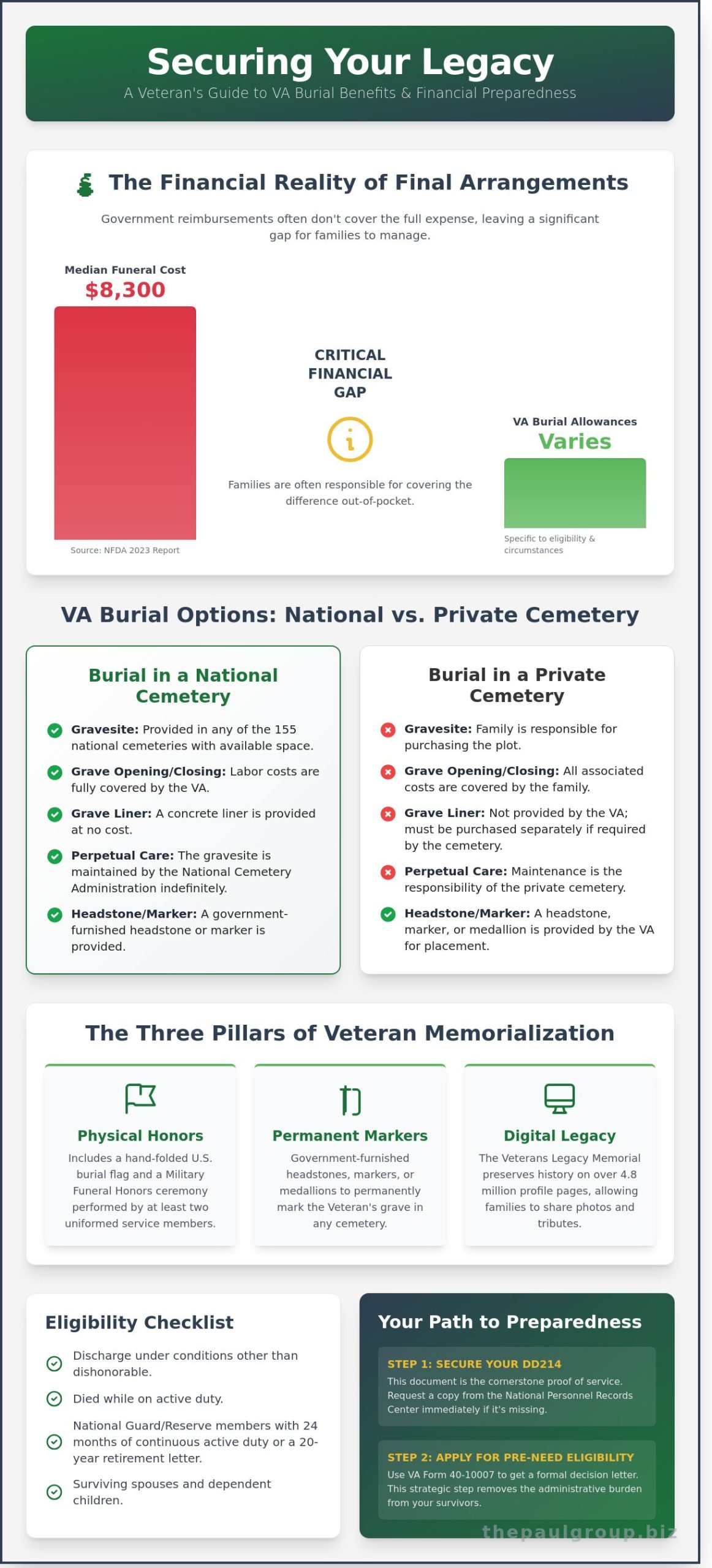
Core Benefits: At the heart of the package is a gravesite in any of the 155 national cemeteries with available space. This includes the opening and closing of the grave and perpetual care of the grounds, ensuring a lasting place of honor.
Memorial Items: To properly commemorate a Veteran’s service, the VA provides several key memorial items at no cost. These include a government-issued headstone, marker, or medallion; a U.S. burial flag; and a Presidential Memorial Certificate.
National vs. Private Cemetery: A critical distinction exists between burial in a VA National Cemetery and a private one. While the gravesite and its care are covered in a National Cemetery, the VA provides financial allowances for burials in private cemeteries, which may not cover the full cost.
The Three Pillars of Veteran Memorialization
The VA’s approach to honoring Veterans is built on three distinct pillars, each contributing to a lasting legacy.
According to U.S. Department of Veterans Affairs, this is a well-documented area of ongoing research and practical application.
Physical Honors: This includes the solemn presentation of the U.S. burial flag to the next of kin and the right to a Military Funeral Honors ceremony, featuring an honor guard of at least two service members who will play "Taps."
Permanent Markers: Whether buried in a national or private cemetery, every eligible Veteran is entitled to a government headstone, grave marker, or medallion. This ensures their service is permanently recognized at their final resting place.
Digital Legacy: The Veterans Legacy Memorial (VLM) provides a modern, digital platform for remembrance. This online memorial allows family and friends to share tributes, stories, and images, preserving the Veteran’s memory for future generations.
Determining Initial Eligibility for 2026
Eligibility is the gateway to all VA burial benefits. While the criteria are specific, they are designed to be inclusive of most individuals who have served in the U.S. Armed Forces.
General Requirements: The foundational requirement is a discharge under any condition other than dishonorable. This applies to most Veterans who completed their term of service.
Service Member Criteria: Active duty service members, as well as members of the National Guard and Reserves who meet specific federal service requirements, are also eligible.
Spouse and Dependent Eligibility: The burial benefits extend to surviving spouses and eligible dependent children, who may be interred in a National Cemetery alongside the Veteran, even if they pass away first.
How to Secure Your VA Burial Benefits: A Step-by-Step Application Guide
The application process for VA benefits requires precision and preparation. Taking proactive steps, particularly through pre-planning, can significantly reduce the administrative burden on your family during a difficult time. The key is to gather documentation and make decisions before the time of need.
Step 1: Document Verification and Pre-Planning
Strategic preparation is paramount. The single most important document for verifying eligibility is the DD Form 214, Certificate of Release or Discharge from Active Duty.
Research published by VA burial benefits shows that this is a well-documented area of ongoing research and practical application.
Locate or Request the DD214: If the original DD214 is lost or unavailable, a replacement can be requested from the National Archives. This process can take time, so it is best initiated well in advance.
Apply for Pre-Need Eligibility: The VA offers a Pre-Need Eligibility Determination program. By submitting an application (VA Form 40-10007), a Veteran can receive a decision letter confirming their eligibility for burial in a National Cemetery. This letter simplifies the process for the family immensely when the time comes.
Coordinate with a Funeral Director: Engage a funeral director who has experience with VA protocols. They can assist in coordinating with the National Cemetery Scheduling Office and ensuring all honors are correctly arranged.
Step 2: Choosing the Burial Location
The choice of a final resting place is a deeply personal decision. The VA system provides options to accommodate family wishes, whether in a national, state, or private cemetery.
Find a National Cemetery: In populous states like California, Texas, and Florida, it is important to identify a VA National Cemetery with available space for casketed or cremation burials. The VA website maintains an updated list.
Request Burial in a Private Cemetery: If a family plot or local private cemetery is preferred, the Veteran can still receive key VA honors, including the headstone or marker, burial flag, and Military Funeral Honors. The family would also be eligible for a plot-interment allowance to help offset costs.
Schedule the Service: Once a location is chosen, the funeral director will coordinate with the National Cemetery Scheduling Office to arrange the committal service and the Military Funeral Honors ceremony.
The Financial Gap: VA Allowances vs. Real-World Funeral Costs in 2026
A common misconception is that the VA covers all funeral expenses. In reality, VA burial allowances are partial reimbursements paid after the fact, not upfront payments. This often leaves families responsible for covering the initial costs and facing a significant financial gap between the government allowance and the total price of a modern funeral service.
Reimbursement Realities: Families must typically pay for funeral home services, a casket, and transportation out-of-pocket and then submit a claim to the VA for reimbursement.
Service-Connected vs. Non-Service-Connected: The reimbursement amounts differ significantly based on whether the Veteran’s death was related to their military service.
Inflation and Rising Costs: With funeral costs steadily increasing, the VA’s statutory caps on allowances may not be sufficient to cover the full expense of a service in a private funeral home.
Out-of-Pocket Expenses: Key costs such as caskets, cremation services, flowers, obituaries, and professional service fees from the funeral home are often not fully covered by VA allowances.
Service-Connected Death Benefits
For a Veteran whose death is determined by the VA to be a result of a service-related injury or disease, the financial support is more substantial. This is rightfully considered the highest tier of VA financial support. The VA will pay up to a maximum statutory amount for burial and funeral expenses. Additionally, the VA may cover the cost of transporting the Veteran’s remains from the place of death to the nearest National Cemetery with available space.
Research published by average funeral costs shows that this is a well-documented area of ongoing research and practical application.
Non-Service-Connected Death and Plot Allowances
For most Veterans, whose deaths are not service-connected, the VA provides a standard burial and funeral expense allowance. If the Veteran is hospitalized by the VA at the time of death, this amount is slightly higher. For those not buried in a National Cemetery, a separate plot-interment allowance is provided to help defray the cost of a private gravesite. When you compare these fixed allowances to market rates, the potential shortfall becomes clear. To understand the full scope of these expenses, it is wise to consult a guide on how much a funeral costs in 2026.
Navigating State Veterans Cemeteries and Local Honors in the Sunbelt
For many families, proximity is a key factor in choosing a final resting place. State-run Veterans Cemeteries offer an excellent alternative to the federal system, providing similar honors and burial benefits closer to home. States with large Veteran populations like Texas, California, and Florida have robust state-level programs.
The Texas and California Advantage
States often establish their own cemeteries to serve Veterans in regions not covered by a National Cemetery. These facilities are managed by the state but must adhere to the high standards set by the VA’s National Cemetery Administration.
Residency Requirements: State Veterans Cemeteries, such as those in Abilene, Mission, and Killeen, Texas, typically have a residency requirement for the Veteran.
Complementary System: These state-funded cemeteries work in concert with the federal system to ensure every Veteran has access to a dignified burial. They offer a powerful option for those seeking to secure their legacy, a goal best supported by a comprehensive plan like that detailed in our guide to burial insurance in Texas.
Coordinating with Regional VA Offices
Navigating the application process can be complex, but local resources are available to help. Veterans and their families are not alone in this process.
Local Representatives: Regional VA offices, such as those in Phoenix, AZ, or Riverside, CA, can provide direct assistance and information.
County Veterans Service Officers (CVSO): A CVSO is a highly valuable, free resource. These accredited professionals are trained to help Veterans and their families understand and apply for the full range of federal and state benefits they are entitled to.
Strategic Legacy Planning: Integrating VA Benefits with Final Expense Protection
VA burial benefits are a profound tribute to a Veteran’s service, but they are not a comprehensive financial plan. They are a foundation of honor upon which a secure legacy must be built. To protect surviving family members from the immediate and often unexpected financial burdens of a funeral, a strategic approach that integrates VA benefits with private insurance is essential.
Bridging the Gap: Final Expense Life Insurance is a tool specifically designed to bridge the financial gap left by VA allowances. It provides immediate, tax-free cash to beneficiaries to cover costs the VA does not, such as funeral home fees, caskets, flowers, and reception expenses.
The Paul Group Methodology: Our firm specializes in curating final expense plans that respect your Veteran status while providing absolute financial protection for your family. We align the strengths of government benefits with the flexibility and immediacy of private insurance.
The Wise Advisor Approach to End-of-Life Strategy
Relying solely on government benefits can inadvertently place a significant financial and emotional strain on your survivors at the worst possible time. A proactive, strategic approach is a final act of service to your family.
Mitigating Financial Strain: By planning ahead, you ensure that decisions are not made under duress and that funds are available precisely when needed.
Tailored Solutions: A burial insurance policy should be tailored to complement, not duplicate, federal allowances. This requires a nuanced understanding of both systems. For a deeper analysis, explore our overview of the best final expense insurance options for seniors.
Securing Your Family’s Financial Peace
The goal of strategic legacy planning is to transform uncertainty into peace of mind. For aging Veterans, policies with fixed rates and no medical exam requirements offer a straightforward path to securing that peace.
Predictability and Access: Final expense plans offer fixed premiums that never increase and a simplified application process. Many policies provide immediate coverage life insurance, ensuring protection is in place from day one.
Strategic Alignment: The Paul Group provides the critical strategic alignment between your hard-earned service honors and your family’s future financial security. We ensure your legacy is one of honor, dignity, and thoughtful preparation.
Frequently Asked Questions About VA Burial Benefits
**Does the VA pay for the entire funeral cost for a Veteran?
**
No. The VA provides fixed monetary allowances as a reimbursement, not an upfront payment. These amounts rarely cover the full cost of a private funeral service, which includes expenses like the casket, funeral home services, and transportation.
**How much is the VA burial allowance for a non-service-connected death in 2026?
**
For a non-service-connected death, the VA provides a set allowance for burial and funeral expenses and a separate plot-interment allowance if not buried in a National Cemetery. These rates are adjusted periodically for inflation; you should consult the official VA website for the exact figures for 2026.
**Can a Veteran’s spouse be buried in a VA National Cemetery?
**
Yes. The Veteran’s spouse, surviving spouse, and certain dependent children are eligible for burial in a VA National Cemetery, even if they pass away before the Veteran. Their headstone and the perpetual care of the gravesite are also provided at no cost.
**What is the difference between a National Cemetery and a State Veterans Cemetery?
**
National Cemeteries are federally funded and managed by the VA. State Veterans Cemeteries are state-funded and managed but must meet the same high standards as the national system. State cemeteries often have residency requirements for the Veteran.
**How do I apply for a Veteran headstone or marker for a private cemetery?
**
You can apply by submitting VA Form 40-1330, Application for Standard Government Headstone or Marker. This is typically done by the next of kin or a funeral director after the death. Proof of military service, such as the DD214, is required.
**What documents do I need to prove eligibility for VA burial benefits?
**
The most important document is the Veteran’s discharge paper, most commonly the DD Form 214. If you are applying for pre-need eligibility, you will also need to complete and submit VA Form 40-10007.
**Does the VA cover the cost of transporting a Veteran’s body?
**
Transportation costs are typically only covered if the Veteran’s death was service-connected. In such cases, the VA may pay to transport the remains from the place of death to a National Cemetery for burial.
**Can I pre-plan my VA burial honors before I pass away?
**
Yes. The VA’s Pre-Need Eligibility Determination program allows Veterans to apply in advance to confirm their eligibility for burial in a National Cemetery. This is a highly recommended step to ease the burden on your family.











Comments (2)
My go to spot for weekend betting now. The interface is clean and I never get lost looking for what I want. Customer service handled my first deposit question perfectly and I was playing within seconds. Really easy to use for both new and experienced folks. vnmc88
My evening routine now starts here because everything just flows so naturally. Promotions are clear and the staff actually follows up on my tickets. Whether I am on my laptop or phone the experience stays smooth and entertaining. Highly recommend giving it a try. phacecasino