

Preventing Family Arguments Over Funeral Costs: A Senior’s Strategic Checklist for 2026
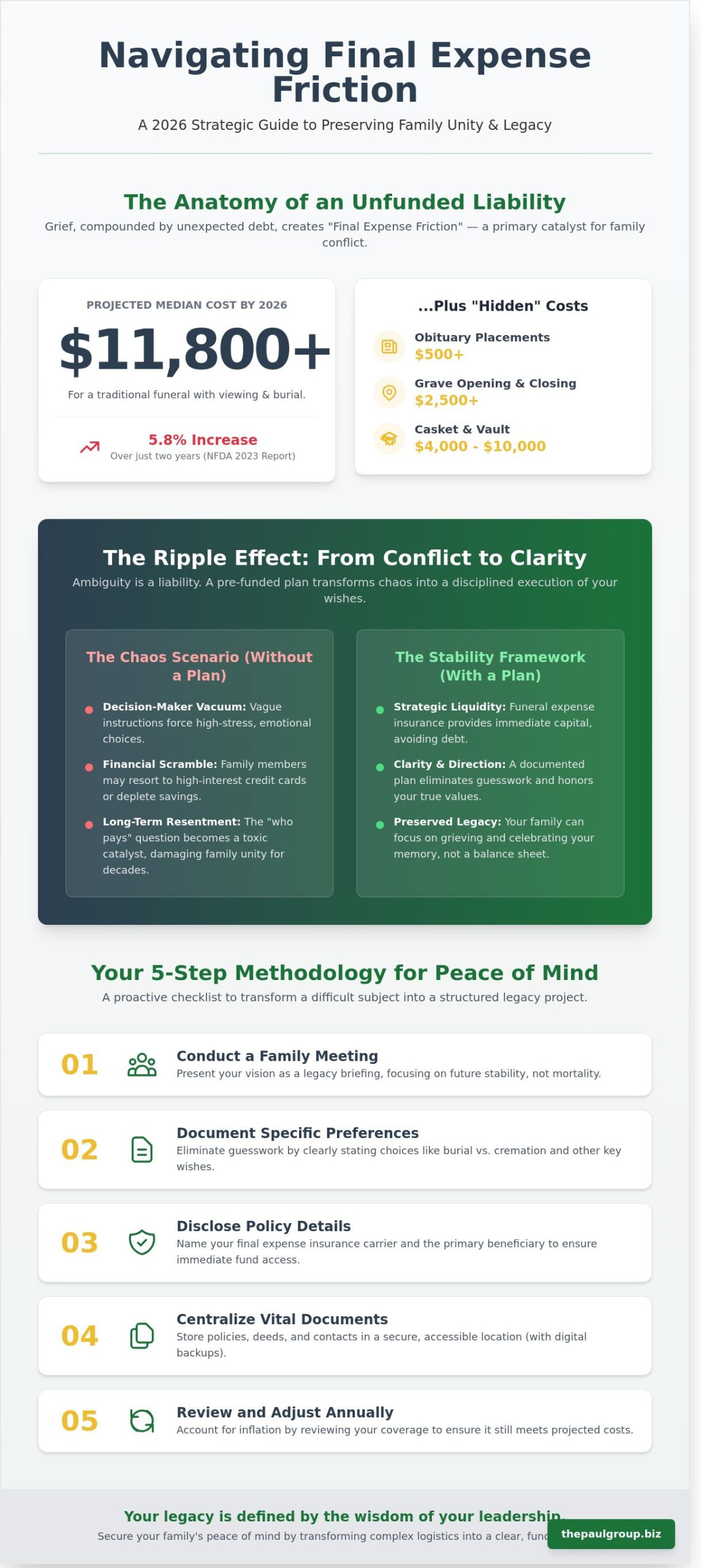
According to the National Funeral Directors Association 2023 report, the median cost of a funeral with a viewing and burial increased by 5.8% over just two years; by 2026, this trajectory suggests that a lack of financial preparation will be the primary catalyst for family friction. You’ve spent a lifetime building a legacy defined by stability and care, so it’s only natural to feel uneasy about the prospect of your final arrangements becoming a source of contention. Most seniors recognize that without a structured mechanism like funeral expense life insurance, the emotional weight of grief is often compounded by the sudden burden of unforeseen financial liabilities.
The Paul Group believes that true peace of mind isn’t found in a hope for the best, but in the rigorous optimization of your estate’s final obligations. We’ll provide a professional framework for neutralizing family conflict through strategic final expense planning and transparent communication. This article details our curated methodology for 2026, ensuring your wishes are fully funded and undisputed so your family can focus on honoring your memory rather than debating the logistics of a balance sheet.
Key Takeaways
- Discover how to mitigate “Final Expense Friction” through a curated communication framework designed to harmonize family expectations before a crisis occurs.
- Evaluate the strategic liquidity advantages of funeral expense life insurance to ensure immediate capital availability and prevent the accumulation of unexpected debt.
- Master the nuances of state-specific “Right to Control Disposition” laws to provide your survivors with a clear, legally sound roadmap for your final arrangements.
- Implement a strategic checklist for documenting burial and cremation preferences to eliminate ambiguity and preserve long-term family unity.
- Adopt a holistic methodology for end-of-life planning that transforms complex logistics into a sustainable legacy of structural integrity and peace.
The Emotional and Financial Anatomy of Funeral Conflict
End-of-life transitions often trigger systemic family breakdowns. In 2026, the intersection of inflation and emotional volatility creates a phenomenon we define as Final Expense Friction. This occurs when the immediate requirement for a dignified farewell meets the harsh reality of an unfunded liability. It’s the collision of profound grief and unexpected debt. When a senior passes without a curated financial strategy, the resulting vacuum is filled by panic rather than peace.
Clarity is a form of kindness. Vague instructions like “just do something simple” or “I don’t want a fuss” are psychologically damaging to survivors. These phrases provide no operational framework for decision-making. Instead, they force children to interpret silence while under extreme duress. Gaining a foundational understanding life insurance serves as the first step in mitigating this friction. Without a dedicated liquidity source, families are forced into hasty, high-stress choices that rarely align with the deceased’s true values.
The High Cost of Indecision
Financial transparency is the only antidote to funeral conflict. By 2026, industry data from the National Funeral Directors Association suggests the median cost of a traditional funeral with a viewing and burial will exceed $11,800. This figure excludes “hidden” fees such as obituary placements, which can cost $500 in major markets, or the $2,500 required for opening and closing a grave site. When money is tight, siblings often weaponize these costs. One child may view a premium casket as a final tribute, while another sees it as an irresponsible drain on a diminishing estate. This Decision-Maker Vacuum exists because no pre-funded methodology was established to govern the process.
The Ripple Effect on Family Legacy
Funeral debt is a toxic catalyst for long-term resentment between beneficiaries. If one sibling charges $15,000 to a high-interest credit card because the estate lacks liquidity, the resulting tension can last for decades. The Paul Group views the removal of the “who pays” question as a strategic imperative for family preservation. Utilizing funeral expense life insurance isn’t merely a purchase; it’s a tool for structural family stability. It transforms a chaotic scramble for funds into a disciplined execution of a plan. By securing funeral expense life insurance today, you ensure that your legacy is defined by the wisdom of your leadership rather than the burden of your departure.
The Strategic Communication Checklist for Seniors
Clarity is a gift. Ambiguity is a liability. For seniors looking toward 2026, the objective is to transform a difficult subject into a structured legacy project. This checklist provides a methodology for eliminating the friction that often arises from financial uncertainty.
- Step 1: Conduct a curated family meeting. Set an agenda that focuses on legacy goals rather than mortality. This meeting should be an executive briefing where you present your vision for the family’s future transition.
- Step 2: Document specific preferences. Eliminate guesswork by stating your choice between burial and cremation. Referencing the FTC’s funeral planning guide can help you understand the legal rights you have during this selection process.
- Step 3: Disclose policy details. Explicitly name the carrier of your funeral expense life insurance and identify the primary beneficiary. This ensures the funds are accessible the moment they’re required.
- Step 4: Centralize vital documents. Store your policy, deed to the cemetery plot, and contact lists in a secure, accessible location. Digital backups are essential in a 2026 landscape.
- Step 5: Review the plan annually. Inflation impacts the death care industry just as it does any other sector. Adjust your coverage to account for cost increases, which averaged 6.4% over the last five-year reporting period.
Facilitating the “Hard” Conversation
Introducing this topic requires a consultative approach. You aren’t asking for permission; you’re providing a briefing. Use this script to set the tone: “I’ve spent time optimizing my estate plan to ensure our family remains focused on our shared history rather than administrative logistics. I’d like to walk you through the framework I’ve built.”
If family members resist by saying they don’t want to talk about it, acknowledge the emotion but maintain the strategic focus. Explain that your goal is to protect their peace of mind during a high-stress period. By involving adult children as partners in the execution of the plan, you foster a sense of shared responsibility and respect.
The Documentation Framework
A formal Will is a legal necessity, but a “Letter of Instruction” is a strategic asset. While a Will handles asset distribution, a Letter of Instruction details your immediate wishes, such as the specific funeral home to contact. This document provides the operational nuance that legal forms often lack. Financial transparency today prevents legal battles tomorrow.
When selecting your coverage, understanding the best final expense insurance for seniors pros and cons 2026 allows you to choose a plan that offers immediate liquidity. This ensures your family isn’t forced to pay out-of-pocket while waiting for probate. Seniors seeking a more tailored strategic alignment for their final arrangements often find that early transparency is the most effective tool for long-term family harmony. Using funeral expense life insurance as a dedicated funding vehicle simplifies the entire transition for your heirs.
Financial Instruments to Neutralize Potential Disputes
Strategic clarity requires a shift from emotional reaction to financial precision. When a death occurs, the immediate need for capital often triggers friction between even the most cohesive families. Traditional savings accounts are structurally flawed for this specific transition; they frequently freeze upon the account holder’s death, remaining inaccessible for six to nine months during the probate process. Pre-paid funeral contracts present a different set of risks, primarily regarding portability and institutional stability. If a funeral home ceases operations or undergoes a corporate merger, the original terms of your agreement may face significant hurdles. Relying on funeral expense life insurance provides a more resilient alternative that bypasses these systemic bottlenecks.
The primary advantage of a dedicated policy is the Liquidity Advantage. While estates remain locked in legal review, insurance carriers typically release funds within 24 to 48 hours of claim approval. This speed ensures that your family doesn’t have to front thousands of dollars from their personal savings. Additionally, the death benefit is a tax-free wealth transfer. This tax-efficient structure allows you to preserve the value of your general estate for your heirs while ensuring the costs of your final arrangements are covered by a separate, optimized instrument. When evaluating burial insurance options, the focus should remain on the speed of payout and the stability of the carrier.
Final Expense Insurance: The Immediate Liquidity Tool
Simplified issue policies are specifically engineered to remove the friction of traditional underwriting. These plans bypass invasive medical exams, allowing seniors to secure coverage through a streamlined health questionnaire. The Paul Group prioritizes the Fixed Rate benefit within these structures. This ensures your premiums never increase as you age, protecting your financial plan from the inflation of the 2026 market. Utilizing a dedicated policy is superior to relying on a general estate because it creates a clear, legal path for funds that exists outside of complex probate litigation. For a deeper analysis of these tools, you may review our guide on the best final expense insurance for seniors.
The Role of the Beneficiary
Choosing a Strategic Beneficiary is as important as the policy itself. This individual functions as the chief operational officer of your final wishes. You should select a person who demonstrates organizational discipline and emotional resilience under pressure. The beneficiary holds a legal responsibility to use the funeral expense life insurance payout for its intended purpose, though the funds are technically paid directly to them. To ensure total alignment, you must provide this individual with a clear roadmap of your expectations. This partnership-driven approach transforms a potentially chaotic situation into a disciplined, executive process, leaving no room for family disputes over funding or logistics.
Navigating State-Specific Regulations and Costs
Geography dictates price. While the National Funeral Directors Association (NFDA) reported a national median cost of $8,300 for a funeral with burial in 2023, regional variables create significant deviations. A strategic approach to funeral expense life insurance requires an understanding of the legal framework governing your specific residence. State statutes, such as California Health and Safety Code Section 7100, define the “Right to Control Disposition,” establishing a strict hierarchy of who makes final decisions. Texas and Florida maintain similar but distinct protocols; Texas allows individuals to designate an agent for body disposition through a specific state-sanctioned form, whereas Florida law prioritizes the wishes of the deceased if expressed in a written, notarized document.
Operational costs shift across state lines. In Illinois, burial plot prices in metropolitan Chicago can exceed rural Illinois rates by 400%. Conversely, Arizona’s desert landscape and high demand for retirement communities have driven a 15% increase in memorial park fees over the last three years. These discrepancies aren’t merely logistical; they’re financial hurdles that require precise planning to ensure your funeral expense life insurance policy remains sufficient for your local market.
Regional Cost Drivers in 2026
Market dynamics in 2026 reflect extreme variance. Nevada and Hawaii face acute land scarcity, driving cemetery costs significantly higher than in Montana, where land is more abundant. Hawaii’s 2024 cost of living index, which is 80% higher than the national average, directly inflates the price of funeral services and transportation. The Paul Group utilizes a curated methodology to analyze these regional shifts, ensuring your coverage aligns with local inflation. We leverage the Federal Trade Commission’s “Funeral Rule,” which mandates that providers give you an itemized price list, to help our clients optimize their spending and avoid unnecessary bundles.
- California: High regulatory oversight ensures price transparency but increases administrative overhead for providers.
- Texas: Strong emphasis on “Right to Control” documentation prevents probate delays.
- Florida: High competition among cremation providers can lower costs if strategic choices are made early.
State-Level Financial Protections
Consumer protection is managed at the state level through Guaranty Associations. These entities provide a safety net, ensuring that if an insurance carrier faces insolvency, your death benefit remains protected up to state-defined limits, often reaching $300,000 in many jurisdictions. In New Mexico, Colorado, and Oregon, state-level licensing requirements for agents are particularly rigorous, demanding a high standard of ethical conduct. The Paul Group’s commitment to excellence means our advisors are synchronized with these local mandates, providing bespoke advice that respects the structural integrity of your state’s financial laws.
Our Group identity is built on the intersection of human leadership and operational precision. We don’t offer off-the-shelf solutions because a plan that works in the Pacific Northwest may fail in the Southeast. To secure your family’s future, you must understand the nuances of policy selection. Review our detailed analysis of the best final expense insurance for seniors pros and cons 2026 to begin your strategic alignment.
The Paul Group Methodology: Curated Peace of Mind
Legacy planning requires a level of precision that generic insurance models simply cannot provide. The Paul Group Methodology is built on the “Wise Advisor” framework, a philosophy that prioritizes intellectual rigor over high-pressure sales. Since our founding in 2009, we’ve dedicated our expertise exclusively to the final expense niche, understanding that seniors deserve a specialized approach to their unique financial challenges. Our approach is defined by a commitment to excellence that avoids the hyperbole of mass-market advertising, opting instead for a grounded, substance-heavy presence that respects your intelligence.
We curate funeral expense life insurance plans that bypass the traditional friction of medical exams. This methodology emphasizes immediate coverage options, ensuring that protection is active when it’s needed most. Our focus remains on creating a partnership-driven relationship where we serve as a seasoned strategic partner, guiding you through complex organizational decisions with quiet confidence and clarity. We believe that your most complex challenges are solvable through disciplined intervention, taking the necessary time to diagnose your family’s specific needs before prescribing a strategic solution.
A Bespoke Approach to Senior Protection
Generic term life policies often fail to address the specific needs of seniors in 2026. The Paul Group Signature involves a rigorous vetting process that favors tailored solutions over off-the-shelf products. We focus exclusively on final expense because it provides the structural integrity necessary for long-term stability. This specialization allows us to navigate the nuances of policy language that others might overlook. You can explore our detailed analysis of the best final expense insurance for seniors pros and cons 2026 to understand how we differentiate our curated selections from standard market offerings.
Securing Your Family’s Future Today
Securing a legacy isn’t a mere transaction; it’s a structural evolution of your family’s financial health. Our agents located in Florida, Texas, and Arizona provide local, grounded support that reflects the specific regulatory and cultural environments of those regions. We move beyond the superficial to offer a strategic consultation that aligns your personal values with operational reality. By choosing this partnership, you transform the inherent uncertainty of the future into a state of organizational clarity. It’s time to replace family tension with a disciplined plan that protects your estate and your loved ones through funeral expense life insurance. This logical path forward ensures that your final wishes are executed with the dignity they deserve.
Securing Your Family’s Emotional and Financial Legacy
The transition from complexity to clarity requires a disciplined approach to legacy planning. By implementing a strategic communication checklist, you neutralize the emotional volatility often associated with end of life logistics. Utilizing a robust funeral expense life insurance policy ensures that your family remains focused on your memory rather than the burden of immediate liquidity. Our methodology emphasizes the intersection of human leadership and operational systems, providing a structural framework that respects your unique preferences and prevents future disputes.
Since 2009, The Paul Group has served as a trusted senior advisor, curating peace of mind through partnerships with A+ rated carriers. We bring localized expertise to clients across 15+ states, ensuring your plan aligns with specific regional regulations and the economic landscape of 2026. Your legacy shouldn’t be a source of friction; it’s a final gift of order and love that protects your heirs from unnecessary hardship. We’re here to guide you through every nuance of this vital transformation, providing the intellectual rigor your family deserves.
Request Your Bespoke Final Expense Consultation with The Paul Group
You’ve worked hard to build a life of stability, and now’s the time to ensure that stability endures for generations to come.
Frequently Asked Questions
What is the number one cause of family arguments over funerals?
Financial ambiguity regarding the allocation of assets is the primary driver of familial discord. According to the 2023 NFDA Member Survey, the median cost of a funeral reached $8,300, a figure that often catches unprepared families by surprise. This lack of fiscal transparency creates a vacuum where grief and financial stress collide. The Group advocates for a documented financial strategy to eliminate this friction and ensure operational clarity during emotional transitions.
Can my children use my life insurance to pay for the funeral immediately?
Traditional life insurance proceeds aren’t accessible immediately because carriers require a certified death certificate, a process that typically takes 30 to 60 days. To bypass this liquidity gap, you can utilize a funeral assignment. This legal mechanism allows the beneficiary to transfer a portion of the death benefit directly to the funeral home. It ensures service costs are covered without forcing your survivors to utilize high-interest credit cards.
Is final expense insurance better than a pre-paid funeral plan?
Final expense insurance provides superior strategic flexibility compared to pre-paid plans because the death benefit is portable and liquid. Pre-paid contracts often lock you into a specific funeral home, which becomes problematic if the business closes or you relocate. A robust funeral expense life insurance policy ensures that your capital remains under your family’s control. This bespoke approach allows for tactical adjustments as service preferences evolve over time.
What happens if my family disagrees on my burial preferences?
If your family disagrees, the legal right to decide falls to the individual designated in your Appointment of Agent to Control Disposition form. Without this document, state laws typically prioritize a surviving spouse followed by a majority of adult children. This hierarchical structure often leads to litigation and delays. We recommend a proactive legal alignment to ensure your instructions are executed without internal resistance or secondary guessing.
Does final expense insurance require a medical exam in 2026?
Most final expense policies in 2026 don’t require a physical medical exam because carriers now utilize sophisticated algorithmic underwriting. Instead of blood work, insurers analyze your prescription history and MIB records to assess risk instantly. This methodology streamlines the application process. It allows seniors with managed health conditions to secure funeral expense life insurance in as little as 24 hours through a simplified digital interface.
How much coverage do I actually need to prevent family debt?
You should secure a minimum of $10,000 to $15,000 in coverage to account for the NFDA’s reported $8,300 median cost plus 3% annual inflation. This buffer protects your family from the 21% price increase observed in the funeral industry over the last decade. A calculated surplus also covers ancillary expenses like floral arrangements and travel for distant relatives. Precise planning prevents the accumulation of debt that often burdens grieving survivors.
Who should I name as my beneficiary to avoid conflict?
You should name a single, fiscally responsible beneficiary who understands their role as the primary executor of your final wishes. Naming multiple children as co-beneficiaries often triggers administrative delays and emotional gridlock. The Group suggests a curated approach where one individual handles the proceeds while a secondary contingency beneficiary is listed for structural redundancy. This ensures a clear line of command and minimizes the potential for sibling disputes.
What if I move to a different state after purchasing my policy?
Your policy remains fully effective regardless of where you reside within the United States because life insurance is a portable financial instrument. Unlike localized pre-need contracts, these policies aren’t tied to a specific geographic provider or funeral facility. If you relocate in 2026 or beyond, your coverage moves with you. This geographic independence provides a layer of long-term stability for seniors who plan to transition to different states during retirement.











Comments (5)
Logging in has never been smoother than here. I appreciate how secure the connection feels while I am placing bets. The daily rewards keep me coming back and the games are top notch. y2k168login
The prediction and betting combo here is exactly what I needed for my casual play routine. No cluttered menus just straight to the point with clear daily recommendations. I appreciate that they never oversell their chances and keep the tone honest. I keep this bookmarked in my daily routine betminespronosticos
The loyalty program actually feels like a heartfelt thank you instead of just numbers. Transactions glide smoothly and the game updates keep the experience alive. I always invite my circle to join mycyl88 for the long haul
As a devoted basketball follower I love how precise the match insights are on this page. The breakdowns cut through the noise and help me track trends without feeling overwhelmed. It feels like having a seasoned analyst right next to me during every tip off. pronosticodenba
Yo, f8pet has some pretty damn cool slots and the site looks sick. Give it a check, it’s legit. Look at this link f8pet.