Table of Contents
The Strategic Necessity of the Final Expense Conversation
Leaving a legacy requires more than just good intentions; it demands a disciplined financial architecture. For modern senior families, the distinction between a legacy and a debt burden often hinges on a single, proactive dialogue. Waiting for a health crisis to initiate talking to parents about final expense is a failed financial strategy that compromises both capital and emotional stability. By the year 2026, the economic landscape of end-of-life care in states like California, Texas, and Florida will necessitate immediate liquidity to prevent the erosion of estate assets. This isn’t merely about burial costs; it’s about the sustainable scaling of a family’s financial health across generations.
Strategic alignment in estate planning ensures that the transition of leadership within the family remains seamless. Specialized final expense insurance acts as a curated tool designed for this exact purpose. It provides the necessary cash flow to settle immediate obligations without forcing the liquidation of long-term investments or family property during a period of market volatility. The Paul Group views this as a critical component of a holistic wealth preservation methodology, ensuring that the final chapter of a parent’s life is defined by dignity rather than a frantic search for funds.
Understanding the Rising Cost of Finality
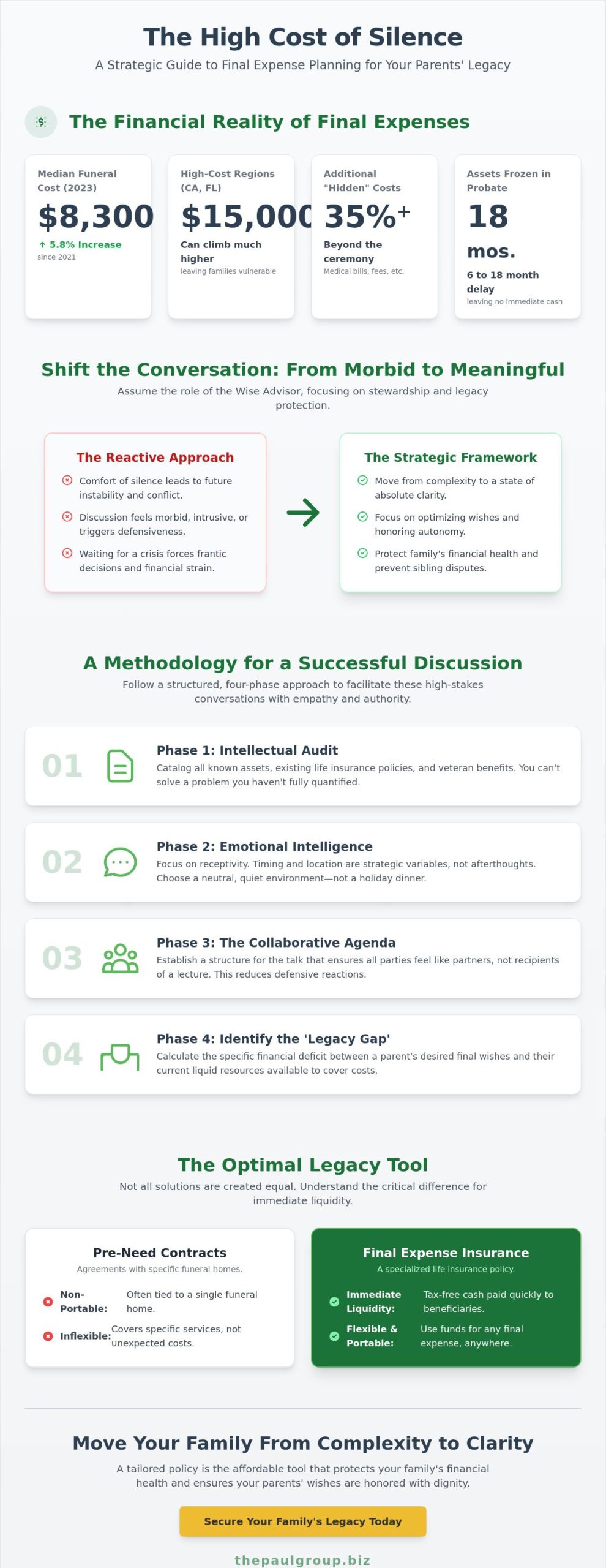
The financial scale of end-of-life logistics has shifted. In 2024, the National Funeral Directors Association reported median funeral costs exceeding $8,300, a figure projected to climb as inflationary pressures continue into 2026. In high-density regions like Los Angeles or Phoenix, comprehensive services frequently reach $12,000 to $15,000. Beyond the visible ceremony, families face 25% to 35% in additional “hidden” costs, including unsettled medical bills, transport fees, and estate settlement charges. Traditional savings accounts are an unreliable solution for these immediate needs. In many jurisdictions, these assets are frozen during the probate process, which often lasts between 6 and 18 months, leaving beneficiaries without accessible capital when they need it most.
The Psychological Shift: From Morbid to Meaningful
Approaching this topic requires a shift from a morbid perspective to one of meaningful stewardship. When talking to parents about final expense, you assume the role of the Wise Advisor, focusing on the optimization of their wishes rather than the finality of the event. This proactive methodology prevents the decision fatigue that often triggers conflict between siblings during a crisis. A well-structured plan, such as those detailed in our analysis of the best final expense insurance for seniors, fosters long-term stability. By securing a bespoke policy today, you honor your parents’ autonomy while protecting the family’s structural integrity for the future.
Preparing for the Discussion: A Methodology for Success
Strategic planning requires a disciplined approach. Success in talking to parents about final expense relies on a structured framework rather than a series of ad-hoc comments. Randomly broaching the subject often triggers immediate resistance. The Paul Group utilizes a specific four-phase methodology to facilitate these high-stakes conversations with intellectual rigor and emotional care.
- Phase 1: Intellectual Audit. Catalog all known assets, existing life insurance policies, and veteran benefits. You can’t solve a problem you haven’t fully quantified.
- Phase 2: Emotional Intelligence. Focus on the external factors that influence receptivity. Timing and location are strategic variables, not afterthoughts.
- Phase 3: The Collaborative Agenda. Establish a structure for the talk that ensures all parties feel like partners. This reduces the likelihood of defensive reactions.
- Phase 4: Identifying the ‘Legacy Gap.’ Calculate the specific financial deficit that exists between a parent’s desires and their current liquid resources.
The Pre-Talk Checklist for Adult Children
Before initiating the dialogue, perform comprehensive due diligence. Regulations vary significantly by geography; for instance, the New Mexico Funeral Services Act governs how providers operate, while Arizona has its own distinct statutes regarding the disposition of remains. Understanding these local nuances prevents misinformation. You must also distinguish between “Pre-Need” contracts, which are often non-portable agreements with specific funeral homes, and “Final Expense” insurance, which offers immediate, flexible liquidity. The Legacy Gap is the shortfall between final wishes and available liquid cash. Reviewing the pros and cons of final expense insurance helps clarify which vehicle best bridges this deficit.
Setting the Stage for a Boardroom-Level Discussion
Context is everything. A holiday dinner is the least effective time for financial planning. The emotional weight of the season creates unnecessary friction. Instead, select a neutral, quiet environment where distractions are minimal. This creates a space for strategic alignment rather than reactive defense. When opening the discussion, utilize the “I need your help” gambit. This shifts the power dynamic. It positions your parents as the experts of their own legacy, inviting them to share their end-of-life wishes with clarity and authority. This approach transforms a potentially grim topic into an exercise in family leadership. If you require a more curated strategy for your family’s unique situation, our advisors can provide the necessary framework for these essential transitions.
Navigating the Conversation: Scripts and Strategic Pivots
Initiating a dialogue about end-of-life planning requires more than empathy; it demands a high-level strategic approach. At The Paul Group, we view these discussions as an exercise in organizational alignment for the family unit. The goal is to transition from a state of ambiguity to one of structured clarity. When talking to parents about final expense, your primary objective is to position yourself as a partner in their legacy, not an auditor of their mortality. This distinction is vital for maintaining their dignity while securing the family’s financial future.
Success depends on matching your communication style to your parent’s specific psychological profile. Analytical parents often respond better to a direct, data-driven methodology that highlights the efficiency of tax-free cash. More private individuals may require an indirect pivot that focuses on the administrative burden left for beneficiaries. By providing immediate liquidity, a curated final expense plan ensures that the 2023 NFDA reported median funeral cost of $8,300 doesn’t deplete the estate’s liquid assets during a period of emotional transition.
Opening Lines That Build Partnership
- The Legacy Script: “I’ve been thinking about the impact you’ve had on this family. I want to make sure your final wishes are executed exactly as you envision them, without any financial friction for the grandkids.”
- The Practical Script: “I’m currently streamlining my own estate documents and realized I don’t have a clear map of your preferences. Can we sit down to organize the logistics so everything stays in alignment?”
- The Storytelling Script: “The 2023 NFDA report shows funeral costs have increased 5.8 percent since 2021. I saw a neighbor struggling with these unexpected expenses last month, and it made me want to ensure we have a locked-in strategy for you.”
Handling Common Parent Objections
Resistance is often a mask for underlying concerns regarding cost or health. When a parent claims it’s too expensive, pivot the conversation toward price protection. Most final expense policies offer fixed rates that never increase, effectively hedging against future inflation. If they worry about health qualifications, emphasize that many modern solutions require no medical exams. You can explore the best final expense insurance for seniors to find a plan tailored to their specific health profile.
If they insist they have it handled, employ expert curiosity. Ask where the policy documents are stored or if the benefit is paid in a lump sum. This isn’t about doubt; it’s about verifying that the current plan provides the necessary speed and tax advantages. When talking to parents about final expense, remember that you’re solving for stability. You aren’t just discussing a policy; you’re engineering a seamless transition of responsibility that honors their life’s work.
Selecting the appropriate financial vehicle requires a move from reactive saving to proactive asset protection. While many families rely on personal savings or certificates of deposit, these assets are often vulnerable to liquidation for long-term care or unexpected medical bills. Term life insurance, though common, carries a significant risk of expiration before the benefit is actually required. When talking to parents about final expense strategies, it’s essential to frame the policy as a ring-fenced asset designed for a single, critical purpose. Unlike traditional investments, these policies offer a guaranteed payout that isn’t subject to market fluctuations or the complexities of asset seizure during Medicaid spend-down processes.
Strategic planning involves weighing the immediate liquidity of a policy against the slow accumulation of a savings account. A dedicated policy ensures that the full face value is available from the moment the first premium is paid, whereas a savings account might take decades to reach the same amount. You can explore the pros and cons of final expense insurance for seniors in 2026 to understand how these specialized tools provide a superior safety net compared to standard retail banking products.
The ‘No Medical Exam’ Advantage for Seniors
The traditional underwriting process often serves as a barrier for seniors with manageable health conditions. Simplified issue policies eliminate the need for invasive medical exams, blood draws, or physician statements. This streamlined methodology allows for a rapid assessment of risk based on a curated health questionnaire. Approvals are frequently secured within 24 to 72 hours, providing a level of agility that traditional life insurance cannot match. By focusing on simplified issue plans, you ensure your parents aren’t disqualified by their health history, securing “Day 1” coverage that avoids the common two-year waiting period trap found in lesser products.
Financial Integrity: Fixed Rates and Guaranteed Benefits
Stability is the cornerstone of any successful legacy plan. For parents living on a fixed income, the threat of rising costs is a constant concern. Final expense policies are built with structural integrity; they feature premiums that are locked in at the time of purchase and can never increase. This protection is vital as we approach 2026, where inflationary pressures continue to impact the cost of services. According to 2023 data from the National Funeral Directors Association, the median cost of a funeral has risen steadily over the last decade. A non-cancelable policy ensures that the coverage remains in force regardless of changes in health or age. Furthermore, because these benefits are paid directly to a beneficiary, they bypass the probate process entirely, providing immediate liquidity within days rather than the months or years often required for estate settlement.
Implementation: Securing the Future with The Paul Group
Successfully talking to parents about final expense requires a disciplined transition from abstract dialogue to concrete implementation. The Paul Group provides the structural framework necessary to convert these sensitive family discussions into a legacy. We don’t view insurance as a mere transaction; we treat it as a critical component of a family’s broader financial architecture. Since our founding in 2009, we’ve focused on providing the stability and intellectual rigor required to manage these end-of-life complexities with grace.
Our approach is rooted in strategic alignment. We match your family’s specific objectives with high-level underwriting solutions that prioritize speed and reliability. Whether you’re coordinating across state lines or managing local logistics, our team ensures that the transition from planning to protection is seamless. We aim for total clarity, removing the ambiguity that often surrounds senior life insurance products.
Bespoke Coverage for Diverse Needs
Standardized, off-the-shelf policies rarely meet the nuanced requirements of a legacy-minded family. The Paul Group utilizes a “Wise Advisor” partnership model to curate coverage that reflects specific regional and cultural traditions. A family in California may face different logistical pressures than one in Florida; our regional expertise allows us to navigate these geographical variables effectively. We analyze the intersection of your family’s heritage and modern financial requirements to ensure the chosen policy performs exactly as intended when it’s needed most.
- Regional Insight: Specialized knowledge of burial and cremation regulations from the West Coast to the Atlantic.
- Historical Stability: A track record of excellence dating back to our 2009 inception.
- Cultural Tailoring: Plans designed to respect and fund specific funeral rites and community traditions.
Next Steps: Taking Action Today
The path toward optimization begins with a curated consultation. During this briefing, our agents perform a holistic assessment of your parents’ current health and financial goals. We specialize in simplified issue products, which means we can often secure a strategic quote without the requirement of a physical medical exam. This methodology reduces the friction typically associated with senior insurance applications and allows for rapid approval cycles. To facilitate a smooth process, have the following items ready:
- Legal identification and social security details for the primary insured.
- A comprehensive list of current medications and health history.
- Contact information for the designated beneficiaries to ensure strategic alignment.
Securing a policy is the final step in closing the loop on your family’s legacy planning. It transforms a difficult conversation into a documented guarantee of support. Don’t leave your family’s structural integrity to chance. Partner with The Paul Group to secure your parents’ legacy today and ensure that your strategic vision for the future is fully realized.
Transitioning From Uncertainty to Strategic Clarity
Securing a family’s future requires more than just good intentions; it demands a disciplined methodology and clear communication. By prioritizing the discussion now, you transform a potentially difficult subject into a profound act of leadership. Successful talking to parents about final expense shouldn’t be an exercise in anxiety. It’s a strategic alignment of resources that ensures their legacy remains defined by their life’s achievements rather than logistical burdens. This proactive stance provides the structural integrity your family deserves.
Since 2009, The Paul Group has specialized in these high-stakes transitions, providing the expertise needed to navigate complex family dynamics with grace. Our approach eliminates the friction of traditional insurance, offering senior-qualified plans that require no medical exams. We currently provide these curated solutions across 15+ states, including California, Texas, and Florida, ensuring your strategy meets specific regional requirements. This isn’t a simple transaction; it’s a partnership rooted in excellence. You’re building a foundation of stability that will support your family for generations to come.
Secure your family’s legacy with a bespoke Final Expense plan from The Paul Group
Frequently Asked Questions
Is it disrespectful to ask my parents about their funeral insurance?
Initiating a dialogue regarding end-of-life logistics is an act of profound respect and strategic stewardship. Talking to parents about final expense planning ensures their legacy remains unburdened by administrative friction or unexpected debt. Research from the National Funeral Directors Association indicates that 62.1% of consumers recognize the value of pre-planning, yet only 21.4% have actually done so. This conversation transforms a sensitive topic into a collaborative roadmap for long-term familial stability.
What if my parents have pre-existing health conditions?
Pre-existing conditions don’t preclude your parents from obtaining robust protection through specialized underwriting. Most carriers offer “guaranteed issue” or “graded benefit” structures designed specifically for individuals with chronic health histories or previous medical incidents. These specialized methodologies ensure that even those with high-risk profiles can secure a policy. It’s a matter of strategic alignment between their health profile and the right carrier’s underwriting appetite to optimize their long-term security.
How much final expense coverage do seniors typically need in 2026?
Seniors should target coverage between $15,000 and $20,000 to account for the projected 3.4% annual increase in funeral costs through 2026. The NFDA reported the median cost of a funeral with burial was $8,300 in 2023, but when you factor in professional fees and cemetery costs, the total often exceeds $12,000. Selecting a curated policy size allows families to address these rising expenses while maintaining a financial cushion for lingering medical bills or legal fees.
Can I pay for my parents’ final expense policy myself?
You can absolutely assume the role of payor on a policy where your parent is the insured party. This arrangement is a common strategic maneuver for adult children who wish to guarantee the policy’s continuity without burdening their parents’ fixed income. You’ll need their consent and participation during the application process to establish insurable interest. It’s a proactive investment in your own financial peace of mind as much as it’s a gift to them.
What is the difference between burial insurance and final expense insurance?
Burial insurance and final expense insurance are functionally identical; both refer to whole life policies with smaller death benefits. The distinction lies primarily in how the funds are intended to be utilized by the beneficiaries in your strategic plan. While “burial” implies a specific use, final expense policies provide a holistic cash payout that can cover everything from cremation to outstanding credit card balances. This flexibility allows for a more comprehensive approach to estate settlement.
How fast does a final expense policy pay out after a death?
Most top-tier carriers facilitate a payout within 24 to 48 hours once the death certificate and claim forms are verified. This rapid liquidity is essential for managing the immediate operational costs associated with a passing. Unlike traditional life insurance which can linger in probate for months, these policies are engineered for speed. This swift intervention prevents the need for families to deplete their personal savings during an already stressful period of transition.
What happens if my parents already have a small policy?
If your parents already hold a small policy, it’s wise to treat it as a foundational layer that likely requires optimization. Many legacy policies from 20 years ago haven’t kept pace with the 40% increase in service costs seen over the last decade. You can bridge this fiscal gap by adding a supplemental policy. This ensures that the total death benefit aligns with modern economic realities rather than outdated valuation models from previous generations.
Can we get coverage in states like Texas or Arizona if we live elsewhere?
Coverage is fully portable, meaning a policy secured for a parent in Texas or Arizona remains valid even if you live in a different jurisdiction. The Group specializes in navigating these interstate nuances to ensure seamless strategic alignment across geographic boundaries. As long as the policy is active, the beneficiary receives the funds regardless of where they reside. This geographic flexibility is a core component of a resilient, modern legacy plan for mobile families.










Leave a Reply