


burial insurance program for seniors
If your final legacy was calculated this morning, would it be measured in the wisdom you’ve shared or the immediate financial liabilities left for your children to resolve? You likely understand that meticulous preparation is the only path to family tranquility, yet the intricacies of selecting a burial insurance program often feel like a hurdle rather than a solution. With the National Funeral Directors Association reporting that median funeral costs have surpassed $8,300, the stakes for your estate’s structural integrity are high. It’s common to feel hesitation when faced with opaque medical requirements or a delayed claims process that leaves loved ones vulnerable.
The Paul Group believes that end-of-life planning deserves the same strategic alignment as any high-stakes corporate transition. We promise to move you beyond confusion by providing a holistic framework for choosing a policy that fits your unique DNA. This guide details the methodology for evaluating policy types, offers a precise checklist for claims management, and introduces a partnership-driven approach to estate logistics. By the end of this briefing, you’ll have the clarity needed to transform a complex financial necessity into a structured, sustainable gift for the next generation.
Key Takeaways
- Reposition end-of-life planning as a sophisticated financial asset by mastering the structural advantages and fiscal stability of a burial insurance program.
- Optimize the legacy transfer process through a strategic framework for pre-organizing documentation, ensuring an efficient and seamless claims experience for beneficiaries.
- Navigate the intricacies of regional funeral cost variances and state-specific regulatory protections within high-impact markets like Texas, California, and Florida.
- Transition from transactional coverage to a curated partnership that emphasizes the structural integrity and long-term stability of your estate planning.
Defining the Burial Insurance Program as a Strategic Asset
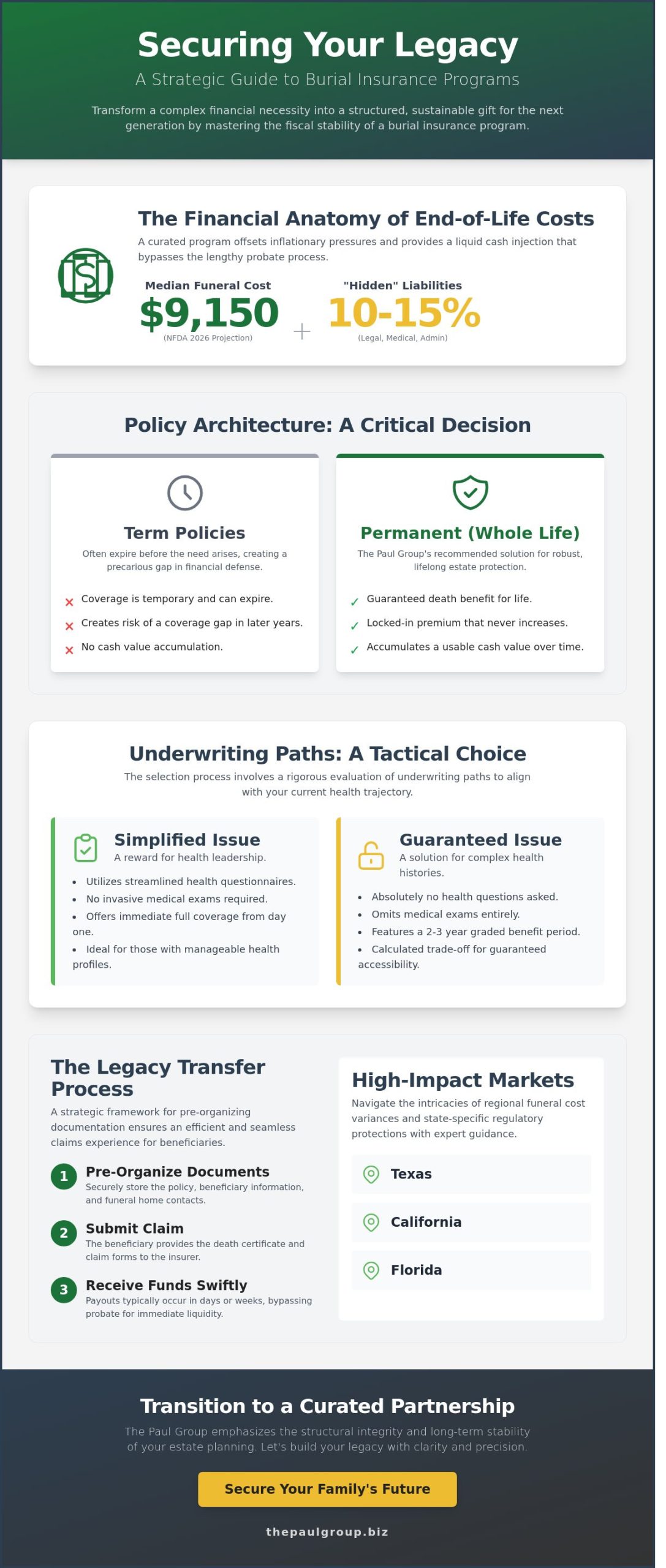
Legacy planning requires more than sentiment; it demands structural integrity. A burial insurance program serves as a foundational pillar in this architecture. While many view these policies through a narrow lens, they are fundamentally specialized whole life contracts designed for liquidity at the exact moment of need. Understanding what is life insurance in its broadest sense allows seniors to appreciate how these niche products offer permanent protection. In the 2026 market, the distinction between “Final Expense” and “Burial Insurance” has evolved. Final expense often implies a broader scope covering debt and taxes, while a burial insurance program specifically targets the immediate logistics of mortality.
The Paul Group advocates for permanent solutions over term alternatives. Term policies often expire before the need arises, creating a precarious gap in a senior’s financial defense. Permanent whole life solutions provide a locked-in premium and guaranteed death benefit. This approach ensures that the strategy remains robust regardless of market volatility or advancing age. Immediate coverage programs offer full benefits from day one, whereas graded benefit programs provide a tiered payout structure. Choosing between them is a matter of strategic alignment with your current health trajectory and long-term estate goals.
The Financial Anatomy of End-of-Life Costs
Precision in financial planning requires looking at the raw data. Based on historical trends from the National Funeral Directors Association, the median cost of a funeral has risen steadily, reaching approximately $9,150 by 2026. This figure does not account for the “hidden” expenses that often paralyze an estate. Legal fees, unresolved medical bills, and administrative probate costs can add an additional 10% to 15% to the total liability. A curated program offsets these inflationary pressures, providing a liquid cash injection that bypasses the lengthy probate process. This methodology ensures that your family maintains operational stability during a period of transition.
Simplified vs. Guaranteed Issue: A Tactical Choice
The selection process involves a rigorous evaluation of underwriting paths. Simplified issue programs utilize streamlined health questionnaires to provide immediate coverage for those with manageable health profiles. It’s a reward for health leadership. Conversely, guaranteed issue programs offer a solution for complex health histories, omitting medical exams entirely. These policies typically feature a two-year graded period, representing a calculated trade-off between accessibility and immediate full-face value. We analyze these options through our best final expense insurance for seniors pros and cons 2026 framework. This ensures the intersection of human health and operational policy systems is managed with professional discipline.
The Strategic Architecture of Burial Insurance Policies
A robust burial insurance program acts as a financial firewall, protecting a family’s liquidity during a period of transition. Fixed premium structures ensure that the cost of protection remains static, regardless of market volatility or the policyholder’s advancing age. This fiscal stability allows for precise long-term budgeting, removing the variables that often plague less disciplined financial products. The 2023 NFDA report indicates that the median cost of a funeral with a viewing and burial is $8,300, a figure that underscores the need for structured planning. Evaluating the best final expense insurance for seniors pros and cons 2026 allows for a bespoke fit that aligns with your broader financial goals.
The secondary benefit of a whole life burial insurance program is the accumulation of cash value. Over time, these policies build a modest reserve that the policyholder can access if financial priorities shift, providing a layer of utility beyond the death benefit itself. The beneficiary serves as the tactical executor of the policy, tasked with managing the immediate end-of-life costs that often arise within 48 hours of a passing. By designating a trusted individual, you ensure that the policy’s liquidity is deployed with surgical precision, honoring the original intent of the coverage.
Immediate Coverage vs. Waiting Periods
The two-year waiting period found in graded policies represents a significant strategic risk. If the policyholder passes away during this window, the benefit is often limited to a return of premiums plus interest, rather than the full face value. Simplified issue policies eliminate this uncertainty by providing Day 1 protection through a streamlined medical questionnaire. This boardroom-level view of policy maturity ensures that the death benefit is available exactly when the organization of the estate requires it most. Choosing a Day 1 coverage plan is an optimization move that prioritizes immediate stability over deferred results.
Bespoke Customization of Policy Riders
Customization is the hallmark of a premium insurance strategy. Accelerated death benefits function as an operational safeguard, allowing the policyholder to access a portion of the funds if a terminal illness is diagnosed. This liquidity can be used to manage medical expenses or facilitate care transitions. Accidental death supplements add another layer of protection, often doubling the payout under specific conditions. Tailoring the policy DNA ensures the coverage matches the unique legacy and risk profile of the individual. You can consult with our specialists to refine these details and ensure your strategy is fully optimized for the future.
The Essential Checklist: What Documents are Needed for a Life Insurance Claim?
Efficiency isn’t accidental. It’s engineered through foresight. A burial insurance program functions as a financial safety net, but its utility depends entirely on the accessibility of its components. Organizing documentation before a crisis occurs prevents the administrative friction that often stalls 40% of claims during the initial 30-day window. This disciplined approach reflects the intellectual rigor of a policyholder who views legacy as a structural responsibility rather than a vague intention. By treating the claims process as a final executive summary of one’s affairs, you ensure that your beneficiaries aren’t left to solve puzzles during a period of grief.
Primary Documentation Requirements
The core of any claim rests on three pillars. First, the certified death certificate acts as the foundational verification for all 2026 claims. Carriers require original copies with raised seals to mitigate fraud. Second, the original policy document serves as the legal contract. While digital storage is standard, maintaining a physical copy prevents access issues during probate. Third, the claimant statement form must be executed with precision. Understanding the structure of life insurance policies is vital for ensuring these forms align with the carrier’s specific methodology. Errors in these initial filings are the leading cause of avoidable payout delays.
Secondary and Verification Documents
Verification requires secondary proof to satisfy state-level probate and carrier compliance. Beneficiaries must provide valid government-issued identification to confirm their status as the rightful recipients. In specific cases, such as those involving complex family structures in states like Alaska or New Mexico, proof of relationship may be required to resolve legal ambiguity. Additionally, simplified issue policies often require a medical records release form. This allows the carrier to conduct a brief, 15-minute verification of the initial health disclosures. For those evaluating options, understanding the best final expense insurance for seniors can clarify which documentation structures are most common for your specific health profile.
The Paul Group facilitates this transition for families with a focus on long-term stability. We don’t just provide a burial insurance program; we curate the operational framework that ensures a seamless transfer of benefits. Our methodology focuses on strategic alignment between the policyholder’s intent and the beneficiary’s experience. We believe that a well-documented program is a hallmark of premium positioning, protecting the family’s financial DNA. By centralizing these documents now, you remove the logistical burden from your loved ones, allowing them to focus on transformation and healing rather than paperwork. This commitment to excellence is what defines our role as a seasoned strategic partner in your legacy planning.
Regional Nuances: Managing End-of-Life Costs in TX, CA, and FL
Geography dictates the financial architecture of end-of-life planning. While a burial insurance program offers a unified benefit, the purchasing power of that benefit fluctuates based on local market dynamics. In 2026, the cost of a traditional funeral in Miami exceeds Phoenix by approximately 18%, driven by escalating real estate values and labor shortages in the Atlantic corridor. These regional variances require a curated approach to policy selection to ensure that the chosen coverage isn’t eroded by local inflation.
Strategic planning requires an understanding of how local laws impact policy liquidity. A policy that provides ample coverage in a rural Texas town might fall short in the high-overhead environment of Los Angeles. The Paul Group views these geographic differences as variables that must be solved through disciplined intervention. We don’t settle for broad estimates; we analyze the specific economic DNA of the client’s region to secure their legacy.
Texas and Arizona: High-Growth Senior Protection
Dallas and Phoenix serve as primary benchmarks for the Southwest’s shifting economic landscape. Families in Dallas currently experience funeral service costs ranging between $7,200 and $9,500, depending on the chosen facility’s overhead. Arizona exhibits similar volatility. Phoenix providers have seen a 12% increase in casket and vault pricing over the last twenty-four months. Carriers in this region often prioritize high-velocity processing to match the rapid population growth. As of 2026, the average cost of a comprehensive funeral service in Texas is $8,450.
Local expertise in these states is critical for strategic alignment. Understanding how Arizona’s specific pre-need contract laws interact with life insurance proceeds can prevent thousands of dollars in unnecessary probate delays. The Paul Group identifies regional carrier strengths, focusing on those that offer the most robust capital reserves to withstand the Southwest’s rapid demographic expansion.
California and Florida: Navigating Complex Regulatory Environments
California’s legislative framework offers unique safeguards for policyholders, specifically regarding the non-forfeiture of benefits and transparent fee disclosures. These protections ensure that a burial insurance program remains a stable asset even during economic shifts. The state’s strict oversight of “free look” periods provides an additional layer of security for seniors who require a high-touch, low-risk enrollment process. Strategic intervention here involves leveraging these laws to maximize consumer flexibility.
In Florida, the sheer volume of the senior demographic creates a paradox; while options are plentiful, the underwriting criteria often tighten due to high claims volume in specific zip codes. This density impacts policy availability for those with complex medical histories. The Paul Group utilizes a multi-state methodology to bypass these regional bottlenecks. Our collective of experts ensures that clients in Florida aren’t penalized by local market saturation, providing access to curated products that smaller, local agencies cannot offer.
Secure your legacy with a strategy tailored to your specific region by exploring our analysis of the best final expense insurance for seniors.
The Paul Group Methodology: Curating Your Legacy
Legacy isn’t accidental. It’s engineered. At The Paul Group, we’ve replaced the traditional insurance sales model with the Wise Advisor philosophy. This approach moves the conversation away from transactional interactions toward a long-term strategic partnership. We don’t just sell policies; we facilitate a transformation in how families approach end-of-life planning. Our footprint currently spans 16 states, providing a broad reach from the Pacific Northwest to the Atlantic coast. This geographic diversity allows us to bring a high-level corporate perspective to local family needs, ensuring that your burial insurance program is built on a foundation of structural integrity.
Our methodology focuses on eliminating the friction often found in traditional underwriting. We specialize in simplified issue expertise, which removes the requirement for invasive medical exams. This disciplined intervention allows for the sustainable scaling of your family’s protection without the delays of clinical reviews. We view insurance as a critical operational system within your estate. By optimizing this system, we ensure that your legacy remains secure and your beneficiaries are protected from immediate financial volatility.
The Partnership-Driven Application Process
We’ve designed our application process to mirror a high-level executive briefing. We call this the Boardroom Conversation. It’s a professional, low-pressure consultation where we diagnose your specific financial objectives before prescribing a solution. We don’t offer off-the-shelf products. Instead, we provide curated selections from top-tier carriers, ensuring each option aligns with your unique DNA. You can explore the pros and cons of various senior insurance options to see how our strategic alignment differs from standard market offerings. This intellectual rigor ensures that the final program is both robust and flexible.
Securing Your Path Forward
Initiating your burial insurance program is the first step in a long-term strategic journey. Once the structure is in place, The Paul Group acts as your ongoing advocate. We monitor industry shifts and regulatory changes to ensure your coverage remains optimized. Our commitment to excellence means we’re focused on the intersection of human leadership and operational stability. We guide you from a state of complexity to one of absolute clarity, providing the reassurance that comes from expert-level oversight. Your family’s future deserves a methodology rooted in precision and visionary leadership.
Architecting a Legacy of Financial Certainty
Selecting a burial insurance program isn’t merely a final expense decision; it’s a strategic optimization of your estate’s structural integrity. By navigating regional cost variations in states like Texas and Florida and preparing essential documentation for claims, you ensure your family’s stability during a period of transition. The Paul Group methodology focuses on these nuances to transform complex end-of-life logistics into a clear, manageable roadmap. We’ve spent years refining this approach to provide clarity where there is often confusion.
Since 2009, our collective has focused on senior advocacy by providing curated solutions that bypass the friction of traditional underwriting. We offer simplified issue plans that require no medical exam for most applicants, ensuring accessibility for those we serve across our 16 licensed states. You deserve a partner who values intellectual rigor and long-term stability over superficial fixes. Take the first step toward a holistic legacy plan today.
Request a Strategic Consultation for Your Burial Insurance Program
Your vision for the future deserves the precision of a seasoned advisor. We’re ready to help you build a lasting foundation for your loved ones.
Frequently Asked Questions
Is a burial insurance program the same as a funeral trust?
A burial insurance program is a life insurance policy while a funeral trust is a legal arrangement that holds funds for a specific service provider. According to the National Funeral Directors Association 2023 report, 19% of consumers prefer insurance for its flexibility. Our programs offer cash liquidity that a trust might restrict to a single mortuary. This ensures your family maintains control over the strategic distribution of funds.
Can I qualify for a burial insurance program if I have pre-existing conditions?
You can certainly qualify for a burial insurance program even with a history of chronic health challenges. Most carriers offer graded benefit tiers or guaranteed issue paths for individuals managing conditions like diabetes or heart disease. In 2024, industry data indicated that 95% of applicants over age 50 find a suitable coverage level. We focus on the strategic alignment between your health profile and carrier underwriting.
How much coverage is typically included in a senior burial program?
Coverage amounts generally range from $2,000 to $50,000 depending on the specific carrier’s limits. The NFDA 2023 data shows the median cost of a funeral with viewing and burial is approximately $8,300. Most seniors choose a $10,000 to $15,000 policy to account for inflation and ancillary costs. This curated approach ensures your family isn’t left with a financial deficit during a period of transition.
What happens if I move from Texas to Florida after starting my program?
Your coverage remains fully intact and valid if you relocate to a different state. Since these programs are underwritten by national carriers, the policy follows you regardless of your specific zip code. Florida and Texas both operate under standard NAIC regulations, ensuring your benefits are portable. This geographic flexibility is a core component of our sustainable scaling strategy for your legacy planning and long term stability.
Is there a physical medical exam required for The Paul Group’s programs?
The Paul Group’s programs do not require a physical medical exam or blood work. We utilize a simplified underwriting methodology that relies on a brief health questionnaire and a prescription database review. This streamlined approach allows for an approval decision within 24 hours. It’s a bespoke solution designed for efficiency, ensuring your strategic plan is implemented without the friction of invasive clinical testing or lengthy waits.
How quickly does the burial insurance claim pay out to the beneficiary?
Claims are typically processed and paid within 24 to 48 hours after the carrier receives the necessary documentation. This rapid liquidity is vital for covering immediate expenses that arise in the first 72 hours following a loss. Our group prioritizes operational excellence to ensure that beneficiaries have the capital required to execute your final arrangements. This speed reflects our commitment to providing clarity during complex organizational challenges.
What are the primary documents needed for a life insurance claim in 2026?
The three essential documents for a claim in 2026 include a certified death certificate, the original policy document, and a completed claimant statement. Some carriers now accept digital verification through blockchain secured databases to accelerate the verification of the 2026 Social Security Death Index. Providing these items promptly ensures the strategic distribution of funds occurs according to your established timeline and prevents any unnecessary administrative delays.
Can the burial insurance payout be used for non-funeral expenses like medical bills?
Beneficiaries can utilize the payout from a burial insurance program for any financial obligation, including medical debt or legal fees. This program functions as a flexible cash asset rather than a restrictive service contract tied to a funeral home. This ensures your estate’s liquidity is optimized for your family’s specific needs. By providing unrestricted capital, you empower your survivors to manage your final affairs with absolute precision.









Leave a Reply