

Inexpensive Burial Insurance: Real Coverage That Fits a Fixed Income
The National Funeral Directors Association reported that the median cost of a funeral reached $8,300 in 2023; however, in metropolitan centers like Los Angeles, these figures often escalate rapidly. You likely feel that leaving such a significant financial burden to your children is an unacceptable risk to your legacy. Securing inexpensive burial insurance is a critical component of a disciplined estate plan, yet the process is frequently clouded by confusing pricing tiers and the anxiety of potential medical denials. We agree that you deserve a transparent path to protection that respects both your health history and your financial boundaries.
This strategic guide promises to help you secure high-quality final expense protection at the most competitive rates available in Los Angeles and across the United States. We’ll examine the specific variables driving local funeral costs in 2026 and detail our curated methodology for locking in a fixed monthly premium. By the end of this briefing, you’ll possess a clear framework for obtaining immediate peace of mind without the need for invasive medical examinations.
Key Takeaways
Analyze the 2026 economic landscape to understand how inflationary trends are reshaping final expense costs in Los Angeles and beyond.
Leverage the "Broker Advantage" to move beyond generic marketing and access a curated selection of carriers for optimal premium efficiency.
Evaluate the strategic differences between Simplified and Guaranteed Issue paths to secure the most inexpensive burial insurance available for your health profile.
Implement a disciplined buyer’s checklist to determine your precise coverage requirements, ensuring a bespoke solution that aligns with your financial objectives.
Align with a seasoned strategic partner to navigate the market with clarity, transforming a complex decision into a sustainable legacy plan.
Table of Contents
The Landscape of Final Expenses: Understanding Costs in 2026
Defining Strategic Value: How to Identify Truly Inexpensive Burial Insurance
Strategic Selection: Simplified vs. Guaranteed Issue for Seniors
The Buyer’s Checklist: Securing Affordable Rates in Your State
Why The Paul Group is Your Strategic Partner for Final Expense
The Landscape of Final Expenses: Understanding Costs in 2026
The landscape of final expenses in 2026 requires a disciplined approach to risk management. Burial insurance is a specialized whole-life policy engineered to mitigate the immediate fiscal impact of end-of-life costs. While many view insurance through a lens of monthly expense, we define inexpensive burial insurance as a strategic allocation of capital that prevents the liquidation of family assets during a crisis. It’s a tool for capital preservation, ensuring that a single event doesn’t destabilize decades of family financial planning.
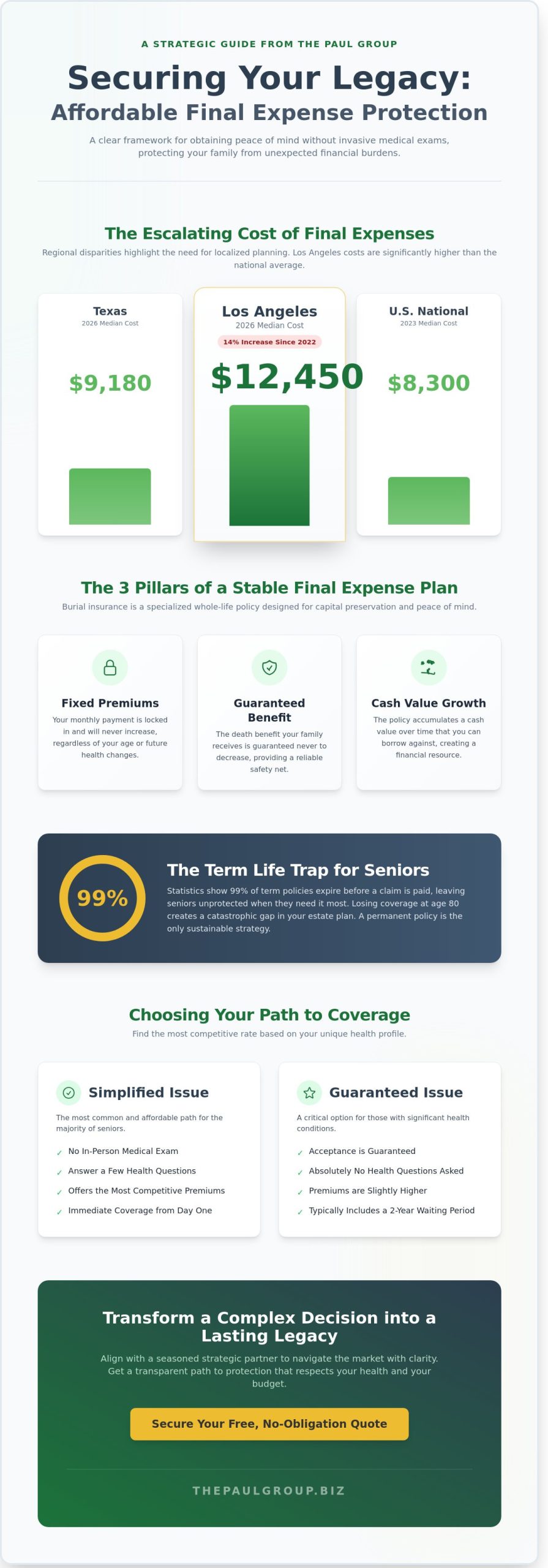
Data from 2026 indicates that the median cost of a funeral with viewing and burial in Los Angeles has reached $12,450, representing a 14% increase from 2022 figures. By contrast, Texas markets show a median cost of $9,180. This regional disparity highlights the necessity of localized planning. A final expense policy provides three core pillars of stability: fixed premiums that never increase, a death benefit that never decreases, and the accumulation of cash value over time. These components transform an inevitable cost into a managed, predictable line item.
The Financial Reality of End-of-Life in Los Angeles
Los Angeles presents unique cost drivers, specifically cemetery property fees which now average $4,200 for a single plot in premium locations. When a household lacks a dedicated liquidity event, the grieving process is often interrupted by the stress of crowdfunding or high-interest debt. We view this coverage as a legacy-building tool. It ensures that your departure initiates a period of reflection rather than a cycle of financial recovery for your heirs.
Why Traditional Term Life Often Fails Seniors
Traditional term life insurance often fails seniors due to expiration risk. Statistics show that 99% of term policies never pay a claim because the policyholder outlives the term. For a 70-year-old, losing coverage at age 80 creates a catastrophic gap in protection. You can explore the best final expense insurance for seniors to understand how these policies maintain value. This permanent coverage offers a more sustainable, inexpensive burial insurance strategy by remaining in force for the duration of the policyholder’s life, providing permanent structural integrity to an estate plan.
Defining Strategic Value: How to Identify Truly Inexpensive Burial Insurance
Market-driven narratives often distill complex financial tools into simplistic slogans. This reductionism serves the insurer, not the policyholder. To secure truly inexpensive burial insurance, you must look beyond the initial premium and examine the underlying contract structure. True affordability is found in the optimization of risk and the elimination of hidden escalations that can destabilize a fixed income later in life.
A strategic approach requires the "Broker Advantage." Unlike captive agents who represent a single entity, a broker accesses a curated portfolio of multiple carriers to find the precise intersection of your health profile and the current market price. This methodology ensures you aren’t overpaying for a brand name when a leaner, more efficient carrier offers the same structural security. In the 2026 market, the role of the Wise Advisor is to guide you through this landscape. They identify plans with fixed rates, ensuring your premium remains static regardless of your age or future health changes. A plan that’s affordable today must remain so in 2030.
The Myth of the "Cheapest" Policy
Low-cost entry points often mask predatory "step-up" premium structures. These plans may appear attractive at age 65 but become financially unsustainable after age 75 as costs double or triple. Reliability is the ultimate metric. "The true cost of insurance is measured by its reliability at the moment of claim, not just the monthly premium."
A $30 monthly policy with a two-year waiting period often provides less cumulative value than a $35 policy with immediate coverage. For those planning funeral logistics in Los Angeles, the Consumer Guide to Funeral and Cemetery Purchases from the California Department of Consumer Affairs highlights the necessity of having liquid funds ready when they’re needed. If a policy fails to pay out because of a waiting period clause, the initial savings vanish. It’s a false economy that leaves families vulnerable.
Immediate Coverage vs. Graded Benefits
Simplified issue policies offer a streamlined path to low-cost protection for relatively healthy seniors. These plans bypass invasive medical exams, focusing on a strategic assessment of major health markers. In many cases, paying a slightly higher premium for immediate coverage is the superior move. It eliminates the risk of a coverage gap during the most vulnerable years. For a more granular look at these structures, review The Paul Group’s pros and cons guide for 2026. Understanding these nuances allows you to transition from a consumer to a strategic buyer. If you’re ready to evaluate your options, consulting with a specialist can clarify your path forward.
Strategic Selection: Simplified vs. Guaranteed Issue for Seniors
Securing a legacy requires a disciplined assessment of the available underwriting methodologies. Most seniors find themselves at a crossroads between Simplified Issue and Guaranteed Issue contracts. According to the Insurance Information Institute, these specialized whole life policies provide fixed death benefits that bypass the invasive medical exams common in traditional life insurance. For the healthy applicant, Simplified Issue is the premier path to securing inexpensive burial insurance. It relies on a brief medical questionnaire rather than fluid samples or physical stress tests. If chronic conditions like congestive heart failure or recent strokes are present, Guaranteed Issue serves as the essential safety net. It ensures coverage is never denied, though it typically carries a higher premium and a two-year waiting period for full benefit payout. The choice isn’t just about acceptance; it’s about the strategic alignment of your health profile with the right carrier’s risk appetite.
Qualifying for the Best Rates in California and Texas
Health qualifications determine whether you receive "Level" pricing or "Modified" rates. In high-volume markets like California and Texas, carriers look for specific indicators of stability. Expect questions regarding insulin-dependent diabetes diagnosed before age 40, hospitalizations for respiratory issues within the last 24 months, and prescriptions for blood thinners. Our regional agents in Arizona and New Mexico observe that carrier preferences vary by geography. Some companies favor the lifestyle profiles of the Southwest, offering more aggressive pricing for well-managed hypertension. Honesty is the only viable strategy during the application. Inaccuracies can lead to claim denials, undermining the very security you intend to build for your family. You can explore a deeper analysis of these contract structures in our guide on the best final expense insurance for seniors pros and cons 2026.
The Cost of Waiting: Age as a Pricing Variable
Delay is the primary enemy of fiscal efficiency. Every year you wait, the mathematical risk to the carrier increases, which is reflected in the premium. A 65-year-old male might secure a $10,000 policy for approximately $45 per month. By age 75, that same coverage often climbs to $85 or more. This 88% increase highlights why 2026 is a critical window for rate locking. Industry shifts suggest that mortality tables are being recalibrated, making current fixed-rate contracts a valuable hedge against future inflation. You shouldn’t wait for a health scare to trigger an application. Locking in inexpensive burial insurance while your health is stable is the most effective way to optimize your entry point. This proactive approach ensures your monthly commitment remains sustainable throughout your retirement, protecting your estate from the rising costs of final arrangements.
The Buyer’s Checklist: Securing Affordable Rates in Your State
Securing inexpensive burial insurance requires a transition from passive shopping to active procurement. The Paul Group utilizes a disciplined methodology to ensure seniors in California, Texas, and Florida don’t overpay for coverage. This strategic approach focuses on three critical pillars of selection.
Step 1: Define the Liquidity Requirement. You must establish a precise dollar amount based on current market data. As of 2026, a traditional funeral service in major metropolitan areas often reaches $9,800, while a direct cremation may only require $2,200. Selecting a benefit amount that aligns with these specific figures prevents premium waste.
Step 2: Consolidate Health Data. Carriers determine risk based on your medical history and current prescriptions. By aggregating your health records and medication list before applying, you allow for a curated quote that reflects your actual eligibility. This precision eliminates the frustration of unexpected rate hikes during the underwriting phase.
Step 3: Audit Tier-Two Carriers. Household names often carry higher premiums to fund their massive advertising budgets. Comparing at least three non-household name carriers frequently reveals hidden value. These specialized firms often provide more aggressive pricing for specific health conditions.
Avoiding Common Pitfalls in "Discount" Insurance
Marketing tactics in 2026 have become increasingly complex, often blurring the lines between comprehensive coverage and limited protection. Many "TV offers" promote low monthly rates that only apply to accidental death. These policies won’t pay a benefit if the passing results from natural causes, such as illness or age. In 2026, over 40% of seniors mistakenly purchase accidental-only coverage thinking it covers natural death; strategic review prevents this error.
Another risk involves the "two-year waiting period" trap. Some carriers apply this delay to every applicant regardless of health status. If you’re in relatively good health, you shouldn’t accept a policy that limits your benefits during the first 24 months. A disciplined analysis of the fine print ensures your family receives the full face value from day one. It’s about finding a balance between cost and immediate reliability.
To understand the full spectrum of available options and how they compare, you can explore our detailed guide on the best final expense insurance for seniors to see which strategy fits your financial goals.
Why The Paul Group is Your Strategic Partner for Final Expense
The Paul Group functions as a Wise Advisor in a market often saturated with fragmented information. Since our founding in 2009, we’ve maintained an exclusive focus on senior final expense needs. This specialization allows us to refine a methodology that prioritizes structural integrity over transactional speed. We don’t just sell policies; we curate the marketplace to ensure your legacy remains protected through disciplined intervention and high-level industry expertise.
Our core philosophy centers on a no-exam, immediate coverage model. This approach eliminates the friction of medical underwriting. It allows for a seamless transition into a protected state without the wait times typically associated with traditional life insurance. By removing these clinical barriers, we transform a complex logistical hurdle into a straightforward administrative milestone. It’s about moving from a state of financial uncertainty to one of absolute structural clarity.
A Partnership-Driven Approach to Insurance
Our consultative process begins with listening. We diagnose your specific objectives before recommending a path forward. This optimization ensures that your coverage aligns with your long-term fiscal goals rather than serving as a temporary fix. While our roots are deep, our network is expanding. We now have dedicated agents serving clients in states like Montana, Illinois, and Nevada. This growth reflects our commitment to bringing sophisticated financial tools and a partnership-driven mindset to a broader audience.
A cornerstone of our strategy is the commitment to fixed rates. Once your plan is established, your premiums never increase. They stay the same regardless of changes in your health or the broader economy. This stability is essential for maintaining a predictable financial environment during retirement. Finding inexpensive burial insurance shouldn’t mean sacrificing long-term reliability. We ensure that the value you secure today remains intact for the duration of your life. When searching for inexpensive burial insurance, the goal isn’t just the lowest price, but the highest degree of certainty for your beneficiaries.
Securing Your Legacy Today
Choosing the right coverage requires more than a search engine. It requires a strategic alignment with experts who understand the nuances of the 2026 insurance market. We invite you to move beyond the stress of the unknown. A quick, no-obligation consultation provides the data you need to make an informed decision. You can request your tailored final expense quote from The Paul Group to begin the process of securing your family’s future. Our team is ready to guide you toward a solution that offers both protection and peace of mind.
Securing Your Legacy Through Strategic Alignment
Navigating the Los Angeles landscape of final expenses requires a disciplined methodology rather than a search for superficial fixes. Success in 2026 hinges on your ability to distinguish between simplified issue and guaranteed issue policies to ensure your family’s structural integrity remains intact. Securing inexpensive burial insurance is a matter of strategic alignment, focusing on curated plans that offer immediate value without the burden of unnecessary medical exams. Since 2009, The Paul Group has acted as a seasoned partner for seniors, applying deep industry expertise across 16 states including California, Texas, Florida, and Arizona. We understand that your legacy isn’t a transaction; it’s a commitment to long-term stability. By leveraging our holistic approach, you replace organizational complexity with a clear, logical path forward. Our group identity is built on providing bespoke solutions that reflect the unique needs of every household we serve. It’s time to move toward a state of certainty. Secure your family’s future with a curated final expense plan from The Paul Group today. You deserve the quiet confidence that comes from a plan engineered for excellence.
Frequently Asked Questions
What is the average cost of burial insurance for a 70-year-old in Los Angeles?
A 70-year-old in Los Angeles typically pays between $75 and $160 monthly for a $10,000 policy based on 2025 industry benchmarks. These rates fluctuate based on gender and tobacco use, but they remain locked once the policy is issued. We focus on securing these fixed costs early to ensure long-term fiscal stability and to avoid the higher premiums associated with older age brackets.
Can I get inexpensive burial insurance if I have pre-existing health conditions?
You can absolutely obtain inexpensive burial insurance despite chronic health conditions by utilizing guaranteed issue products. These plans eliminate medical questions entirely for 100% of applicants, ensuring that no one is turned away. While they include a two-year graded benefit period, they provide a vital safety net for those previously deemed uninsurable due to serious medical histories.
Does burial insurance require a physical medical exam in 2026?
Physical medical exams are largely obsolete for burial insurance in 2026. Carriers now leverage real-time data analytics to review your health history and prescription records in seconds. This shift toward digital underwriting makes securing inexpensive burial insurance faster and more accessible than traditional insurance models, often resulting in an approval decision during the initial consultation.
How soon does a burial insurance policy pay out to my family?
Beneficiaries typically receive funds within 48 hours of submitting a valid death certificate to the insurance carrier. This accelerated payout schedule prevents the financial strain of immediate funeral expenses and associated logistical costs. It provides the liquid capital necessary for families to manage arrangements without the burden of high-interest debt or the need to liquidate retirement assets prematurely.
Will my premiums increase as I get older or if my health declines?
Your premiums are contractually guaranteed to never increase regardless of your age or future health status. This level-premium structure ensures that your strategic financial plan remains intact over several decades. It removes the volatility often found in term life products, which can see price hikes of 300% upon renewal, providing you with predictable monthly overhead.
Is burial insurance the same as a "pre-paid" funeral plan at a mortuary?
Burial insurance provides a tax-free cash payout to your family, whereas pre-paid plans are restrictive service contracts tied to specific funeral homes. Insurance offers a holistic advantage by allowing your beneficiaries to choose any service provider or use funds for non-funeral debts. This portability is essential in an era where 20% of families relocate at least once every decade.
Can I buy burial insurance for my parents in another state like Texas or Florida?
You can certainly purchase coverage for parents in Texas or Florida provided you have their legal consent and can demonstrate an insurable interest. The Paul Group facilitates these multi-state arrangements to ensure comprehensive family protection. Standardized regulations across 48 states allow for a seamless application process for non-resident policyholders, maintaining a unified legacy strategy.
What happens if I move from California to another state after buying a policy?
Moving to another state has zero impact on your policy’s validity or your monthly premium amount. The contract is established with the insurance carrier, not the state of California, making it fully portable across the country. This permanent protection ensures that your strategic alignment remains consistent even if your primary residence changes during your retirement years.









Comments (2)
Long time player here and I can confidently say this casino delivers exactly what seasoned gamers expect from a top tier brand. The slot tournaments are incredibly well organized and the bonus terms are always crystal clear. betssoncasino
I stumbled upon this site by accident and ended up staying because the community vibe is just so welcoming. The moderators are friendly and always ready to help you navigate the different game categories. It is rare to find a platform that cares about its users this much. vv2667link