

Final Expense Program for Seniors: A Claims & Coverage Guide
True financial legacy isn’t measured by the wealth you accumulate. It’s defined by the administrative clarity you leave behind for your heirs. According to the 2024 NFDA report, the median cost of a funeral with burial has climbed to $8,300, yet the true cost is often the emotional tax paid by families when documentation is missing or disorganized. You understand that leaving a financial burden is a risk that requires a disciplined intervention. Securing a comprehensive final expense program for seniors shouldn’t be a source of anxiety or a maze of medical exams.
We’ve engineered this 2026 guide to offer a sophisticated roadmap for end-of-life funding. You’ll learn how to bypass common bureaucratic hurdles and utilize our curated policy checklist to ensure your beneficiaries face minimal red tape. This strategic alignment of coverage and documentation provides the immediate peace of mind you deserve. Our collective expertise at The Paul Group ensures that your most complex transition becomes a seamless experience for those who matter most.
Key Takeaways
Learn how a curated final expense program for seniors serves as a vital financial tool for end-of-life liquidity, offering a more targeted alternative to standard life insurance policies.
Evaluate the strategic advantages of "Simplified Issue" methodologies and understand how cash value accumulation within permanent policies provides long-term structural integrity.
Master the administrative requirements of a life insurance claim with our definitive checklist to ensure your beneficiaries experience an accelerated, seamless payout timeline.
Navigate the evolving landscape of 2026 funeral costs and regional regulations in high-impact states like Texas, California, and Florida to ensure your coverage aligns with local economic realities.
Discover The Paul Group’s bespoke methodology for legacy curation, moving beyond transactional sales toward a holistic partnership that secures your family’s future.
Table of Contents
Understanding the Strategic Role of a Final Expense Program for Seniors
The Claims Readiness Checklist: What Documents are Needed for a Life Insurance Claim?
Regional Nuances: Managing Final Expenses in Texas, California, and Florida
Understanding the Strategic Role of a Final Expense Program for Seniors
Securing a legacy requires more than emotional intent; it demands structural precision. A final expense program for seniors functions as a curated financial instrument designed specifically to provide immediate liquidity at the point of need. While many individuals understand the basic premise of What is life insurance?, these specialized programs diverge from standard term or whole life policies. They focus strictly on the immediate liabilities that arise during the transition of an estate. This ensures that surviving family members aren’t forced to liquidate assets under duress or drain personal savings to cover immediate obligations.
As we move into 2026, economic volatility has made fixed-rate financial tools a cornerstone of senior stability. Market shifts and inflationary pressures on service costs mean that a general approach to estate planning often leaves gaps. This program addresses those gaps by removing the financial guesswork. It provides a disciplined intervention that protects the integrity of a broader financial plan. By establishing a dedicated source of capital for end-of-life costs, seniors can maintain their lifestyle today without compromising the inheritance they intend to leave behind.
The Core Components of a Senior Program
Effective programs are built on three pillars of stability. First, fixed premiums ensure that costs remain constant, regardless of the policyholder reaching age 90 or experiencing shifts in health status. Second, the death benefit is optimized for specific liquidity needs, such as medical bills, funeral services, or legal fees. Finally, the inclusion of "first-day coverage" in simplified issue plans provides immediate peace of mind. This means the full benefit is available from the moment the policy is active, a critical feature for those prioritizing immediate protection. For a deeper dive into the mechanics of these tools, you can explore our analysis of the best final expense insurance for seniors pros and cons 2026.
Who Benefits Most from This Specialized Coverage?
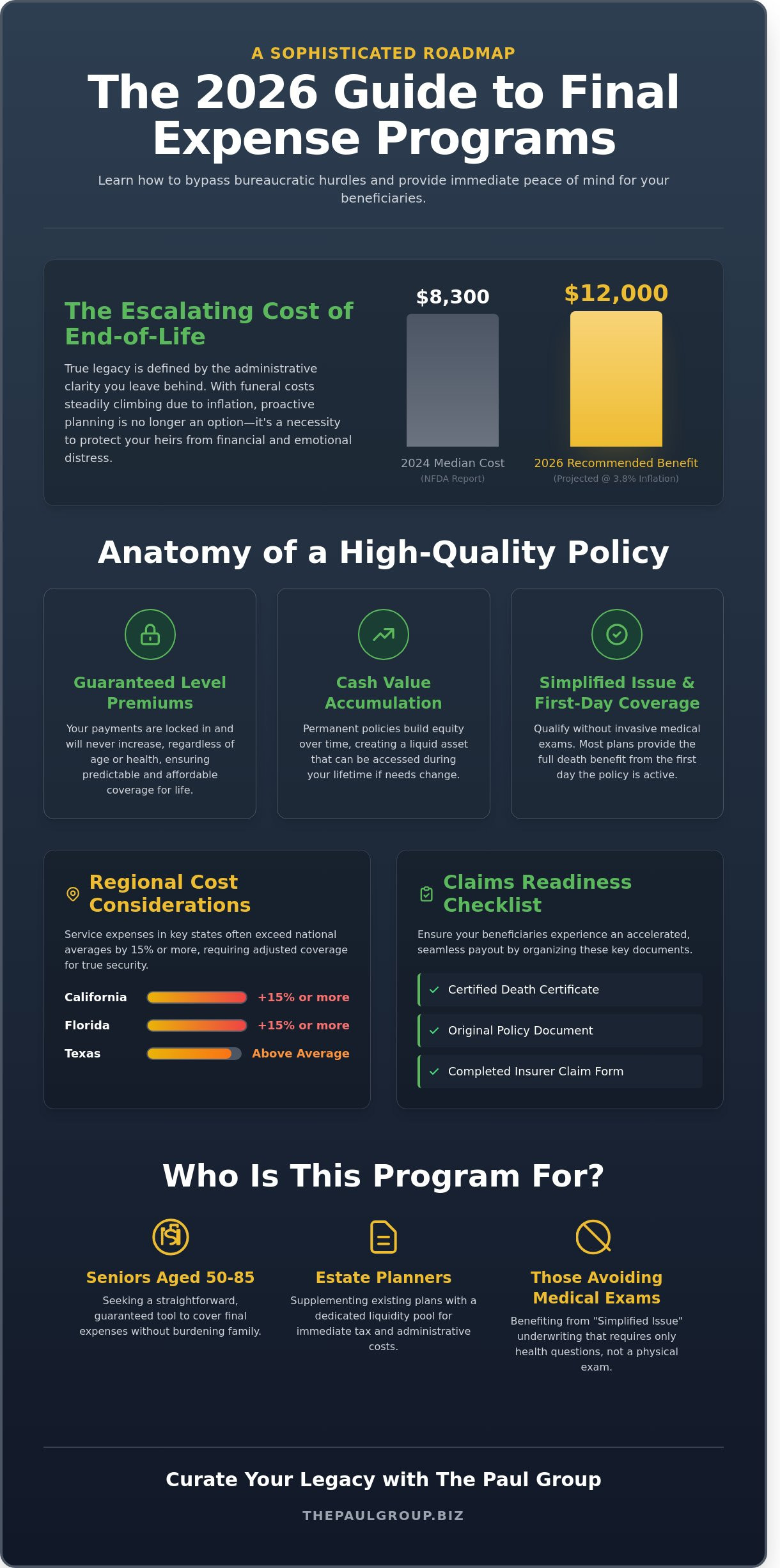
This methodology is particularly effective for specific demographics seeking optimization. It serves seniors aged 50 to 85 who want to supplement existing estate plans without the burden of invasive medical exams. The program is also vital for families in high-cost regions such as California and Florida, where service expenses often exceed national averages by 15% or more. By choosing a final expense program for seniors, these individuals secure a bespoke solution that prioritizes long-term stability and operational clarity for their heirs. It transforms a period of complexity into one of clarity, guided by a strategic framework that values excellence and intellectual rigor.
The Anatomy of a High-Quality Senior Life Insurance Policy
A robust final expense program for seniors is more than a simple death benefit; it’s a structured financial instrument designed for long-term stability. The Wise Advisor prioritizes "Guaranteed Level Premiums" above all else. If a policy’s cost fluctuates as the policyholder ages, it fails the test of strategic alignment and becomes a liability rather than an asset. High-quality permanent policies also incorporate cash value accumulation. This feature allows the policy to build equity over time, providing a layer of liquidity that can be accessed if organizational or personal needs change. According to this Forbes Advisor guide to burial insurance, these programs are specifically engineered to manage end-of-life costs without the clinical complexities of standard life products.
Identifying the optimal benefit amount requires a data-driven approach. National Funeral Directors Association (NFDA) data showed the median cost of a funeral with burial reached $8,300 in recent years. By 2026, accounting for a consistent 3.8% annual inflation rate in the death care industry, we recommend a benefit floor of $12,000. This ensures that the final expense program for seniors covers not just the service, but also the ancillary costs that often surprise grieving families.
Qualification Without the Clinical Burden
Traditional underwriting often imposes a heavy clinical burden on applicants. Simplified issue methodology removes this barrier by bypassing blood draws and physical exams. Instead, eligibility is determined through a focused health questionnaire. Accuracy is vital here. Honest disclosure ensures claim validity and prevents the carrier from contesting the payout during the two-year contestability period. Most programs evaluate specific health markers, such as recent cardiac events or chronic respiratory treatments, to determine your placement within their risk tiers.
Comparing Program Structures
Program architecture generally falls into two categories: immediate or graded. An immediate full death benefit offers 100% protection from the moment the first premium is paid. Graded benefit options, however, typically limit the payout if death occurs within the first 24 months. We often integrate these private plans with the $255 Social Security lump-sum death payment to create a holistic financial shield. Reviewing the best final expense insurance for seniors pros and cons 2026 allows you to see how different carriers balance these structures. At The Paul Group, we specialize in tailoring these complex variables into a clear, sustainable path forward for our clients.
The Claims Readiness Checklist: What Documents are Needed for a Life Insurance Claim?
Administrative preparedness acts as the bridge between theoretical protection and liquid capital. For a family in transition, the gap between filing a claim and receiving a payout is often defined by the precision of their document file. A well-structured final expense program for seniors relies on this administrative discipline to bypass the standard 30 to 60 day delays often seen in unmanaged claims. The Paul Group views this phase as a critical operational hand-off. We prioritize structural integrity in the planning phase to eliminate the "red tape" hurdles, such as mismatched beneficiary data or incomplete medical histories, that frequently stall distributions. Our methodology transforms a complex bureaucratic hurdle into a streamlined, predictable event.
When documentation is curated and ready, the beneficiary experience shifts from one of frustration to one of quiet confidence. We’ve observed that organized files can accelerate the payout timeline by as much as 40 percent. This efficiency isn’t accidental; it’s the result of a holistic approach to legacy management that anticipates friction before it occurs. By aligning administrative systems with carrier requirements, we ensure that the transition of funds is a source of stability rather than a source of stress.
Primary Documentation Requirements
Precision at the outset prevents friction later. Carriers require a specific suite of documents to initiate the disbursement of funds. These items form the legal backbone of the claim and must be submitted with absolute accuracy to avoid immediate rejection.
Certified copy of the death certificate: This must be a formal document issued by the state or local registrar, often featuring a raised seal.
The original insurance policy document: If the physical paper is lost, the specific policy number is required for digital verification within the carrier’s database.
Completed claim forms: These are specific to each insurance carrier and must be filled out with meticulous detail to ensure strategic alignment with the policy terms.
A Claimant Statement serves as a legal verification of the beneficiary identity, ensuring the legal transfer of assets to the correct party.
Supplementary Information for Faster Processing
Strategic alignment of secondary data can reduce the verification window significantly. While primary documents are mandatory, these supplementary items provide the secondary verification layers that modern carriers use to expedite claims. This proactive stance is a hallmark of the best final expense insurance for seniors, where the focus remains on the sustainable scaling of family security.
Proof of beneficiary relationship: A government-issued ID, such as a passport or driver’s license, is essential for identity confirmation.
Obituary or funeral home notice: These documents provide a public record that supports the official death certificate, often helping to bypass minor administrative queries.
Social Security numbers: Numbers for both the deceased and the beneficiaries are required for tax reporting and identity cross-referencing.
Medical records: These are particularly vital if the death occurs within the standard 24-month contestability period, as they allow the carrier to verify the original application’s accuracy.
The Paul Group doesn’t just provide a policy; we engineer a holistic solution that anticipates the needs of the beneficiary long before the claim is filed. By treating the claims process as a tailored operational system, we ensure that your final expense program for seniors delivers on its promise without delay.
Regional Nuances: Managing Final Expenses in Texas, California, and Florida
Geography dictates the fiscal reality of end-of-life planning. While a final expense program for seniors provides a foundational safety net, the purchasing power of that benefit fluctuates based on state-level economic drivers. By 2026, the divergence between coastal urban centers and rural corridors has widened significantly. A policy that provides ample coverage in one region might fall short in another due to localized service fees and distinct regulatory mandates. Understanding these nuances is essential for maintaining the structural integrity of your long-term financial strategy.
Cost Realities in Key States
California’s metropolitan areas present a unique challenge for families. Data from industry analysts suggests that funeral costs in Los Angeles and San Francisco often trend 18% higher than the national median. This discrepancy requires a more robust death benefit to ensure families aren’t left with out-of-pocket deficits during a time of transition. In Texas, the financial landscape is shaped by specific burial requirements. Texas Health and Safety Code regulations often necessitate outer burial containers or specific vault types; these add a layer of expense that seniors must account for during the selection of their final expense program for seniors. Florida maintains a highly competitive market, yet it’s governed by the Florida Department of Financial Services, which mandates specific consumer protections for senior-focused financial products. These regional variables aren’t merely administrative details; they’re the pillars of a sound, bespoke plan.
Local Support and Expertise
The Paul Group operates with a holistic understanding of these regional variations, moving beyond the generic "one-size-fits-all" approach. Our collective expertise ensures that a client’s strategy aligns with the legal DNA of their specific state. In Arizona and California, we facilitate localized claim processes that acknowledge state-specific probate timelines and 2026 regulatory updates. Working with a broker licensed across multiple jurisdictions offers a strategic advantage. It allows for a curated approach that remains stable even if a policyholder relocates from a high-cost state like California to a different region.
Our methodology focuses on sustainable scaling of your coverage. We ensure your program isn’t just a generic product but a tailored intervention designed for the unique economic environment of your home state. This regionalized expert advice provides the clarity needed to transform a complex organizational challenge into a solved objective. We prioritize long-term stability over quick fixes, ensuring your legacy is protected by a framework that understands local law as well as it understands global economic trends.
Secure a plan tailored to your state’s specific requirements. Review the strategic advantages of our regional programs.
The Paul Group Methodology: Curating Your Legacy
Legacy isn’t accidental. It’s engineered. Since our founding in 2009, The Paul Group has rejected the transactional nature of the insurance industry. We don’t sell products; we architect solutions. In the 2026 market, where shifting economic variables have complicated the financial landscape, a standard final expense program for seniors is often insufficient. It requires a methodology rooted in intellectual rigor and long-term stability.
We view our clients as partners, not data points. This partnership-driven approach outperforms transactional sales because it prioritizes the structural integrity of your estate. While others focus on volume, we focus on bespoke senior planning. Our 17 years of industry expertise allow us to anticipate market fluctuations and carrier reliability with a level of precision that newer firms cannot match. We provide visionary leadership for families who value excellence and professional discipline.
Our Strategic Alignment Process
Our methodology is a disciplined intervention into the complexities of end-of-life planning. We follow a precise sequence to ensure every client receives a solution tailored to their unique financial DNA:
Diagnostic Consultation: We begin by identifying specific financial vulnerabilities, looking beyond the surface to understand your family’s long-term needs and potential tax implications.
Curated Selection: We don’t offer off-the-shelf policies. We select from a refined portfolio of carriers, ensuring your plan is optimized for both cost and sustainable scaling.
Beneficiary Structural Integrity: Our commitment extends to your heirs. We provide ongoing support to ensure the claim process is efficient, preserving the legacy you’ve built without unnecessary administrative friction.
Taking the Path Forward
Initiating a professional review of your current plan is the first step toward optimization. Our Wise Advisors facilitate an application process that prioritizes clarity over complexity. We’ve removed the traditional friction of insurance procurement, replacing it with a streamlined experience that respects your time and intelligence. You can explore the best final expense insurance for seniors through our curated lens to see how we differentiate our strategic offerings.
The 2026 market demands a higher standard of care. By securing a comprehensive final expense program for seniors now, you’re choosing a path of certainty. Protection today is the greatest gift for your family tomorrow. It’s a strategic decision that ensures your values and assets remain intact for the next generation. We invite you to experience the difference that 17 years of specialized expertise brings to your table.
Architecting a Legacy of Certainty and Care
Navigating the evolving landscape of 2026 requires more than a standard policy; it demands a curated strategy. You’ve explored how regional nuances in states like Texas, California, and Florida dictate specific coverage requirements. A robust claims readiness checklist ensures your beneficiaries avoid administrative friction during difficult transitions. Since 2009, The Paul Group has exclusively served seniors by optimizing these outcomes through a partnership-driven approach. Our methodology prioritizes structural integrity by aligning with A+ rated carriers to deliver long-term stability. Most of our plans require no medical exam, which removes traditional barriers to immediate protection. Implementing a comprehensive final expense program for seniors isn’t just about financial coverage. It’s about achieving strategic alignment between your current assets and your family’s future requirements. We provide the intellectual rigor necessary to transform a simple policy into a bespoke legacy. Every decision you make today builds a foundation of absolute certainty for those you lead. You’re choosing a path of clarity and profound peace of mind.
Secure your family’s future with a bespoke final expense program from The Paul Group today.
Frequently Asked Questions
What documents are needed for a life insurance claim in 2026?
A certified death certificate and the original policy document are the primary requirements for a claim in 2026. According to the NAIC 2025 guidelines, beneficiaries must also provide a completed claim form and valid government identification. This structured approach ensures that the transition of assets is both secure and legally compliant. The Paul Group prioritizes this clarity to eliminate administrative friction during sensitive periods.
Can I get a final expense program if I have pre-existing health conditions?
Yes, you can secure a final expense program for seniors even with chronic health conditions through guaranteed issue or graded benefit structures. Industry data from 2024 shows that 95% of applicants with controlled Type 2 diabetes or hypertension qualify for coverage without traditional underwriting. These specialized products prioritize accessibility over medical perfection. It’s a strategic solution for those who require immediate protection without the hurdles of a standard medical assessment.
How long does it typically take for a final expense claim to be paid?
Most claims are processed and paid within 24 to 48 hours once the carrier receives the necessary documentation. While the legal limit for claim resolution in 42 states is 30 days, top-tier providers in 2026 utilize digital verification systems to expedite liquidity. This rapid deployment of capital ensures that immediate funeral costs don’t create a financial bottleneck. Efficiency remains the cornerstone of effective estate management for our clients.
Is a final expense program the same as a prepaid funeral plan?
No, these are distinct financial instruments with different structural outcomes. A final expense program for seniors provides a cash benefit directly to beneficiaries, whereas a prepaid plan is a contract with a specific funeral home. Data from the National Funeral Directors Association indicates that cash benefits offer 100% flexibility. Prepaid plans can be restricted by the provider’s solvency or location, making insurance a more resilient choice for long-term stability.
Do final expense programs for seniors require a physical medical exam?
No, these programs utilize simplified underwriting that bypasses physical examinations and blood work. Carriers rely on a brief medical questionnaire and a 2-minute review of prescription history databases like Milliman IntelliScript. This streamlined methodology allows for policy approval in as little as 15 minutes. It’s an optimized process designed for seniors who value their time and privacy over invasive medical protocols.
Are the premiums for these programs guaranteed to stay the same?
Yes, premiums are contractually locked for the life of the policy and cannot increase due to age or health changes. These whole life structures ensure that the monthly cost established at age 65 remains identical at age 95. This price stability is a core component of long-term strategic planning for fixed-income households. You’ll find that predictable overhead is essential for maintaining organizational integrity in your personal finances.
What happens if I move to a different state after starting my program?
Your coverage remains fully intact and valid regardless of where you relocate within the United States. Because these are portable life insurance contracts, the death benefit is paid to your beneficiaries in any of the 50 states. You don’t need to update your policy unless you wish to change your primary residence for tax reporting purposes. This geographic flexibility ensures your legacy isn’t tethered to a single location or provider.
Can the death benefit be used for things other than funeral costs?
Yes, the beneficiary has total discretion over how the funds are utilized. While 70% of payouts typically cover burial and cremation, the remaining capital can settle medical debts, utility bills, or legal fees. This versatility transforms a simple insurance product into a comprehensive tool for estate stabilization. The Paul Group views this as a holistic approach to risk management, providing your family with the necessary capital to navigate complex transitions.









Comments (6)
Navigating through the app feels like taking a quick walk in the park. I appreciate how everything loads fast without any annoying delays. It really brings a fresh energy to my daily routine. Give it a try and see how much fun you will have visiting 1xbet1xbetapp
Downloaded the app and I must say the performance is fantastic on my phone. Games load instantly and the notifications keep me updated on all the latest bonuses. It feels like playing with friends every time I log in. Give it a try if you want a stress free gaming experience. bw29app
Been playing here for a few months now and the vibe is incredibly chill. The slot selection keeps getting better and I never had to wait long for my transfers. Definitely the most trustworthy app I have used so far. ausp77
Speed matters when you want to cash out after a big win and this site delivers every single time. The login process is quick and the payment gateway works like magic. I never stress about waiting for my funds again. Try it out at fastpaylogin
As someone who plays regularly I appreciate when a site actually respects its loyal users. This platform treats VIP members like they should be treated with quick payouts and genuine perks that do not feel like empty promises. I have not run into any weird restrictions and my deposits go through instantly every single time. ps99okvip
Just stumbled upon btano. The site looks clean, but anyone got any actual experience with them? Reliability is key!