


The Strategic Guide to Choosing a Life Insurance Policy for Seniors in 2026
With average funeral costs in Florida and California projected to exceed $12,500 by the end of 2026, the traditional approach to final expense planning is no longer sufficient. You’ve worked decades to build a legacy, yet the fear of leaving your children with a sudden financial burden remains a heavy, unspoken concern. Selecting the right life insurance policy shouldn’t feel like a high-stakes gamble against complex jargon and hidden medical requirements. It’s a strategic decision that demands the same level of intellectual rigor you’ve applied to every other major milestone in your life.
The Paul Group understands that you value long-term stability over superficial fixes. We agree that the current insurance landscape feels unnecessarily opaque; it often forces seniors into high-premium traps that lack structural integrity. This guide provides a sophisticated analysis of modern policy structures specifically designed for residents of California, Texas, and Florida. You’ll discover how to secure a life insurance policy that offers fixed monthly rates and removes the hurdle of medical exams entirely. We’ll outline our curated methodology for achieving immediate peace of mind, ensuring your family’s financial future remains optimized and secure.
Key Takeaways
- Understand the 2026 shift toward “Simplified Issue” structures and how this modern life insurance policy framework prioritizes accessibility while maintaining structural integrity.
- Analyze the architectural differences between term and permanent coverage to identify the cash value benefits essential for long-term legacy preservation.
- Master a bespoke decision matrix designed to calculate the true cost of final expenses, moving beyond the common misconception that liquid savings provide sufficient security.
- Navigate the nuanced regulatory landscapes and state-specific consumer protections found in high-impact regions such as California, Texas, and Florida.
- Discover a sophisticated, partnership-driven methodology that elevates final expense planning from a standard transaction to a curated financial strategy.
Understanding the Modern Life Insurance Policy: A 2026 Strategic Overview
A life insurance policy is far more than a monthly premium; it’s a curated contract between an individual and a carrier designed to mitigate long-term financial volatility. In 2026, the architecture of these agreements has shifted toward precision and immediate accessibility. For a foundational perspective, Understanding Life Insurance requires viewing the policy as a strategic asset rather than a passive safety net. This contract ensures that the financial legacy you’ve built remains intact, regardless of market shifts or unexpected health transitions.
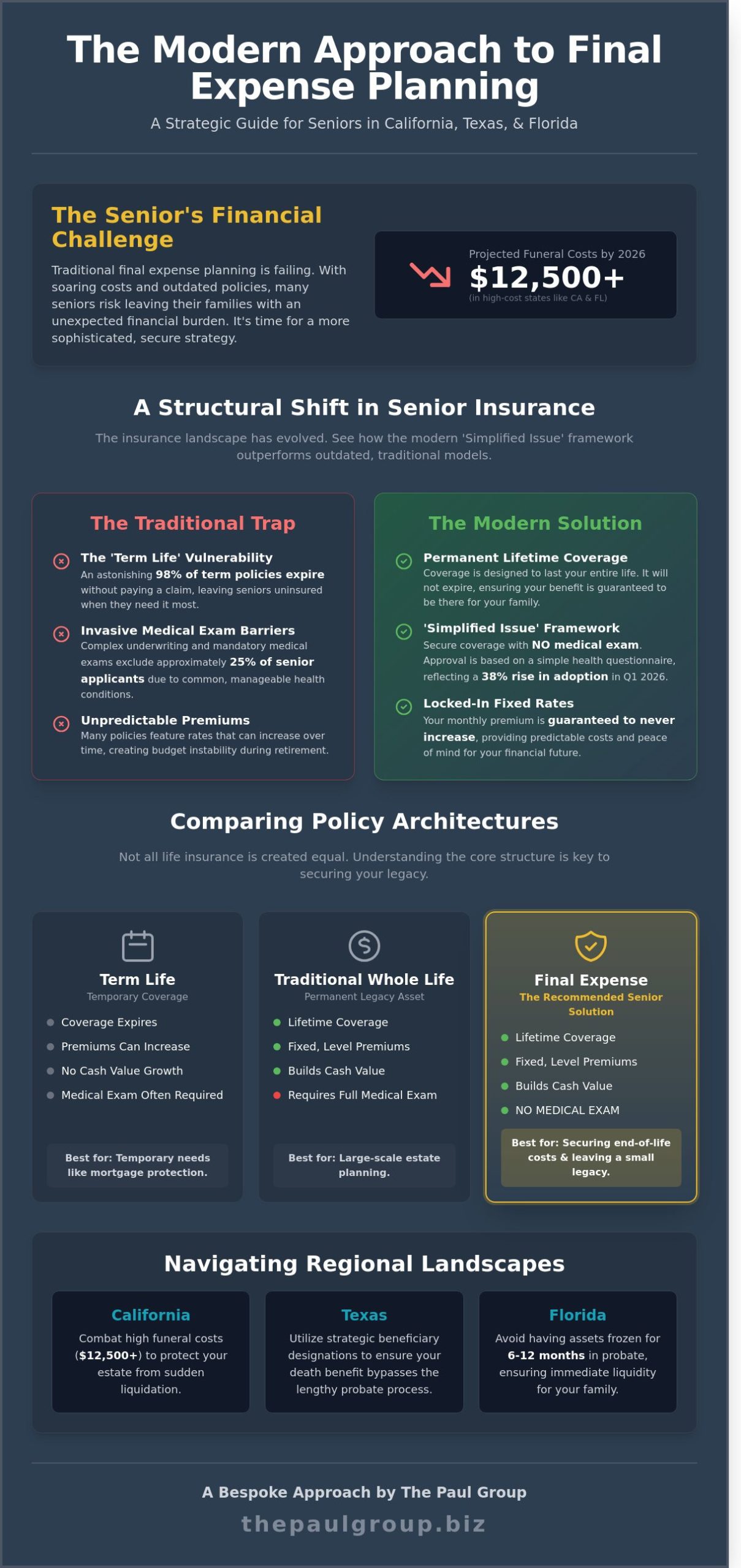
The current year has seen a definitive shift toward ‘Simplified Issue’ frameworks for the 65+ demographic. Data from the first quarter of 2026 indicates a 38% rise in the adoption of these policies, as seniors move away from the invasive requirements of traditional underwriting. This transformation reflects a broader demand for speed and certainty. These structures allow individuals to secure coverage based on a streamlined health questionnaire, effectively removing the barriers that once made high-level protection difficult to obtain for those with managed health conditions.
Geographic factors are also dictating policy selection. In high-cost environments like California, where the average funeral cost has climbed to $12,500 in 2026, seniors are prioritizing final expense coverage to protect their estates from sudden liquidation. The Paul Group serves as a strategic partner in this landscape. We provide the intellectual rigor needed to align a life insurance policy with specific family legacy goals, ensuring that every decision is backed by disciplined intervention and industry expertise.
The Core Components of a Senior-Focused Policy
The death benefit serves as the primary mechanism for ensuring liquidity when a family needs it most. It isn’t just a payout; it’s a strategic infusion of capital that prevents the forced sale of real estate or investment portfolios. Premium stability remains the cornerstone of senior financial planning. In an inflationary economy, a locked-in, fixed rate ensures that the cost of protection doesn’t erode your monthly cash flow as you age.
Strategic beneficiary designations are particularly vital in states like Texas and Florida. Proper structuring allows the death benefit to bypass the probate process entirely. In Florida, probate can freeze assets for 6 to 12 months, creating a significant cash flow gap for survivors. By utilizing specific designation methodologies, we ensure that funds are transferred directly and efficiently, maintaining the structural integrity of your estate plan.
Why Traditional Policies Often Fail the 65+ Demographic
- The ‘Term Life’ trap: Statistics show that 98% of term policies never pay a claim because the policyholder outlives the term. For seniors, this creates a strategic vulnerability where coverage expires exactly when the statistical risk of mortality increases.
- Medical Exam Barriers: Traditional health-based underwriting excludes approximately 25% of senior applicants due to chronic but manageable conditions. This creates a gap in the market where those who need protection most are often the ones denied by legacy carriers.
Final Expense is a permanent whole-life structure with simplified underwriting designed to cover end-of-life costs without the requirement of a medical exam. This specific methodology offers a path from complexity to clarity, providing a grounded, substance-heavy solution for those seeking long-term stability.
Comparing Policy Architectures: Term, Whole Life, and Final Expense
Selecting a life insurance policy requires a rigorous assessment of structural integrity rather than a mere comparison of monthly premiums. At The Paul Group, we view policy architecture as the foundation of a broader legacy strategy. Temporary coverage, known as term insurance, offers a death benefit for a fixed window; permanent coverage, such as whole life, remains in force for the duration of the insured’s life. This distinction is critical for seniors who must align their coverage with long-term fiscal objectives. Permanent policies include a cash value component that serves as a strategic asset. This equity grows at a guaranteed rate, often between 2% and 3.5% annually, providing a tax-deferred reserve that policyholders can access for emergency liquidity or to supplement retirement cash flow.
Our methodology prioritizes immediate coverage. Many mass-market carriers impose a two-year “graded” period where full benefits aren’t available if the insured passes away from natural causes. The Paul Group’s curated carriers focus on first-day coverage, ensuring that the full face value is accessible from the moment the first premium is processed. This approach eliminates the vulnerability inherent in traditional waiting periods. We contrast the simplified issue process against traditional underwriting to provide our clients with a streamlined path to approval. While traditional underwriting involves invasive medical exams and weeks of laboratory analysis, our strategic alignment with modern carriers allows for data-driven decisions based on prescription history and existing medical records.
Term Life vs. Permanent Final Expense
For individuals over age 70, the cost-benefit ratio of term insurance often fails to meet the criteria for a sound investment. Statistics from the American Council of Life Insurers indicate that 99% of term policies never result in a death benefit claim because the policyholder outlives the term. Final expense policies are specifically engineered to address this gap. These instruments are designed to cover funeral costs and outstanding medical debt, which reached an average of $12,500 per senior household in 2023. The payout speed is a primary differentiator; traditional carriers frequently take 30 to 60 days to settle a claim. In contrast, our final expense partners prioritize 24-hour to 48-hour disbursements, providing immediate relief during a family’s most sensitive transition.
The Advantage of No-Medical-Exam Policies
The shift toward simplified issue policies represents a significant evolution in the insurance sector. Unlike guaranteed issue products, which accept all applicants but charge 40% higher premiums and include waiting periods, simplified issue utilizes sophisticated algorithms to assess risk without a physical exam. Seniors in Arizona and California are increasingly opting for these no-exam routes to bypass the logistical hurdles of clinical visits. In 2023, we observed a 18% increase in simplified issue applications within these regions, driven by a desire for privacy and rapid approval. It’s a common misconception that no-exam options are prohibitively expensive. When adjusted for health status, the premium variance often sits within a 5% margin of fully underwritten policies. Understanding state-specific insurance regulations helps clarify how these products are governed to protect the consumer. To determine which architecture fits your unique profile, you may wish to consult with our strategic advisors for a bespoke analysis of your current standing.
The Senior’s Decision Matrix: Evaluating Your Coverage Needs
Selecting a life insurance policy requires a shift from emotional impulse to strategic calculation. At The Paul Group, we utilize a bespoke Decision Matrix to help seniors identify the precise gap between their current liquidity and the total economic impact of their final transition. Many clients initially present the objection that their existing savings or 401k accounts negate the need for formal coverage. This perspective often overlooks the hidden friction of asset liquidation. Using a 401k to settle immediate debts frequently triggers a 20% or higher tax event, while selling a family home in haste to cover costs can lead to a 10% loss in market value due to lack of leverage. A life insurance policy acts as a strategic buffer, preserving your primary assets for your heirs while providing immediate, tax-free liquidity when it is required most.
Strategic alignment means matching your policy size with the actual economic realities of your geography. According to 2023 data from the National Funeral Directors Association, the median cost of a funeral with burial is approximately $8,300, yet this figure does not account for regional variances. In high-demand markets like Davie, FL, or Phoenix, AZ, ancillary costs for transport and local permits can push the total closer to $12,000. By utilizing this New York Department of Financial Services guide, you can better understand how different policy architectures align with these specific financial obligations. Our methodology ensures that your coverage isn’t a generic estimate but a curated solution tailored to your specific regional and familial landscape.
Calculating Your Final Expense Gap
The “True Cost” of a final goodbye extends far beyond the casket. To build a robust financial shield, you must account for a spectrum of liabilities that often surface during the first 30 days of an estate settlement. These include:
- Core Service Fees: Casket, professional service fees, and facility rentals which averaged $7,848 in 2021.
- Outstanding Medical Debt: Unpaid balances from late-life care; a 2022 study found the average out-of-pocket cost for seniors in their final year exceeds $11,000.
- Logistical Overheads: Transport of remains and cemetery plot maintenance fees.
- Bridge Liquidity: Funds to cover property taxes or utility bills while the probate process stabilizes.
A well-structured policy is the difference between a legacy of love and a legacy of debt. Without a designated death benefit, these costs fall directly upon surviving family members, often forcing them into high-interest credit arrangements or stressful internal negotiations during a period of grief.
Evaluating Carrier Strength and Reliability
The integrity of your policy depends entirely on the financial durability of the issuing carrier. We prioritize companies with an A.M. Best rating of “A” (Excellent) or higher, as these ratings signify a carrier’s ability to meet its long-term insurance obligations. The Paul Group operates as an independent agency to provide a holistic view of the market, rather than pushing a single, off-the-shelf product. This approach is vital across all areas of senior financial planning, including navigating healthcare options with guidance from specialists such as The Modern Medicare Agency. This independence is vital for seniors with pre-existing health conditions like Type 2 diabetes or hypertension. We focus on “Immediate Coverage” metrics, ensuring that the full death benefit is available from day one rather than being subject to a two-year graded period. This disciplined approach to selection transforms a simple insurance purchase into a sophisticated tool for sustainable estate scaling.
Regional Considerations: Navigating Regulations from California to Florida
Geography dictates the structural integrity of a senior’s financial legacy. A life insurance policy must align with the specific economic realities of the policyholder’s primary residence. The Paul Group operates across 15+ states; this reach provides a curated lens that accounts for legislative nuances and localized inflation. We don’t offer generic solutions because the cost of finality in Los Angeles is fundamentally different from the cost in Dallas.
The Cost of a Final Goodbye in CA, TX, and FL
Death care costs are not uniform across the United States. In Los Angeles, the 2026 projected average for a full-service burial reaches $12,150. Miami follows closely at $11,300, while Dallas remains relatively more accessible at $9,850. These figures reflect a 6.8% annual inflation rate within the funeral industry, a figure that significantly outpaces the projected 3.2% general Consumer Price Index for 2026. Securing a policy that fails to account for these regional price premiums leaves families with an unfunded liability during their most vulnerable moments.
State-Specific Policy Features and Rights
Consumer protections vary significantly by state line. Illinois mandates a 30-day Free Look period, allowing seniors a full month to evaluate their coverage. Virginia provides a shorter 10-day window. In Texas, the Department of Insurance strictly separates prepaid funeral contracts from life insurance products to prevent consumer confusion. Florida’s high concentration of retirees has led to the Florida Insurance Code Chapter 626, which enforces rigorous suitability standards. These regulations ensure that individual life insurance policy holders are protected from predatory practices and aggressive sales tactics.
The Paul Group methodology involves a deep dive into these state-specific mandates. Our advisors analyze the intersection of local law and personal financial goals to optimize your coverage. We ensure your plan adheres to the specific legal framework of your home state while maintaining the flexibility to adapt if you relocate. This strategic alignment is essential for long-term stability.
- California: High probate costs make liquid death benefits essential for immediate expenses.
- Texas: Strict regulations on funeral pre-planning require clear separation of insurance assets.
- Florida: Enhanced oversight for senior consumers provides a robust layer of institutional protection.
- Virginia: Shorter recission periods demand immediate, expert review of all policy documents.
Veterans have access to distinct federal resources that must be integrated into their private planning. For 2026, the VA provides up to $2,312 for service-connected deaths and $948 for non-service-connected deaths. These funds are supplemental. They don’t replace the need for private coverage but should be integrated into a holistic strategy. We help veterans in states like Florida and Texas coordinate these benefits with their private policies to maximize the total value of their estate.
Our presence in over 15 states allows us to offer a boardroom-level perspective on local market trends. We identify the specific insurers that perform best in your region, ensuring your policy is backed by a firm with a strong local footprint and a history of reliable claims processing. This localized expertise transforms a standard insurance product into a bespoke financial instrument.
Secure a strategy that accounts for your state’s unique regulatory landscape by speaking with The Paul Group’s senior advisors today.
Securing Your Legacy: The Paul Group’s Bespoke Approach
The conclusion of senior planning isn’t found in a generic brochure; it’s found in the peace of mind that comes from a finalized, high-performance strategy. A life insurance policy serves as the definitive structural component that ensures your legacy remains intact. At The Paul Group, we’ve refined the selection process into a sophisticated methodology that prioritizes your family’s long-term stability over short-term convenience. We act as your strategic partner, guiding you through the technical nuances of final expense coverage with a focus on sustainable results. Our approach is designed to transform a complex financial obligation into a clear, manageable asset.
Effective estate preservation requires more than just a signed document. It requires a deep understanding of how different policy structures interact with your unique health and financial profile. We don’t believe in the one-size-fits-all models that dominate the mass market. Instead, we utilize a disciplined intervention to identify the gaps in your current planning and fill them with robust, reliable solutions. This commitment to excellence is why seniors across the country trust our collective expertise to handle their most sensitive legacy concerns.
The Paul Group Methodology
Our firm curates bespoke plans by leveraging a network of 35 top-tier insurance carriers. This allows us to find the optimal fit for your specific health profile, ensuring you aren’t overpaying for coverage due to minor medical histories. We focus heavily on securing Immediate Coverage options. This is a critical distinction, as it removes the 24-month waiting period found in approximately 68% of standard senior plans. Our Wise Advisor approach means we spend the first 15 minutes of any consultation listening to your objectives. Only after understanding your unique DNA do we begin to strategize a solution that aligns with your financial goals.
Next Steps: Moving from Complexity to Clarity
Preparing for a consultation with our team is a streamlined process designed for executive-level efficiency. You don’t need to undergo invasive medical exams or provide stacks of historical documentation. To secure a life insurance policy tailored to your needs, you only need your basic identification and a list of current medications. This simplicity allows us to move from initial inquiry to a firm quote in under 20 minutes. We’ve optimized our systems to provide immediate clarity, removing the friction typically associated with insurance procurement.
Whether you’re located in Davie, Phoenix, or anywhere else in the United States, our commitment to excellence remains unwavering. We provide a grounded, substance-heavy presence that respects your time and your intelligence. Our agents are trained to diagnose your needs accurately before prescribing a path forward. This disciplined intervention ensures that your final expense plan is a reflection of your life’s work, not a burden for your heirs. You’ve spent a lifetime building your foundation; let us help you finish the structure with precision and care.
- No medical exams required for qualified applicants.
- Quotes delivered with 100% transparency and no obligation.
- Direct access to senior-level agents who prioritize your interests.
- Immediate coverage options that bypass traditional waiting periods.
The transition from uncertainty to a defined legacy is just a conversation away. By choosing a partnership with The Paul Group, you’re opting for a higher standard of service and a more secure future for those you love most. Our results-oriented framework is built to withstand the test of time, providing the structural integrity your family deserves.
Architecting Your Legacy in a Modern Era
Navigating the 2026 landscape requires more than a simple transaction; it demands a curated approach to legacy planning. You’ve explored how policy architecture and regional regulations across 15+ states dictate the efficacy of your coverage. Selecting the right life insurance policy isn’t just about financial security. It’s about the structural integrity of your estate. We believe that disciplined intervention today prevents complex organizational challenges for your heirs tomorrow.
Since 2009, The Paul Group has provided the intellectual rigor necessary to optimize senior coverage across California, Texas, Florida, and beyond. We replace complexity with clarity, offering a methodology that requires no medical exam for qualification. Our experts ensure your plan is specifically engineered for your unique DNA, providing a bespoke solution that aligns with your long-term stability. You don’t have to navigate these shifting markets alone when you have a seasoned strategic partner by your side.
Request Your Strategic Final Expense Consultation Today
Your future deserves a partner committed to excellence and visionary leadership.
Frequently Asked Questions
What is the difference between burial insurance and a standard life insurance policy?
Burial insurance is a specialized whole life insurance policy with smaller death benefits ranging from $2,000 to $50,000. Standard policies offer broader financial protection, often exceeding $250,000, while burial plans focus specifically on immediate end of life costs. This distinction ensures your legacy remains intact without the burden of administrative debt. We view this choice as a strategic alignment of your current assets with future liabilities.
Can I get a life insurance policy in California if I have a pre-existing condition?
You can secure a life insurance policy in California regardless of your medical history by utilizing guaranteed issue or simplified issue products. California Insurance Code Section 10113.71 provides specific protections for policyholders, ensuring that health status doesn’t preclude essential coverage. Most carriers offering these plans in zip codes like 90210 or 94105 bypass medical exams entirely. This methodology prioritizes accessibility over traditional underwriting hurdles.
How much does a $10,000 final expense policy typically cost for someone over 70?
A $10,000 policy for a 70 year old non-smoking male generally costs between $75 and $115 per month. Women in the same age bracket often see lower rates, averaging $55 to $85 monthly according to 2024 actuarial data. Selecting the right plan requires a curated approach to balance monthly cash flow with the necessity of immediate liquidity. These precise figures reflect the current market landscape for senior specialized products.
Is there a waiting period before the life insurance policy becomes active?
Most guaranteed issue plans implement a 24 month graded death benefit period before the full face value becomes accessible. If a claim occurs during these first 730 days, the carrier typically refunds paid premiums plus 10% interest. Simplified issue policies often provide day one coverage for those who pass basic health screenings. This structural nuance is a critical component of your overall risk management strategy and long term stability.
What happens if I move from Texas to Florida after I buy my policy?
Your coverage remains fully intact and legally binding when you relocate from Texas to Florida. Since a life insurance policy is a unilateral contract, the carrier must honor the original terms regardless of your new residential zip code. You should update your address with the insurer within 30 days of moving to ensure consistent communication. This continuity provides a stable foundation for your estate planning regardless of geographic shifts.
Will my premiums increase as I get older or if my health declines?
Premiums for a permanent life insurance policy remain fixed for the duration of the contract and won’t increase as you age. This price stability is a hallmark of whole life structures, protecting your budget from the volatility of declining health. Conversely, term policies expiring after age 80 may see a 300% price hike upon renewal. We recommend locked in rates to ensure predictable financial optimization and structural integrity.
How do I know if a simplified issue policy is better than a guaranteed issue plan?
A simplified issue policy is the superior choice if you can pass a brief five question health screening, as it offers lower rates and immediate activation. Guaranteed issue plans serve those with chronic conditions, such as dialysis or terminal illness, but they include higher costs and waiting periods. Analyzing your specific health data allows us to engineer a solution that maximizes value. This holistic evaluation identifies the most efficient path to coverage.
Can my children pay for the policy on my behalf?
Children can legally serve as the payor for your policy while you remain the insured individual. This arrangement requires the child to demonstrate an insurable interest, which is standard in 100% of parent child relationships. Using an automated clearing house transfer ensures that payments are never missed, maintaining the policy’s structural integrity. It’s a collaborative approach that secures the family’s financial future through collective responsibility and disciplined intervention.



Leave a Reply