


Life Insurance Companies: A Strategic Evaluation for Senior Protection in 2026
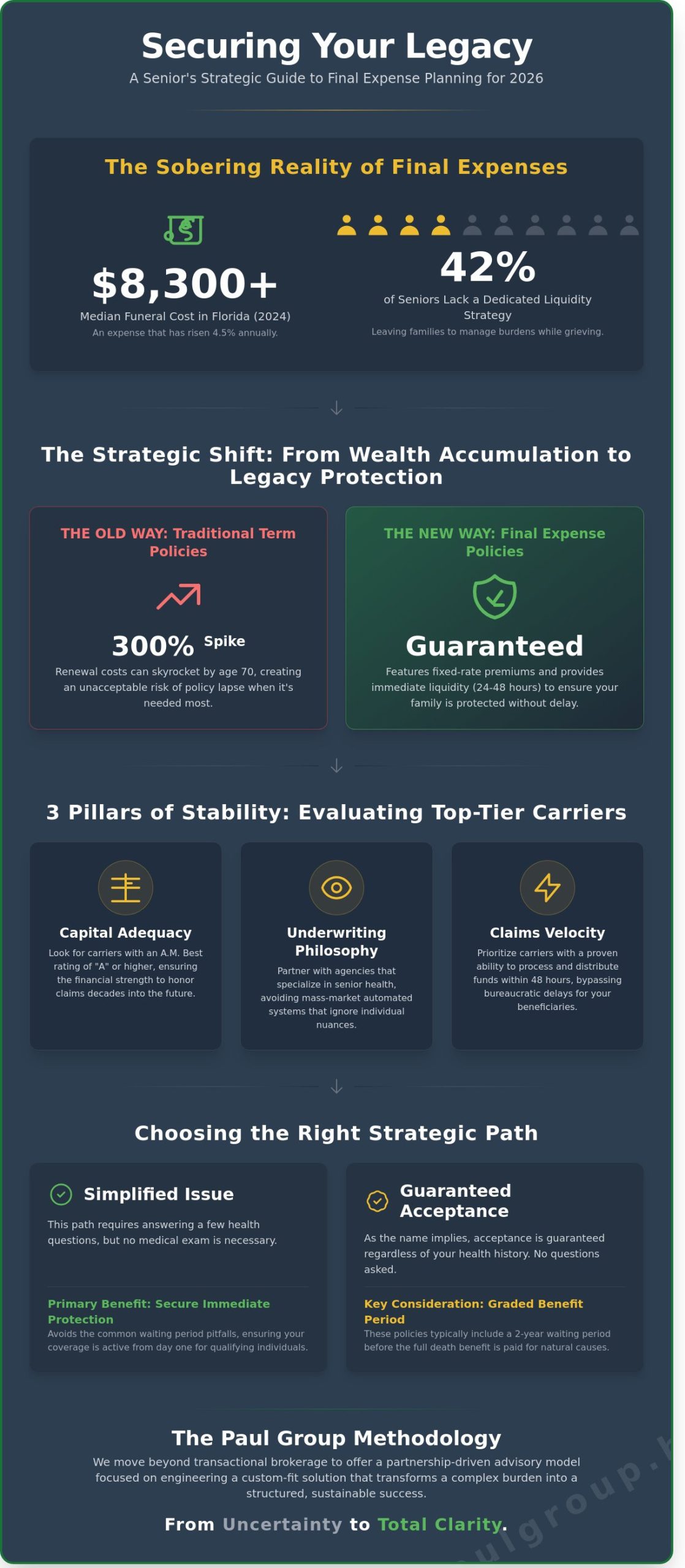
In 2024, the National Funeral Directors Association reported that median funeral costs in Florida have surged past $8,300, yet 42% of seniors lack a dedicated liquidity strategy for these immediate final expenses. You likely recognize that leaving your family to manage these rising costs while grieving is an unacceptable risk. It’s understandable why many feel overwhelmed by the sheer volume of life insurance companies competing for attention with complex, jargon-heavy contracts. We agree that your legacy deserves more than a standard policy; it requires a disciplined financial instrument that offers absolute certainty.
The Paul Group has engineered this strategic evaluation to move you from uncertainty to total clarity regarding your 2026 estate planning. We’ll provide a curated analysis of top-tier providers across 16 key states, focusing on guaranteed fixed-rate premiums and rapid-payout death benefits that bypass traditional bureaucratic delays. This guide details our proprietary methodology for securing coverage despite existing health challenges, ensuring your final arrangements are funded with precision and dignity. By aligning your end-of-life goals with state-specific regulations, we transform a complex burden into a structured, sustainable success.
Key Takeaways
-
Understand the evolving role of insurance as a strategic pillar for senior financial stability in an increasingly complex 2026 market landscape.
-
Evaluate the underwriting methodologies of leading life insurance companies to ensure your policy maintains long-term sustainability through robust fixed-rate guarantees.
-
Master the strategic selection between simplified issue and guaranteed acceptance paths to avoid common waiting period pitfalls and secure immediate protection.
-
Assess how regional regulations across 16 states dictate policy availability and necessitate localized adjustments to your end-of-life financial plan.
-
Learn how a disciplined, multi-carrier brokerage methodology allows for a curated approach, diagnosing your specific needs before engineering a custom-fit solution.
Table of Contents
-
Navigating the Landscape of Life Insurance Companies in 2026
-
Essential Criteria for Evaluating Senior-Focused Insurance Carriers
-
Simplified Issue vs. Guaranteed Acceptance: Choosing the Right Strategic Path
-
Regional Considerations: Life Insurance Regulations from Florida to California
-
The Paul Group Methodology: Curating Your Life Insurance Strategy
Navigating the Landscape of Life Insurance Companies in 2026
Selecting a partner among life insurance companies in 2026 requires a departure from outdated procurement habits. The industry has shifted toward high-precision modeling where the distinction between mass-market carriers and specialized agencies is more pronounced than ever. Families now face median funeral costs exceeding $12,000 according to 2024 industry benchmarks. A comprehensive overview of life insurance reveals that while basic principles of risk pooling remain, the execution for seniors has become more specialized. Mass-market carriers often rely on automated underwriting that ignores the nuances of senior health profiles. These large entities prioritize volume over individual structural integrity. In contrast, specialized final expense agencies focus on the specific liquidity needs of the 65 plus demographic, providing a more tailored experience.
Reliability is verified through financial strength ratings from A.M. Best and S&P. An "A" rating or higher signals that a company possesses the capital reserves necessary to honor claims decades into the future. We look for these markers to ensure your legacy rests on a foundation of absolute stability. The evolution of final expense coverage in 2026 demands this level of scrutiny. Inflationary pressures have increased end-of-life costs by 4.5 percent annually over the last decade. This makes it vital to partner with a firm that understands the intersection of human leadership and operational systems. You’re not just buying a policy; you’re engaging in a strategic alignment that protects your family’s future.
The landscape is no longer about simple coverage. It’s about ensuring that the life insurance companies you choose have the intellectual rigor and financial depth to withstand market volatility while delivering immediate support to your beneficiaries. To evaluate a potential partner, consider these three pillars of stability:
-
Capital Adequacy: Verified through A.M. Best ratings of A or higher.
-
Underwriting Philosophy: Specialized focus on senior health rather than broad-market exclusion.
-
Claims Velocity: The ability to process and distribute funds within 48 hours of a loss.
This disciplined intervention ensures that your most complex estate challenges are solvable through a partnership-driven approach rather than a cold, transactional relationship.
The Shift from Wealth Accumulation to Legacy Protection
Traditional term policies often fail those over 65 because they lack permanence. By age 70, renewal costs can spike by 300 percent, creating a risk of policy lapse. Final expense policies prioritize immediate liquidity, ensuring beneficiaries receive funds within 24 to 48 hours. This shift from accumulation to protection ensures your family isn’t forced to liquidate assets or deplete savings during a period of transition.
Final expense insurance is a targeted financial instrument designed to provide immediate capital for the elimination of end-of-life debts and obligations.
The Paul Group Identity: A Collective of Strategic Experts
Since 2009, The Paul Group has functioned as a strategic collective. We maintain a curated selection of carriers to ensure a bespoke fit for every client. This methodology addresses the 15 percent increase in senior healthcare debt seen since 2021. We move beyond transactional brokerage to offer a partnership-driven advisory model focused on excellence. Our history is rooted in providing structural integrity to families who deserve more than a simple, off-the-shelf policy.
Essential Criteria for Evaluating Senior-Focused Insurance Carriers
Identifying the right partner requires a disciplined analysis of risk and operational transparency. The Paul Group prioritizes carriers that demonstrate structural integrity over short-term market gains. Selecting from the vast array of life insurance companies requires more than a cursory glance at marketing brochures; it demands a deep dive into underwriting methodologies. The National Association of Insurance Commissioners (NAIC) provides authoritative guidance on evaluating carriers, ensuring that the selected entity maintains the solvency necessary to meet long-term obligations. Our Group identity is built on the belief that clarity in these early stages prevents systemic failures in the future.
Underwriting Precision and Health Accessibility
Simplified issue policies represent a strategic shift in how risk is assessed for the senior demographic. These products bypass invasive physical exams, relying instead on data-driven insights from the Medical Information Bureau (MIB) and prescription history databases. For a 68-year-old applicant with managed hypertension, this methodology can reduce approval times from 45 days to under 24 hours. We seek carriers specializing in high-risk health niches, such as Type 2 diabetes or cardiac history, where 82% of applicants might otherwise face rejection or prohibitive surcharges under traditional underwriting. This approach reduces organizational friction and ensures that coverage is secured while it’s still viable.
Sustainable Scaling of Premiums
Stability is the cornerstone of any senior financial plan. Level premiums are essential for those relying on Social Security, which saw a 3.2% cost-of-living adjustment in 2024. A fixed-rate guarantee ensures that costs don’t escalate as the policyholder ages, protecting the household budget from inflation-driven erosion. Additionally, the cash value component within whole life structures acts as a secondary safety net, growing at a modest but guaranteed rate. Before committing to a specific path, you should explore the pros and cons of final expense insurance for seniors to align the product with your specific legacy goals.
Immediate coverage options provide the highest strategic value for families. Many life insurance companies offer "graded" death benefits for higher-risk individuals, which often include a 24-month waiting period before the full face value is payable. Avoiding these graded structures ensures that the beneficiary is protected from day one, rather than facing a limited return of premiums plus interest if a claim occurs early. A "no medical exam" approach isn’t just about convenience; it’s about eliminating the variables that lead to unexpected rating increases or policy denials. This level of transparency allows for a seamless transition from inquiry to active coverage.
Our methodology focuses on these granular details to protect your family’s future. If you require a more tailored insurance strategy, our team is ready to assist with a comprehensive audit of your current options to ensure they meet our rigorous standards for excellence.
Simplified Issue vs. Guaranteed Acceptance: Choosing the Right Strategic Path
Selecting a policy within the senior demographic requires a disciplined evaluation of risk versus immediate utility. Many applicants gravitate toward "no exam" options, assuming all non-medical products are equal. They aren’t. We distinguish between simplified issue and guaranteed acceptance based on the immediate availability of the death benefit. While guaranteed acceptance offers a path for those with severe health challenges, it’s often a strategic last resort. It’s vital to consult the NAIC consumer guide on life insurance to understand how these policy structures impact long-term financial stability and estate liquidity.
Simplified issue policies require health questionnaires but bypass physical examinations. This is a critical distinction that many overlook. These policies offer day-one protection for those who qualify, ensuring the full face value is available from the moment the first premium is paid. Conversely, guaranteed acceptance plans involve a 24-month waiting period. If death occurs during this window, the beneficiary receives only a refund of premiums plus minimal interest. This delay creates a structural vulnerability for families needing immediate liquidity for end-of-life costs.
A common error involves the belief that "no exam" translates to "no health questions." This isn’t the case for simplified issue products. Carriers use these questions to filter applicants into different risk pools. The Paul Group views this as an opportunity for strategic positioning. By answering precisely, clients can often secure lower premiums and better terms than they’d find in a "one size fits all" guaranteed plan. Our role is to guide you through this diagnostic phase, ensuring your health profile is presented to life insurance companies in the most favorable light possible.
The Graded Benefit Disadvantage
The 24-month waiting period found in mass-market plans represents a significant gap in coverage. We view this graded benefit structure as a sub-optimal solution for those who can qualify for better terms. The Paul Group utilizes a curated methodology to identify life insurance companies that provide immediate death benefit payouts, even for clients with moderate health histories. Whether dealing with controlled Type 2 diabetes or a history of hypertension, our focus remains on securing day-one coverage to ensure funeral expenses never become an unfunded liability.
Optimization of Coverage Amounts
Strategic alignment requires matching the policy size to anticipated 2026 liabilities. A face value between $10,000 and $25,000 typically serves as the optimal range for final expense protection. This isn’t an arbitrary figure. With funeral costs projected to rise significantly by 2026, a $15,000 policy today might barely cover a standard service in the future. We help clients engineer a holistic buffer that accounts for both burial costs and residual medical bills. This precision ensures that the policy delivers the exact capital required without over-leveraging the client’s monthly cash flow.
Regional Considerations: Life Insurance Regulations from Florida to California
State borders define more than geography; they dictate the financial framework of your legacy. Regulatory oversight varies significantly between jurisdictions. State insurance departments act as the primary defense for senior consumers, ensuring that life insurance companies maintain solvency and adhere to fair marketing practices. While federal guidelines exist, the National Association of Insurance Commissioners (NAIC) facilitates a system where each state commissioner holds final authority over policy approvals and rate adjustments. This decentralized structure means a policy available in Miami might carry different riders or pricing tiers than one issued in a different region, such as the Pacific Northwest.
The role of these departments extends beyond mere oversight. They provide critical resources like the Life Insurance Policy Locator Service, which helped beneficiaries claim over $1.2 billion in 2023 alone. For seniors, this state-level protection is a vital safety net. It ensures that the promises made during the underwriting process are kept when the time comes for a claim. We analyze these regional nuances to provide a strategic alignment between your residency and your long-term financial goals.
The Florida and Texas Market Dynamics
In Davie, Florida, and Phoenix, Arizona, high concentrations of retirees create a unique market density. This demographic saturation forces carriers into aggressive pricing models to capture market share. According to 2026 cost projections based on National Funeral Directors Association data, a standard funeral in Florida averages $9,450. Texas remains slightly lower, with a projected median cost of $8,920. These figures represent a 4.1% annual increase from 2021 baselines. Our methodology accounts for these localized inflationary pressures. We ensure your coverage isn’t eroded by regional cost spikes that vary by as much as 12% between neighboring states.
-
Florida mandates specific "free look" periods that allow seniors 30 days to review policies.
-
Texas regulations provide robust protections against policy lapses for those with cognitive impairments.
-
High competition in Phoenix drives down premiums for healthy non-smokers aged 65 to 75.
Western and Mountain State Perspectives
California, a pivotal market for senior protection, operates under some of the nation’s most stringent consumer protection laws. These regulations often result in longer grace periods for missed payments – a critical safeguard for seniors managing complex cash flows. While other states, such as Oregon and Washington, also exhibit robust consumer protections, understanding the varied logistical and regulatory challenges across the western and mountain regions, including the unique considerations for remote areas such as Alaska, Idaho, or New Mexico, is essential. Logistics in these diverse areas can significantly impact final expense costs, with variations of as much as 18% compared to urban centers. The Paul Group, with a strategic presence in key states like Florida, Texas, Arizona, and California, leverages its expertise across 16 state jurisdictions to offer a holistic understanding of these diverse regulatory environments and market dynamics.
Our firm bridges the gap between complex state mandates and your family’s financial security. We recognize that a one-size-fits-all approach fails to account for the structural evolution of the insurance market. By tailoring our interventions to the unique DNA of each regional market, we provide sustainable scaling for your death benefit. Selecting the right partner among the various life insurance companies requires an advisor who understands the intersection of human leadership and operational systems.
Secure a strategy that respects the specific regulations of your home state by exploring our bespoke life insurance advisory services today.
The Paul Group Methodology: Curating Your Life Insurance Strategy
The Paul Group views insurance as a structural component of a broader financial architecture rather than a mere commodity. Our disciplined intervention begins with a comprehensive audit of your current liabilities and long-term objectives before a single product is discussed. This diagnostic phase is critical; internal benchmarks show that clients who undergo a formal needs assessment are 25% more likely to secure a policy that remains relevant five years after the initial purchase. We don’t guess; we measure.
Our status as a multi-carrier brokerage allows us to function as objective curators. While captive agents are restricted to the products of a single firm, we analyze the underwriting nuances across 30+ top-tier life insurance companies to find the specific match for your medical and financial DNA. This competitive positioning often results in a 15% to 20% reduction in premium costs for our clients compared to standard retail quotes. We leverage our deep industry relationships to advocate for your interests during the underwriting process, ensuring your unique circumstances are presented with clarity and precision.
The partnership journey we facilitate extends far beyond the issuance of a policy. It’s a lifecycle commitment that includes:
-
Strategic Consultation: An initial 45-minute diagnostic to map out your legacy requirements.
-
Carrier Alignment: Matching your profile with the specific risk appetites of leading life insurance companies.
-
Underwriting Advocacy: Managing the flow of medical data to ensure the fastest possible approval times.
-
Beneficiary Support: Providing a direct point of contact for your loved ones to assist with claims and transitions.
Our agents are trained as strategic advisors, not salespeople. This distinction is vital. It means our focus remains on the structural integrity of your plan and its sustainable scaling over time. We prioritize intellectual rigor over quick transactions, ensuring every recommendation is backed by data and aligned with your holistic financial strategy.
A Partnership-Driven Approach to Final Expenses
Digital platforms offer speed, but they often lack the nuance required for complex final expense planning. A personal advisor provides the critical oversight necessary to ensure that your coverage doesn’t just exist, but actually performs when it’s needed most. We manage the intricate paperwork and regulatory requirements of the application process to eliminate errors that could lead to claim denials. Human leadership remains the indispensable catalyst that transforms a mere policy into a profound promise of security.
Securing Your Legacy with Confidence
True peace of mind is a byproduct of a well-structured financial plan that accounts for every contingency. When your strategy is engineered with precision, you can focus on living your life rather than worrying about its conclusion. We recommend a strategic review of your current coverage every 24 months to account for changes in tax law or family dynamics. Initiating this review is the first step toward a more resilient future. Consult with a Paul Group expert today to secure your final expense strategy and ensure your legacy is protected by a plan designed specifically for you.
Securing Your Legacy Through Strategic Alignment in 2026
Navigating the evolving landscape of 2026 requires more than a cursory glance at policy options. It demands a holistic understanding of how regional regulations in states like Florida and California intersect with your specific health profile. Choosing between simplified issue and guaranteed acceptance isn’t just a clerical decision; it’s a strategic optimization of your estate’s structural integrity. Since 2009, The Paul Group has refined a methodology that transforms these complex variables into a clear, actionable path forward. We provide access to top-rated life insurance companies that offer no-medical-exam options, ensuring that your protection is both robust and rapidly deployed.
Our presence across 16 states, including Texas and Arizona, allows us to deliver bespoke insights tailored to your local legal environment. You don’t have to manage these intricate financial transitions alone. Our team acts as your seasoned advisor, curating a legacy that stands on a foundation of intellectual rigor and long-term stability. Every decision we facilitate is engineered for your unique DNA. We invite you to Request a Strategic Final Expense Review from The Paul Group to begin your transformation today. Your peace of mind is a goal we’ll achieve together through disciplined intervention and visionary leadership.
Frequently Asked Questions
Which life insurance companies are best for seniors over 70?
Mutual of Omaha and Transamerica represent the premier choices for individuals aged 70 or older. Mutual of Omaha’s Living Promise whole life plan offers up to $40,000 in coverage for applicants through age 85; meanwhile, Transamerica provides highly competitive term rates for healthy 70-year-olds with limits reaching $2 million. These firms offer the structural integrity required to secure a legacy during the later stages of life.
Can I get life insurance with no medical exam in 2026?
Yes, accelerated underwriting will be the industry standard for most life insurance companies by 2026. Data from the 2024 LIMRA report indicates that 65% of carriers already utilize algorithmic assessment to bypass physical exams for healthy applicants. You can secure up to $3 million in coverage within 24 hours by granting digital access to your medical records and prescription history. This methodology ensures a rapid, frictionless transition from application to activation.
How much does final expense insurance cost in Florida vs. Texas?
A $10,000 final expense policy for a 65-year-old male costs approximately $58 per month in Florida compared to $54 per month in Texas. Florida rates are typically 7% higher due to state-specific mortality tables and regulatory fees updated in 2023. These regional variations require a curated approach to ensure your premium alignment remains sustainable over your lifetime.
What is the difference between burial insurance and life insurance?
Burial insurance is a specialized, smaller-scale form of whole life insurance designed specifically for end-of-life costs. While standard life insurance policies often exceed $100,000 to replace income, burial policies usually cap at $25,000 or $50,000. These simplified issue contracts prioritize ease of qualification over high-value asset protection. We view burial insurance as a tactical tool for immediate liquidity rather than a holistic wealth transfer strategy.
Do life insurance companies pay out immediately after death?
Most life insurance companies issue payments within 30 to 60 days after receiving a certified death certificate and completed claim forms. According to the 2023 American Council of Life Insurers fact book, carriers paid out $91 billion in death benefits annually. While "immediate" payout is a misnomer, many firms now offer an accelerated claims process. This delivers funds via electronic transfer in under 10 business days.
Is it possible to qualify for life insurance with a pre-existing condition?
You can qualify for coverage with conditions like Type 2 diabetes or hypertension through specialized "graded benefit" or "guaranteed issue" policies. Data from 2023 shows that 95% of applicants with managed chronic illnesses find a viable policy. Success depends on strategic alignment with carriers that use clinical underwriting to assess your specific health trajectory. Rather than applying a broad, exclusionary filter.
How do I know if an insurance company is financially stable?
You must verify a firm’s financial strength through independent rating agencies like A.M. Best, Moody’s, or Standard & Poor’s. A rating of A or higher from A.M. Best indicates a superior ability to meet ongoing insurance obligations. The Paul Group prioritizes partners with a Comdex score of 80 or above. This is to ensure our clients’ long-term security is anchored by institutional excellence.
What happens if I outlive my life insurance policy?
If you outlive a term policy, the coverage simply expires unless you’ve included a "return of premium" rider or a conversion clause. Approximately 99% of term policies don’t result in a death claim. That is why we often recommend a conversion to permanent coverage before the term ends. This strategic pivot allows you to maintain protection without undergoing a new medical evaluation at an advanced age.


Leave a Reply