


How Much Does a Funeral Cost in 2026? A Strategic Financial Guide for Seniors
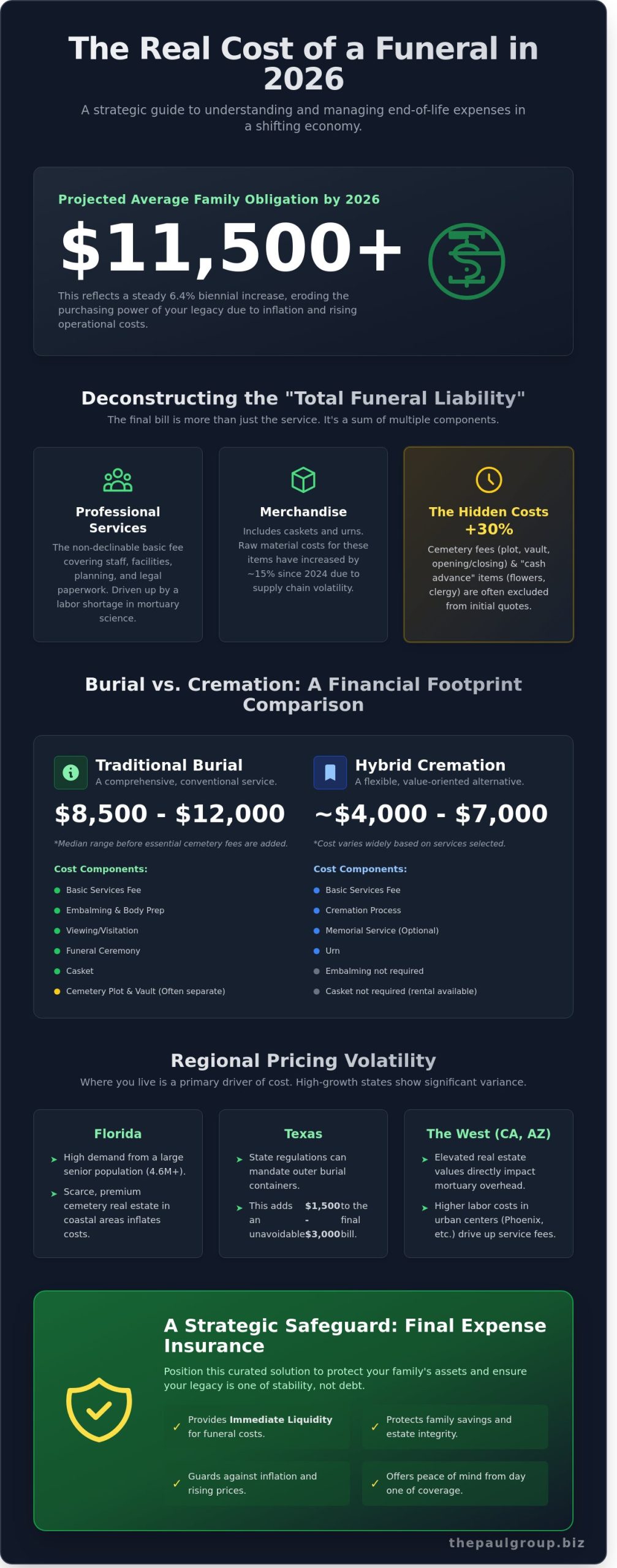
By 2026, the average family will likely face a financial obligation exceeding $11,500 for a traditional memorial service; this figure reflects a steady 6.4% biennial increase reported by the National Funeral Directors Association. You’ve likely noticed that inflation isn’t just a headline. It’s a tangible force eroding the purchasing power of your legacy. It’s natural to feel concerned that your final wishes might become a fiscal burden for your children rather than a moment of dignified remembrance. Understanding how much does a funeral cost in this shifting economic climate is the first step toward reclaiming control over your financial narrative.
The Paul Group believes that clarity is the foundation of peace of mind. We’ve curated this strategic guide to provide a comprehensive breakdown of end-of-life expenses, moving beyond surface-level quotes to reveal the hidden fees and regional price variances that often catch families off guard. You’ll discover a holistic methodology for funding your final arrangements that preserves your estate’s integrity. We’ll examine the specific components of modern service pricing and outline a clear, logical path to ensure your transition is a gift of stability, not a source of debt.
Key Takeaways
- Define your “Total Funeral Liability” by analyzing how 2026 inflation impacts professional services to determine exactly how much does a funeral cost in the current economic climate.
- Navigate regional pricing volatility across high-growth states like Texas and Florida to understand the non-declinable foundations of modern funeral contracts.
- Compare the financial footprint of traditional burial against emerging hybrid cremation models to ensure your final arrangements reflect both personal value and strategic economy.
- Account for third-party “Cash Advance” items and cemetery plot investments that often fall outside the standard mortuary service agreement.
- Position Final Expense Life Insurance as a curated solution for immediate liquidity, creating a structural safeguard that protects your family’s assets from the first day of coverage.
The Economic Reality of End-of-Life Expenses in 2026
Understanding how much does a funeral cost starts with acknowledging a fundamental operational certainty: the death rate remains at a fixed 100%. This reality transforms end-of-life planning from a somber task into a critical organizational challenge for every family. At The Paul Group, we define the “Total Funeral Liability” as the aggregated sum of professional services, merchandise, and third-party cash advances. It’s a comprehensive fiscal obligation that requires precise management to avoid depleting a family’s liquid assets during a period of transition.
To navigate these expenses, consumers must utilize the General Price List (GPL). This is a federally mandated consumer protection tool that ensures price transparency within the death care industry in the United States. The GPL allows families to deconstruct bundled packages into individual line items, providing the clarity needed to align services with specific budgetary constraints and personal values.
The Median Cost vs. The Actual Expense
Current data for 2026 indicates the median cost for a traditional burial ranges between $8,500 and $12,000. However, these figures often mislead the unprepared. Averages frequently underrepresent the final bill because they exclude essential cemetery fees, such as the plot, the vault, and the labor for opening and closing the grave. These additions can increase the total by 30% or more depending on the geographic market. We’re observing a psychological shift among our clients from “spending” on a service to “strategic legacy protection.” Families are increasingly evaluating the best final expense insurance for seniors to ensure that the transfer of wealth remains unburdened by sudden, high-interest liabilities.
Why 2026 Prices Differ from Previous Decades
Several macroeconomic factors have converged to drive up costs this year. Supply chain volatility has increased the price of raw materials for caskets and urns by approximately 15% since 2024. Simultaneously, a persistent labor shortage in the mortuary science sector has forced firms to raise service fees to attract and retain licensed professionals. These systemic shifts mean that how much does a funeral cost today is largely dictated by external inflationary pressures rather than simple service choices. Final Expense is the total sum required to settle all end-of-life obligations without depleting family savings. By viewing these costs through the lens of structural integrity, families can move from a state of complexity to one of strategic clarity.
Itemizing the General Price List: A Regional Analysis for Texas, Florida, and the West
Understanding the financial architecture of end of life care requires a granular look at the General Price List (GPL). Geographic location remains the primary driver of pricing volatility across the United States. In states like California and Florida, where real estate values and labor costs are elevated, families often find that how much does a funeral cost depends heavily on the specific zip code of the service provider. These regional fluctuations aren’t merely anecdotal; they represent a complex intersection of market demand and state level regulatory requirements.
Cost Drivers in Florida, Texas, and Arizona
Florida represents a unique market where a senior population of over 4.6 million creates a high demand environment. While competition among providers is fierce, the scarcity of premium cemetery real estate in coastal regions often inflates final costs. In Texas, state specific cemetery regulations regarding outer burial containers can add $1,500 to $3,000 to the total bill. Urban centers like Phoenix or Davie carry significantly higher overhead than rural areas, where land is more accessible but service options are often less curated. Strategic planning requires a deep dive into the latest funeral cost statistics to benchmark these regional shifts against national medians.
Professional Service Fees and Embalming
The foundation of every contract is the Basic Services Fee. This non-declinable charge typically starts at $2,300 and covers the essential administrative infrastructure of the funeral home. It encompasses the following operational elements:
- Securing official death certificates and necessary permits.
- Coordinating logistics with cemeteries, crematories, or third party vendors.
- Maintaining the facility and essential staff 24/7.
- Providing professional consultation for the family.
Body preparation and embalming add another layer of expense, usually ranging from $750 to $1,200 depending on the complexity of the case. These fees are fixed; they don’t fluctuate based on your choice of casket or urn. Local expertise is vital for navigating the specific regulations in Sun Belt states, as transport laws across state lines can trigger additional surcharges. For those seeking to mitigate these rising expenses through strategic alignment, exploring the best final expense insurance for seniors provides a structured path toward long term financial stability. Our methodology focuses on transparency, ensuring that families aren’t surprised by the $2,000+ basic fees that serve as the industry floor. When you ask how much does a funeral cost, you’re really asking about the sum of these fixed professional services and your chosen variables.
Comparing Traditional Burial and Modern Cremation: Cost vs. Value
Determining how much does a funeral cost requires a granular analysis of the chosen disposition method. The Paul Group views this choice not merely as a preference, but as a strategic allocation of family resources. Traditional burial remains the premium choice for families prioritizing historical continuity; however, the financial commitment is substantial. A casket, outer burial container, and grave opening fees typically exceed $5,200 in 2026. This figure excludes the hearse, which averages $450, or professional floral arrangements that often reach $700 per service. Understanding your consumer rights under the Funeral Rule ensures you only pay for the specific components your family values, preventing the inflation of the final invoice through unbundled services.
The Financial Architecture of a Traditional Burial
Traditional burial provides a specific aesthetic and ritualistic value that many find indispensable. The holistic cost includes immediate expenses and long-term liabilities. Beyond the $5,200 for the primary hardware and labor, families must account for the perpetual care of the site. In 2026, cemetery maintenance fees often add 15% to the initial plot price. This ensures the structural integrity of the grounds remains intact for decades. The viewing service, while adding approximately $1,200 in staffing and facility fees, offers a psychological closure that many clients consider a vital part of the value proposition.
Cremation: Optimization without Sacrificing Dignity
Families asking how much does a funeral cost in a cremation context often find that flexibility is the primary asset. Direct cremation costs currently range from $1,500 to $3,200, providing a foundation of fiscal efficiency. The 2026 market shows a 22% increase in “Cremation with Service” models. This hybrid approach pairs the logistical flexibility of cremation with the emotional resonance of a traditional memorial. It’s a bespoke solution that allows for services at unconventional locations, potentially reducing facility rental fees. You must still account for “hidden” variables like premium urns, which cost between $300 and $1,200, or columbarium niches that start at $2,500.
The Paul Group views the choice of disposition as the primary driver of insurance strategy. A burial requires a higher liquidity threshold to cover immediate land and labor costs. Selecting the best final expense insurance for seniors involves aligning the death benefit with these specific 2026 price points. By matching the policy limit to the projected disposition cost, you protect the estate from sudden, unmanaged liabilities.
Beyond the Mortuary: Accounting for Cemetery and Ancillary Costs
The funeral home service fee represents only the baseline of a comprehensive memorial plan. To accurately calculate how much does a funeral cost, a family must account for “Cash Advance” items. These are third-party services that the funeral director facilitates but does not personally control. In high-growth markets like Florida and Texas, where land values rose by 12% between 2024 and 2026, cemetery costs have become a primary driver of the total expenditure. These costs require a strategic perspective to ensure the memorial remains both dignified and fiscally responsible.
Cemetery Plots and Interment Fees
Location dictates the pricing structure of a final resting place. A single burial plot in a metropolitan area like Davie, FL, can exceed $4,800, while a similar space in a rural county might cost under $950. This disparity stems from land scarcity and the long-term maintenance endowments required by urban municipalities. Beyond the purchase price, families must pay “Opening and Closing” fees. These labor costs for excavating and restoring the site typically range from $1,400 to $2,800, often increasing for weekend services. Most modern cemeteries also mandate a grave liner or outer burial container. These concrete or poly-guard structures, designed to prevent soil subsidence, add another $1,100 to $2,200 to the total bill.
Ancillary Expenses: The Details That Add Up
Small details often create the most friction in a budget if not accounted for during the initial planning phase. Headstones and monuments serve as permanent family markers, yet their costs vary based on material and craftsmanship. A simple flat bronze marker starts near $1,200, while a custom upright granite monument can easily surpass $18,000. Life celebration elements also require careful selection. Professional catering for 50 guests averages $1,750; curated floral arrangements often reach $850; and digital obituary notices now cost between $250 and $600 in major metropolitan publications.
Clergy honorariums, professional musician fees, and certified death certificates, which average $30 per copy in 2026, are non-negotiable cash outlays. Because these costs are volatile and often required upfront, many families utilize the best final expense insurance for seniors to ensure liquid capital is available immediately. This methodology prevents the forced liquidation of long-term assets during a period of transition. It’s a pragmatic way to maintain structural integrity in a family’s financial plan while honoring a loved one’s legacy.
Mitigating Financial Risk: Why Final Expense Insurance is a Strategic Necessity
Quantifying exactly how much does a funeral cost is only the first step in a disciplined estate strategy. While the raw data provides a baseline, the true challenge lies in liquidity and timing. Final expense life insurance functions as a curated solution for end-of-life expenses, ensuring that capital is available precisely when it is required. This strategic tool transforms a potential family crisis into a managed transition. It provides immediate coverage options that protect a beneficiary’s interests from the first day the policy is active. By locking in fixed rates, you insulate your estate from the 3.4% average annual inflation seen in the death care industry over the last decade. This ensures that the purchasing power of your benefit remains intact regardless of future market shifts.
Traditional life insurance often presents barriers for those over age 65. Our approach utilizes “No Medical Exam” provisions to bypass these hurdles. This benefit is vital for seniors with existing health challenges who require robust protection without the friction of invasive physicals. It represents a shift from transactional insurance to a structural financial safeguard.
The Paul Group Methodology: Bespoke Coverage for Seniors
We reject the industry standard of off-the-shelf products. Our methodology focuses on the unique DNA of each family’s financial profile to engineer a plan that fits. The Paul Group maintains a sophisticated presence in Texas, Arizona, California, and Florida, giving us deep insights into the regional cost variations that impact how much does a funeral cost in specific markets. Our “Wise Advisor” approach moves beyond simple sales; we analyze your specific debt obligations and legacy goals to determine the optimal death benefit amount. We ensure every dollar is strategically aligned with your long-term objectives.
Securing Your Legacy Today
The transition from financial complexity to clarity begins with a focused consultation. Our Davie-based agency operates on a partnership-driven model, prioritizing high-level strategic alignment over high-pressure tactics. We help you evaluate the best final expense insurance for seniors to determine which vehicle serves your family’s needs. This is about more than a policy; it’s about the sustainable scaling of your legacy. Don’t leave your surviving family members to manage the burden of sudden debt. Reach out to our team to establish a foundation of stability and professional integrity that lasts for generations.
Securing Your Legacy Through Strategic Financial Alignment
Navigating the economic shifts of 2026 requires more than a casual glance at current market trends. Understanding how much does a funeral cost in today’s inflationary environment is the first step toward comprehensive risk mitigation. We’ve identified that traditional burials in 2026 often exceed $12,500, while regional price volatility across Texas and California creates a complex landscape for families to manage. These figures represent a significant structural challenge that demands a holistic, disciplined intervention rather than a reactive approach. Relying on outdated estimates creates a vulnerability that can destabilize even the most carefully curated estate plans.
The Paul Group has operated as a seasoned strategic partner for seniors since 2009, providing the intellectual rigor needed to solve these organizational hurdles. Our expertise is specifically tailored to the unique regulatory environments of Florida, Texas, Arizona, and California. We offer immediate coverage options that require no medical exam, allowing for a seamless optimization of your end-of-life strategy. It’s time to secure your family’s future with a bespoke Final Expense plan from The Paul Group. You’ve spent a lifetime building your legacy; let’s work together to ensure its preservation through sustainable scaling and expert guidance.
Frequently Asked Questions
Is $10,000 enough for a full funeral and burial in 2026?
A $10,000 budget provides a functional baseline but often falls short of a comprehensive service when you factor in cemetery fees. According to NFDA projections for 2026, the median cost for a funeral with a viewing and burial is $9,125; however, this figure excludes the vault and the plot. Families should anticipate an additional $3,500 for these essential cemetery components to ensure a holistic financial strategy.
Can I use a life insurance policy to pay the funeral home directly?
You can utilize a life insurance policy to settle expenses through a process known as an assignment. The Paul Group observes that most funeral homes accept this methodology, though they typically charge a processing fee ranging from 3% to 5% of the total bill. This approach optimizes liquidity during a period of transition, allowing beneficiaries to preserve their cash reserves for other immediate family needs.
Does the VA cover the full cost of a funeral for veterans?
The Department of Veterans Affairs doesn’t provide a full cost reimbursement for private funerals. As of 2024, the VA offers a $948 burial allowance for non-service-connected deaths and $2,000 for service-connected instances. While they provide a gravesite in a national cemetery and a headstone at no charge, the family remains responsible for the primary funeral home service fees and transportation costs.
What is the cheapest way to be buried or cremated?
Direct cremation represents the most cost-effective methodology for final disposition. In 2026, the national average for this streamlined service is $2,400, which avoids the $3,000 to $5,000 expenses associated with embalming and formal viewings. When families ask how much does a funeral cost, we highlight that bypassing traditional ceremonies in favor of a private memorial service significantly reduces the total financial commitment and operational complexity.
Are funeral prices negotiable or fixed by law?
Funeral prices aren’t fixed by law; the FTC Funeral Rule actually mandates that providers offer transparent, itemized pricing to every consumer. This regulatory framework allows for a bespoke selection of services rather than being forced into rigid, expensive packages. We recommend requesting a General Price List from at least three local firms to identify the 15% to 20% variance often found in professional service fees.
How much does a cemetery plot cost in Florida or Texas?
Cemetery plot costs vary significantly based on regional demand and precise location. In Florida, a standard plot in a metro area like Miami averages $4,500, while Texas offers a broader range with rural plots starting at $1,200 and urban sites in Dallas reaching $6,000. These figures represent the initial acquisition cost and exclude the mandatory $1,500 to $2,000 perpetual care endowment required by most state statutes.
What happens if a person dies with no money for a funeral?
Local county governments maintain indigent burial programs for individuals who die without assets or life insurance. For example, Cook County, Illinois, allocated $1.2 million in 2023 to manage these services through contracted providers. These programs typically offer a basic cremation or a simple burial in a designated public plot, ensuring a dignified conclusion without creating an unmanageable financial burden for the state or the surviving family.
Is burial insurance different from final expense insurance?
Burial insurance and final expense insurance are essentially the same financial instrument marketed under different names. Both are simplified-issue whole life policies with face values typically capped at $25,000. When calculating how much does a funeral cost, the Paul Group views these policies as a tool for strategic alignment, ensuring that liquid capital is immediately available to cover the $9,000 to $12,000 required for a traditional service.




Leave a Reply