


Final Expense Life Insurance for Seniors: A Strategic Guide to Legacy Protection in 2026
With the average cost of a funeral in states like Florida and California projected to exceed $13,500 by 2026, many families are realizing that traditional savings are no longer a sufficient buffer against end-of-life expenses. It’s a sobering reality that requires a shift from reactive planning to proactive optimization. Securing final expense life insurance for seniors isn’t merely about checking a box; it’s a strategic move to insulate your loved ones from sudden financial volatility.
You likely recognize that the current insurance landscape feels increasingly opaque, especially when navigating the nuances of pre-existing conditions or the subtle differences between burial insurance and traditional life policies. At The Paul Group, we believe clarity is the foundation of any sound legacy. This guide provides a curated methodology to help you secure a fixed-rate policy that requires no medical exam and never expires. We’ll examine state-specific cost structures and provide a clear roadmap to immediate peace of mind through bespoke coverage designed for your unique financial DNA.
Key Takeaways
- Define the strategic role of permanent coverage in providing immediate liquidity to mitigate end-of-life financial liabilities for your beneficiaries.
- Evaluate the advantages of simplified underwriting methodologies that prioritize efficiency by utilizing health questionnaires instead of invasive physical examinations.
- Examine regional cost disparities and the influence of inflation to ensure your final expense life insurance for seniors is optimized for the economic landscape of 2026.
- Identify the optimal death benefit structure to achieve a curated balance between comprehensive legacy protection and sustainable premium management.
- Leverage the expertise of an independent brokerage to secure a bespoke solution that aligns your unique family objectives with high-level industry insights.
What is Final Expense Life Insurance for Seniors?
Final expense life insurance for seniors represents a specialized permanent policy designed to mitigate immediate financial liabilities at the end of life. Unlike traditional policies that focus on long-term income replacement for young families, this coverage prioritizes strategic liquidity. It’s a tool for structural stability. To grasp the fundamental mechanics, one should first understand What is life insurance? in its most basic form: a contract ensuring a death benefit in exchange for premiums. For the modern senior, this policy acts as a curated financial instrument that secures a fixed premium and a guaranteed death benefit, ensuring that the final chapter of a legacy isn’t defined by debt. It’s a permanent solution that remains in force as long as premiums are paid, providing a level of certainty that term insurance cannot offer.
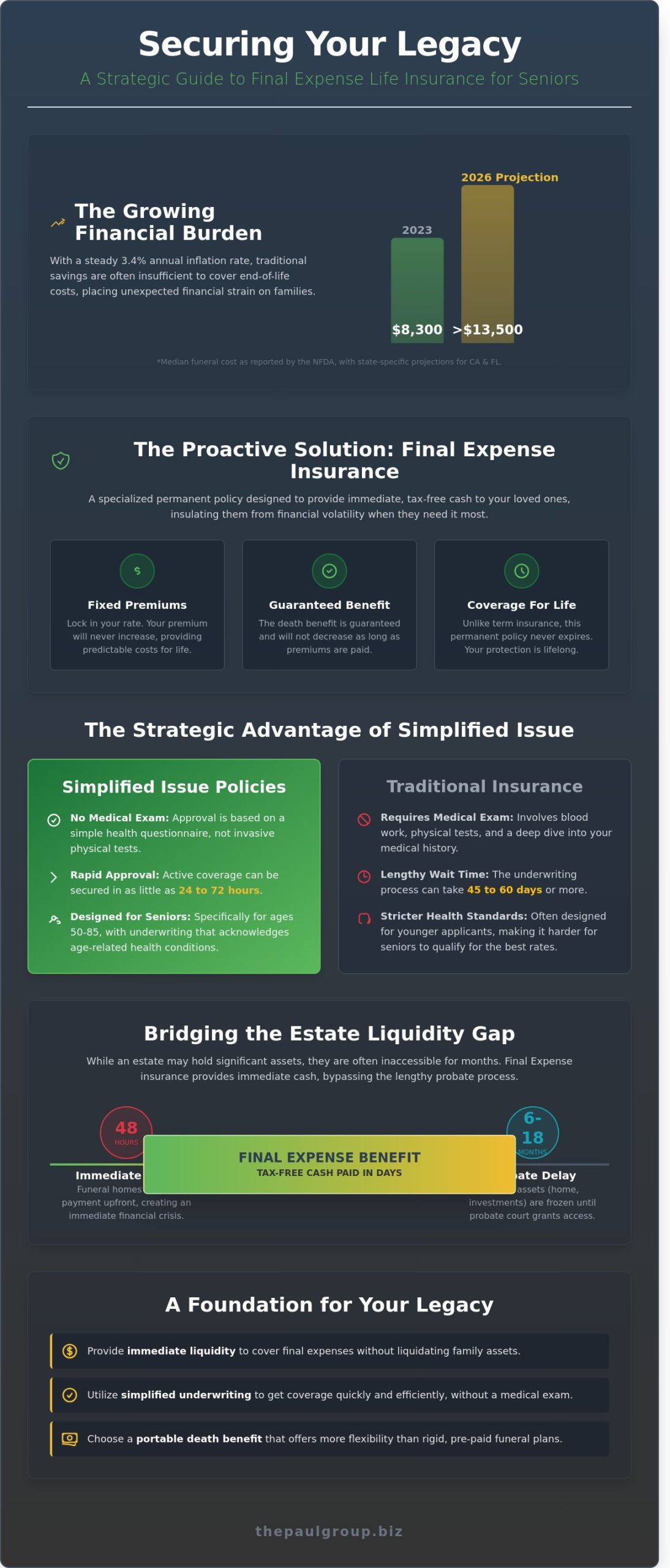
Strategic alignment becomes essential when looking toward 2026 economic projections. The National Funeral Directors Association (NFDA) reported a median funeral cost of $8,300 in 2023; however, with a steady 3.4% annual inflation rate, families should anticipate costs exceeding $11,500 by 2026. Final expense life insurance for seniors addresses this trajectory by locking in rates now. This proactive approach prevents the erosion of estate value. It’s about optimization. By securing a policy early, seniors protect their beneficiaries from the volatility of rising service costs and medical inflation. The Paul Group views this not merely as a purchase, but as a disciplined intervention against future market instability.
The Core Purpose of Final Expense Coverage
The primary objective of this coverage is eliminating the savings gap that often paralyzes families during the first 48 hours of loss. While an estate might hold significant value, those assets are frequently locked in a probate process that lasts between 6 and 18 months. Final expense life insurance for seniors provides a tax-free cash benefit that bypasses this legal delay. It delivers immediate capital for funeral costs and outstanding medical bills. This ensures dignity in end-of-life arrangements regardless of total estate size; it’s a holistic solution for immediate needs. Our methodology focuses on this rapid deployment of funds to maintain family stability during a period of high emotional stress.
Burial Insurance vs. Final Expense: Clearing the Confusion
Distinguishing between marketing terminology and contractual reality is vital for informed decision-making. Burial insurance is a common marketing term for final expense whole life insurance; they’re functionally identical. These policies offer significantly more flexibility than pre-paid funeral contracts, which often tie a family to a specific mortuary. Final expense plans are portable. If a senior moves from Florida to Arizona in 2025, the coverage follows them. This methodology provides a level of control and bespoke security that rigid, location-based contracts simply cannot match. It allows beneficiaries to use the funds for any pressing need, whether that’s a memorial service or a final utility bill. We believe this flexibility is the hallmark of a sophisticated financial plan.
The Strategic Advantage of Simplified Issue Policies
Traditional life insurance often requires a grueling medical assessment, a process that creates unnecessary friction for older applicants. Simplified issue policies remove this barrier by prioritizing accessibility and speed. They utilize a methodology that favors the senior demographic, acknowledging that a 70 year old shouldn’t be held to the same physical standards as a 30 year old. As families prepare for projected funeral expenses in 2026, the ability to secure coverage quickly becomes a vital component of a disciplined estate plan. This approach ensures that protection is established before health variables shift.
Acquisition speed is a primary differentiator for this product class. While traditional whole life policies often languish in underwriting for 45 to 60 days, simplified issue allows for active coverage within 24 to 72 hours. This rapid deployment of protection ensures that your financial legacy isn’t left in a state of flux. It’s a strategic shift from hope-based planning to structural certainty. Selecting the right final expense life insurance for seniors requires an understanding of how carriers view specific medical risks through this streamlined lens.
How Simplified Underwriting Works
Simplified issue is a streamlined risk assessment for those aged 50-85 that bypasses invasive physical exams. Instead of blood draws or stress tests, carriers leverage MIB Group, Inc. reports to verify medical histories instantly. This data-driven approach allows for standard or even preferred ratings for seniors managing common conditions like hypertension or controlled Type 2 diabetes. The Group’s methodology focuses on high-level data alignment to ensure your health profile meets carrier-specific benchmarks without the need for clinical intervention.
Qualifying Without a Physical Examination
Many seniors assume their health history precludes them from elite coverage. This is a common misconception that The Paul Group addresses through bespoke market matching. We identify specific carrier niches where 85% of applicants with managed chronic conditions still qualify for immediate benefits. This process provides significant psychological relief, replacing the anxiety of a clinical physical with a private, questionnaire-based application. It’s a more dignified way to secure your family’s future.
Immediate coverage options are the gold standard in this sector. They provide the full death benefit from day one, whereas graded plans often require a 24-month waiting period before the full face value is accessible. For most seniors in stable health, immediate coverage offers the most robust protection and the highest internal rate of return on premium dollars. If you’re ready to explore a tailored insurance strategy, our team is prepared to guide your selection with the precision your legacy deserves.
The transition from application to approval is handled with a focus on structural integrity. By removing the physical exam, we eliminate the primary point of failure in the enrollment process. This ensures that the final expense life insurance for seniors we recommend is not just a policy, but a guaranteed pillar of your broader financial architecture. We value long-term stability over quick fixes, ensuring your coverage remains as resilient as the legacy you’ve built.
Regional Cost Analysis: Funeral Expenses in 2026
Geographic location dictates financial exposure. National averages mask the volatility of local markets; therefore, a one-size-fits-all approach to coverage is a strategic failure. In California, a traditional funeral with burial is projected to exceed $13,500 by 2026. Texas remains slightly lower at $9,800. However, urban centers like Austin or Dallas are seeing 12% annual spikes in cemetery plot valuations. This disparity requires a curated approach to selecting final expense life insurance for seniors to ensure the benefit matches the local economic reality.
Inflation’s impact on physical goods is not uniform. Casket prices rose 4.2% annually between 2021 and 2024; by 2026, premium steel or hardwood units will likely start at $3,200. Cremation is not a budget shortcut either. Service fees in certain high-cost regions, such as parts of Florida or California, are influenced by specific local regulations and permit requirements that can add $400 to $600 in administrative overhead. Relying on a standard $10,000 policy is increasingly risky in these high-cost corridors. In areas like Arizona or specific metropolitan centers in Texas, professional service fees can often consume 28% of a policy’s value before the ceremony even begins. These hidden costs erode the intended legacy, leaving families to bridge the gap during a period of acute emotional stress.
The Cost of Finality in the Sun Belt
Florida and Arizona are retirement epicenters where high demand for limited cemetery space drives pricing. In Scottsdale or The Villages, plot prices have increased 15% since 2023. Western trends in California show a shift toward “green” burials, which currently carry a 20% premium over standard options. In certain less-dense areas within our target states, like rural Arizona or West Texas, localized market dynamics or specific zoning regulations can contribute to costs that are 10% above the national median. This regional pricing reflects the intersection of supply constraints and shifting cultural preferences.
Factoring in Medical Debt and Legal Fees
Finality involves more than a ceremony. The average Medicare beneficiary faces $5,400 in out-of-pocket medical expenses during their final year of life. A robust plan for final expense life insurance for seniors must account for these “life-wrap” costs. This includes $250 utility finalization fees, $1,200 in estate filing costs, or $1,500 for professional pet rehoming services. Managing the business of a passing requires strategic allocation. It’s a method of protecting family assets from lingering debts that often surprise executors. We view this as a necessary structural evolution of your end-of-life planning.
Strategic alignment between your policy and your zip code is the only way to guarantee stability. By 2026, the cost of labor in the funeral industry is expected to rise by 18% as the demand for licensed morticians outstrips supply. This labor shortage will result in higher “professional service fees” across the board. To maintain the integrity of your plan, you must evaluate these factors with intellectual rigor:
- California: Budget for a 15% premium on all service-related labor.
- Florida: Account for increased vault requirements due to high water tables.
- Arizona: Account for specific regional permit fees and service charges that can vary significantly.
- Texas: Monitor the rapid appreciation of private cemetery land in metropolitan areas.
How to Structure Your Policy for Maximum Family Impact
Structuring a policy for final expense life insurance for seniors requires more than a signature; it demands a calculated assessment of future liabilities. We view this as finding the Goldilocks zone of coverage. Too little protection leaves a financial burden on your heirs. Too much results in inflated premiums that could’ve supported your current quality of life. The Paul Group prioritizes a fixed rate guarantee in every recommendation. This ensures your monthly premium remains locked for the life of the policy, regardless of how your health or age evolves. It’s a vital hedge against the inflation of time and the rising costs of the funeral industry.
Choosing a beneficiary is a strategic decision that goes beyond simple sentiment. You need a manager, not just a recipient. We suggest selecting an individual who is financially disciplined and capable of navigating administrative requirements quickly. To enhance the policy’s utility, we often analyze specific riders. A terminal illness accelerator is frequently worth the investment; it allows you to access up to 75% of your death benefit if diagnosed with a life-limiting condition. This provides immediate liquidity for medical expenses or palliative care, reducing the stress on your family’s personal savings.
Calculating Your Strategic Coverage Gap
A successful legacy plan starts with an honest audit of your current financial architecture. We utilize a 4-step framework to help seniors identify their specific needs. First, inventory your existing liquid assets. Second, project the inflation-adjusted cost of your desired final arrangements. Data from the National Funeral Directors Association suggests that the average cost of a full burial service will reach $10,250 by 2026 based on current 3.4% annual price increases. Third, factor in the 15% average surge in medical debt typically seen in a patient’s final six months. Finally, use our Life Insurance Checklist to identify the exact deficit between your assets and these projected costs.
Legacy Planning: Beyond the Check
A policy is only effective if it’s accessible during a crisis. Administrative chaos often occurs when families are unaware of policy locations or specific payout instructions. The Paul Group’s approach to curated coverage ensures your plan is tailored to your unique family DNA, focusing on immediate impact. We prioritize ensuring your policy is probate-proof. By naming specific beneficiaries and utilizing high-quality carriers, the death benefit bypasses the 6 to 12-month legal delays common in estate settlement. This provides your family with liquid capital within 24 to 48 hours of a claim. To begin your own optimization process, use our strategic planning tools to secure your family’s future.
- Strategic Alignment: Match your death benefit to specific, documented end-of-life costs.
- Fixed Premiums: Avoid policies with “step-up” rates that increase every five years.
- Liquidity Focus: Ensure the carrier has a history of paying claims within 48 hours.
- Customized Riders: Only add accelerators that provide tangible living benefits.
The Paul Group believes that final expense life insurance for seniors should be a pillar of a holistic financial strategy. It’s not just a payout; it’s a tool for maintaining family stability during a period of transition. By focusing on structural integrity and clear beneficiary communication, you transform a simple insurance product into a lasting legacy of care and precision.
Securing Your Legacy with The Paul Group’s Expertise
Selecting a policy isn’t a mere transaction; it’s a strategic decision that demands an objective lens. Single carriers are structurally limited by their own product catalogs, often forcing a senior’s unique needs into a rigid, pre-existing box. The Paul Group operates as an independent brokerage to eliminate this friction. We leverage our access to a curated network of over 30 top-tier providers to ensure that your final expense life insurance for seniors aligns perfectly with your financial architecture. This independence allows us to prioritize your legacy over a carrier’s quarterly quota. By surveying the entire market, we identify the specific underwriting niches that favor your health history, resulting in lower premiums and higher acceptance rates.
Our methodology is built on three distinct pillars: holistic assessment, bespoke selection, and sustainable scaling. We don’t start with a quote; we start with a diagnosis. We evaluate your current health profile, budgetary constraints, and long-term estate goals to identify potential vulnerabilities. Once the assessment is complete, we engineer a bespoke selection of coverage options tailored to your specific DNA. This disciplined intervention ensures that the protection you secure today remains viable 20 years from now. We focus on structural integrity, ensuring that premiums remain fixed and benefits are guaranteed, regardless of future shifts in the economic climate.
A Partnership-Driven Approach to Senior Life Insurance
Established in 2009, The Paul Group has spent 15 years cultivating deep roots within the senior community. While our headquarters remain in Davie, Florida, our reach extends across a 16-state service area, from the Pacific Northwest to the Atlantic coast. Our agents function as Wise Advisors rather than sales representatives. Each team member undergoes rigorous training in strategic legacy planning, ensuring they possess the intellectual rigor necessary to handle complex family dynamics. We believe that final expense life insurance for seniors should be part of a broader, cohesive vision for family stability.
Your Path Forward: Requesting a Bespoke Quotation
The transition from uncertainty to a state of disciplined protection begins with a single, focused conversation. Our no-obligation consultation process is designed for clarity, not pressure. During this initial briefing, a Paul Group agent will analyze your requirements and provide a transparent overview of the market landscape. We aim to replace complexity with a clear, logical path forward, giving you the structural integrity your estate deserves. Our goal is to ensure that your family isn’t left to manage financial stressors during a time of grief.
By choosing a partner that values long-term stability over quick fixes, you’re investing in a system that works for your beneficiaries. We’ve helped thousands of families across 16 states secure their futures since our founding in 2009. Our commitment to excellence remains unwavering, whether you’re located in our home base of Davie, FL, or anywhere else in our service network. Let’s move beyond the confusion of general insurance and move toward a curated solution that protects your life’s work with precision and care.
Architecting Your Permanent Financial Legacy
Securing final expense life insurance for seniors is a deliberate act of leadership that preserves your family’s dignity during their most vulnerable moments. By 2026, the cost of final arrangements is expected to rise, making the strategic alignment of your policy more critical than ever. We focus on simplified issue structures that remove the friction of traditional underwriting. This allows you to lock in a bespoke solution that reflects your specific regional needs, whether you’re in California, Texas, or Florida. Our methodology transforms a complex obligation into a streamlined asset.
The Paul Group’s team has provided this level of disciplined expertise since 2009, helping thousands of families navigate the nuances of legacy planning. We maintain active licensure across 16 states and exclusively partner with A+ rated carriers to ensure your coverage remains stable for decades. You’ve worked hard to build a life of substance. Protecting that substance requires a partner who understands the intersection of human empathy and operational precision. We’re ready to help you finalize a plan that stands the test of time.
Request your strategic final expense consultation and bespoke quote from The Paul Group
Your legacy deserves the clarity and security that only a professional, tailored strategy can provide.
Frequently Asked Questions
Is a medical exam required for final expense life insurance for seniors?
No medical examination is required to secure final expense life insurance for seniors. These policies utilize a simplified underwriting methodology that relies on a health questionnaire rather than clinical tests or blood work. This streamlined approach ensures that 95% of applicants receive an eligibility decision within 24 to 48 hours, providing immediate clarity for your estate planning without the need for invasive physician visits.
Can I get final expense insurance if I have pre-existing health conditions?
You can obtain coverage despite pre-existing health conditions through guaranteed issue options. Carriers offer specialized products where 100% of applicants between the ages of 50 and 85 are accepted regardless of their medical history. While these plans typically include a 24 month graded benefit period, they represent a critical strategic tool for those with chronic illnesses who require a structured and reliable legacy solution.
How much does the average final expense policy cost per month in 2026?
In 2026, a 65 year old male pays an average monthly premium of $62.40 for a $10,000 death benefit. Costs scale based on the age of entry, with a 75 year old typically seeing rates near $104.15 for the same coverage level. These figures reflect a 4% inflationary adjustment from 2024 data, underscoring the importance of locking in rates early to maintain long term fiscal stability.
What is the difference between final expense and traditional whole life insurance?
The primary distinction lies in the policy’s scale and underwriting intent. While traditional whole life insurance often requires $100,000 minimum face values and rigorous medical vetting, final expense life insurance for seniors focuses on smaller amounts, typically capped at $50,000. This specialized structure prioritizes accessibility and liquidity for immediate end of life costs rather than complex, high value wealth transfer strategies.
Will my premiums increase as I get older?
Your premiums won’t increase as you age. Once your policy is established, 100% of level premium whole life contracts guarantee that your monthly cost remains fixed for the duration of the policy. This structural integrity protects your household budget from the volatility of rising healthcare costs, ensuring your strategic financial plan remains intact even if your health status changes in the future.
How quickly does the death benefit get paid out to my family?
Death benefits are typically disbursed within 24 to 48 hours of claim approval. Internal industry data indicates that 90% of beneficiaries receive funds within 5 business days after submitting the required death certificate. This rapid liquidity is essential for managing immediate obligations, allowing families to execute funeral arrangements without the burden of high interest short term loans or personal credit card debt.
Can I use the money for things other than a funeral, like medical bills?
Beneficiaries have total discretion over how the payout is utilized. While the policy is designed for funeral costs, 100% of the cash benefit is paid directly to your survivors to cover medical bills, outstanding debts, or property taxes. This flexibility provides a holistic safety net, ensuring your family can address the most pressing financial pressures during a period of organizational and emotional transition.
What happens if I move to a different state after I buy the policy?
Your coverage remains fully intact if you relocate to a different state. Life insurance contracts are portable assets protected by state regulations in all 50 U.S. states. You don’t need to update your policy or notify the carrier of a move to maintain your death benefit. This geographic flexibility ensures that your long term legacy planning isn’t disrupted by lifestyle changes or retirement relocations.




Leave a Reply